Commentary – The political storm unfolding in Britain over approval for a vast new Chinese embassy complex in London has cast an unexpected light on a question many Pacific nations, including Tonga, have largely sidestepped: how much public scrutiny should accompany the expansion of foreign diplomatic footprints—particularly those of major powers such as China.
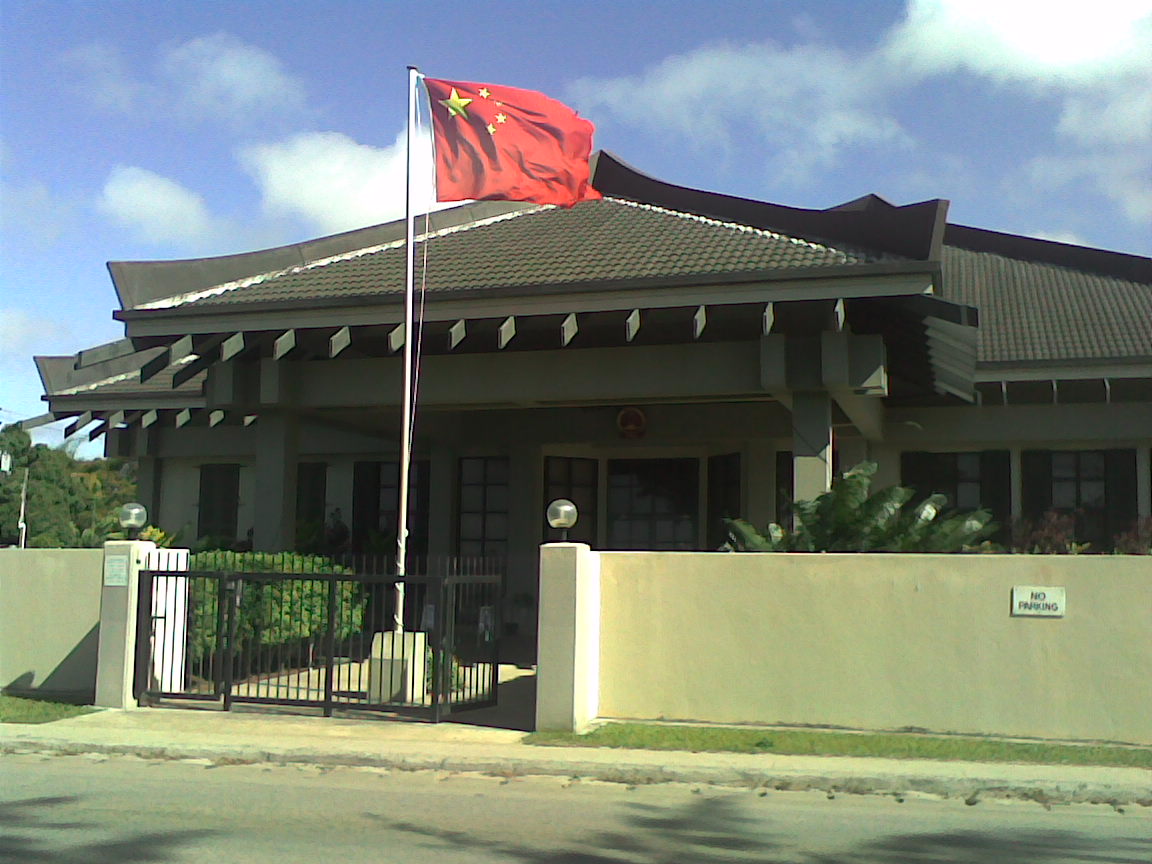
The Embassy of the People’s Republic of China in Nukuʻalofa, Tonga. Photo: Kransky, via Wikimedia Commons, CC BY‑SA 3.0.
Last week, Britain’s Conservative Party criticised Prime Minister Keir Starmer’s Labour government after planning authorities cleared the way for what opponents have labelled a Chinese “super embassy” in central London.
Senior Conservatives accused the government of downplaying national-security concerns and prioritising relations with Beijing over public safety, arguing that the scale of the proposed complex far exceeds normal diplomatic requirements.
The Labour government has rejected those claims, insisting the approval followed established planning processes and security assessments. Even so, the intensity of the backlash has ensured the issue is being debated openly—in Parliament, across national media, and among the wider public.
A debate Britain is having out loud
At the centre of the UK controversy is the issue of scale and purpose. Critics argue that an embassy of such magnitude is more than a diplomatic mission, raising concerns about its potential strategic function.
Some have warned of intelligence-gathering risks, language that UK Labour has dismissed as speculative and exaggerated.
Regardless of where the facts ultimately settle, the significance lies in the process.
In Britain, the construction of a foreign embassy has become a matter of public accountability: who approved it, on what basis, and what safeguards are in place.
The debate is visible, contested, and ongoing.
Thousands of kilometres away in the Pacific, that openness stands in sharp contrast to how similar questions have been handled—or quietly bypassed.
Tonga’s quiet precedent
For Pacific observers, the debate has a familiar undertone. As far back as 2018, veteran Pacific journalist Michael Field questioned the scale of China’s expanded embassy compound in Nukuʻalofa, describing it as unusually large for a country with a small population and limited consular demand.
At the time, the observation prompted little sustained discussion. There were no notable parliamentary debates, no detailed public explanations, and minimal scrutiny in local media. The buildings were completed largely without public interrogation.
In seeking balance, Kaniva News has contacted the Chinese Embassy in Nukuʻalofa for comment, asking about the purpose and scale of the compound, the planning and approval process, staffing levels, compliance with Tongan law and the Vienna Convention on Diplomatic Relations, and how the mission compares with Chinese embassies in other Pacific countries.
No response had been received at the time of publication.
When Familiarity Mutes Scrutiny
China’s presence in Tonga has been a source of domestic division since the early 1990s, when hundreds of Chinese passport holders arrived following the collapse of the Kingdom’s passport-sale scheme of the 1980s, which generated about US$26 million later lost in a US investment.
Some locals and critics viewed the newcomers’ business-oriented approach and rapid adaptation to Tonga’s limited economic environment as a threat, arguing that they came to dominate local commerce and lease a significant share of commercial land in Nukuʻalofa and Vava‘u.
However, after nearly half a century of the Chinese community’s presence in Nukuʻalofa, there has been a noticeable growth in public trust, particularly in the operation of wholesale and retail businesses. Their extended trading hours—often operating six days a week, as Tonga restricts Sunday trading—along with full-time owner involvement and proactive customer service, have contributed to a perception among many consumers that Chinese-run businesses are among the most reliable in the country.
That shift—from early suspicion to everyday reliance—may also explain why China’s expanding diplomatic footprint drew little public attention. As Chinese-run businesses became a normal part of Tonga’s commercial life, China itself was increasingly perceived as familiar rather than foreign.
In that context, questions that might have arisen elsewhere about scale, purpose, or transparency were largely muted. What was accepted on the street was rarely interrogated at the state level.
Scale, perception, and transparency
That familiarity, however, does not remove the relevance of scale.
While everyday economic interaction may dull public curiosity, the size and visibility of diplomatic infrastructure raise a different set of questions—ones that go beyond trust and into governance.
Embassy scale is not merely symbolic; it shapes perception, accountability, and the public’s understanding of how foreign power is exercised within national space.
There is nothing inherently improper about large embassies. Major powers operate globally and require substantial diplomatic infrastructure. China, like others, has legitimate reasons to maintain a strong overseas presence.
But perception matters. When an embassy appears disproportionate to its surroundings—whether in London or Nukuʻalofa—questions inevitably arise. Such questions do not presume wrongdoing; they reflect a public interest in transparency, proportionality, and governance.
In this sense, Britain’s controversy is less about China itself and more about how democratic societies explain sensitive foreign-policy decisions to their citizens.
A mirror, not a verdict
Britain’s parliamentary battle will not determine policy in Tonga. But it does offer a mirror.
If a proposal in London can provoke intense national scrutiny, it is reasonable to ask whether Pacific publics should have been afforded greater opportunity to understand and debate similar developments closer to home.
In London, the argument is unfolding in real time.
In Tonga, it may have arrived late—but it has arrived nonetheless.