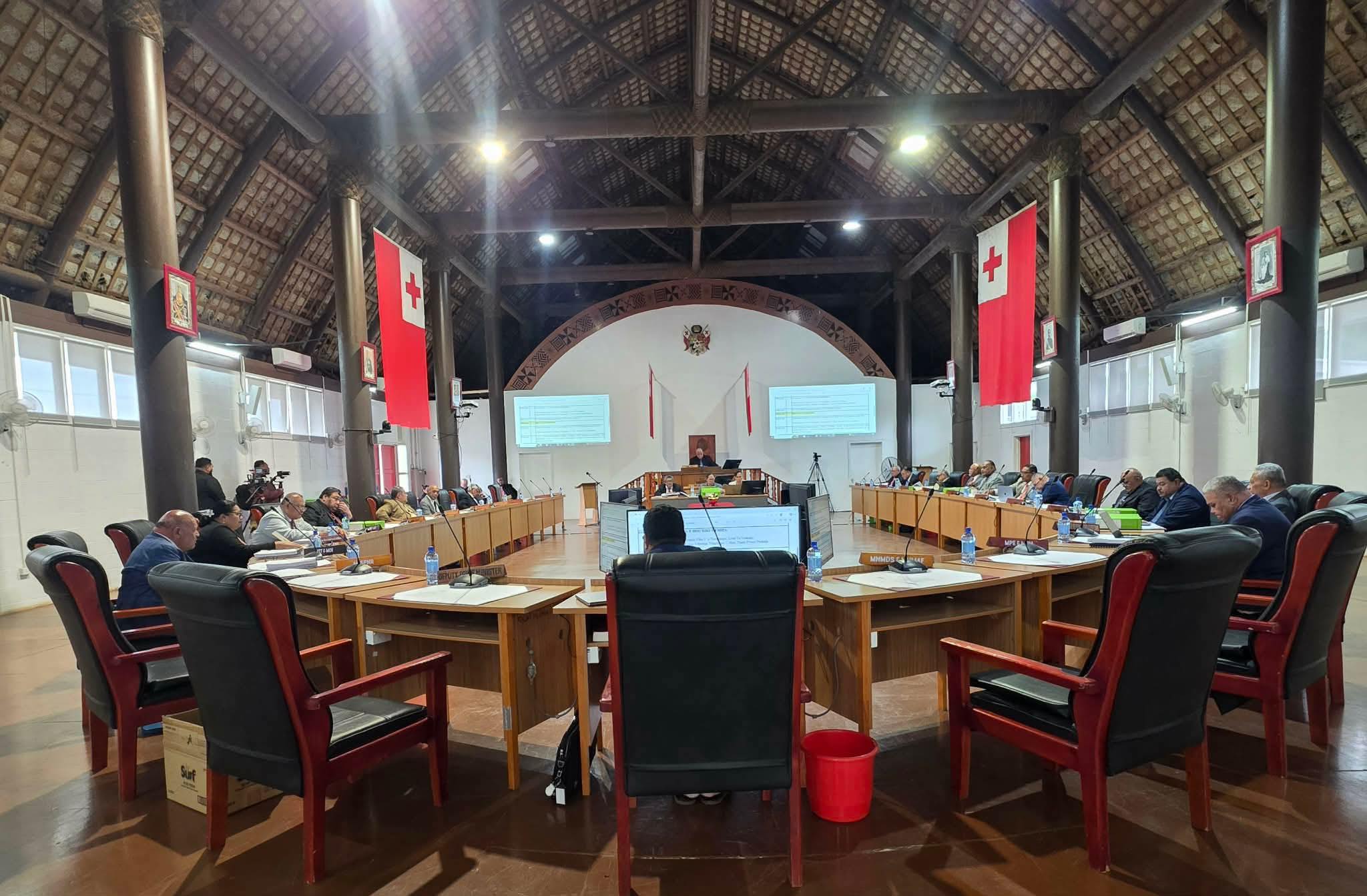
Tonga’s proposed $929.5 million paʻanga national budget has revealed a government increasingly concerned about slowing economic growth, rising living costs and the long-term pressures facing the Kingdom’s economy as global fuel instability continues to bite.
Presenting the Government’s 2026/27 Budget Estimate to Parliament on Monday, Prime Minister Lord Fakafanua outlined what is effectively a defensive budget aimed at shielding households and essential services from worsening economic conditions, while acknowledging deeper structural weaknesses within the economy.
The budget projects national revenue of $891.4 million against planned expenditure of $929.5 million, leaving a forecast deficit of $38.1 million. The shortfall will largely be financed through $35 million in domestic government bonds, with the remaining $3.1 million drawn from cash reserves.
While deficits are not uncommon during periods of economic stress, the budget marks one of the clearest acknowledgements yet from Government that Tonga expects difficult economic conditions to continue over the next several years.
Economic growth is now forecast to slow from 2.7 per cent in 2025 to 2.3 per cent in 2026 before falling further to 1.9 per cent in 2027, with the Prime Minister attributing much of the pressure to ongoing instability in the Middle East and its impact on global fuel prices.
For a country heavily dependent on imported fuel and imported goods, the consequences are significant. Rising energy costs continue flowing through electricity generation, shipping, transport and the broader cost of living, placing pressure on both households and businesses.
One of the largest allocations in the budget is an $18 million electricity subsidy designed to offset rising power costs for all households following recent electricity tariff increases. Government has also allocated an additional $1 million toward emergency energy-related responses, reinforcing concerns that fuel and electricity pressures may continue for some time.
The budget also includes $5 million to fund a 3 per cent cost-of-living adjustment for civil servants, which Government says is necessary to help workers cope with inflation and rising household costs linked to the energy crisis.
Additional support measures include $3.2 million for the Government-owned Lulutai Airlines, $3.7 million for inter-island ferry services and $900,000 for a one-off $100 top-up payment to elderly and disability welfare recipients.
Beyond the headline spending measures, the budget speech provided a revealing assessment of the broader challenges confronting the Kingdom.
Lord Fakafanua openly acknowledged a range of structural issues including high government operational costs, an underdeveloped private sector, youth unemployment, skills shortages, reliance on imported goods and the continued migration of skilled workers overseas.
He also raised concerns over insufficient support for technical and vocational education, particularly among young males, while warning that Tonga continues losing trained doctors, nurses and health professionals to overseas employment opportunities.
The Prime Minister said the budget theme, “Accelerate delivery of vital Government initiatives to generate sustainable, inclusive growth,” was designed to respond to growing economic pressures, natural disasters, climate change and the ongoing dengue fever outbreak.
However, the speech also highlighted the increasingly difficult balancing act facing Government as it attempts to manage immediate social pressures while dealing with longer-term economic vulnerabilities.
Tourism was another area identified as requiring greater attention, with the Prime Minister expressing concern over declining whale watching numbers in 2025 and calling for increased investment into the sector.
The comments come as Tonga’s tourism industry continues adapting to changing travel patterns and rising international travel costs, although recent migration and visitor data has also pointed to strong movement from the Tongan diaspora and returning overseas-based Tongans attending family, cultural and sporting events.
Political observers say the budget reflects a Government attempting to stabilise the economy during a period of global uncertainty, while also preparing the public for slower growth and continued cost-of-living pressures.
At the same time, the budget is likely to generate debate over whether Government has provided a sufficiently clear long-term economic roadmap beyond subsidies and short-term relief measures.
Parliament unanimously passed the first reading of the Budget Estimate following its presentation. The proposal has now been referred to the Finance and Public Accounts Committee for further scrutiny before returning to the House next week.