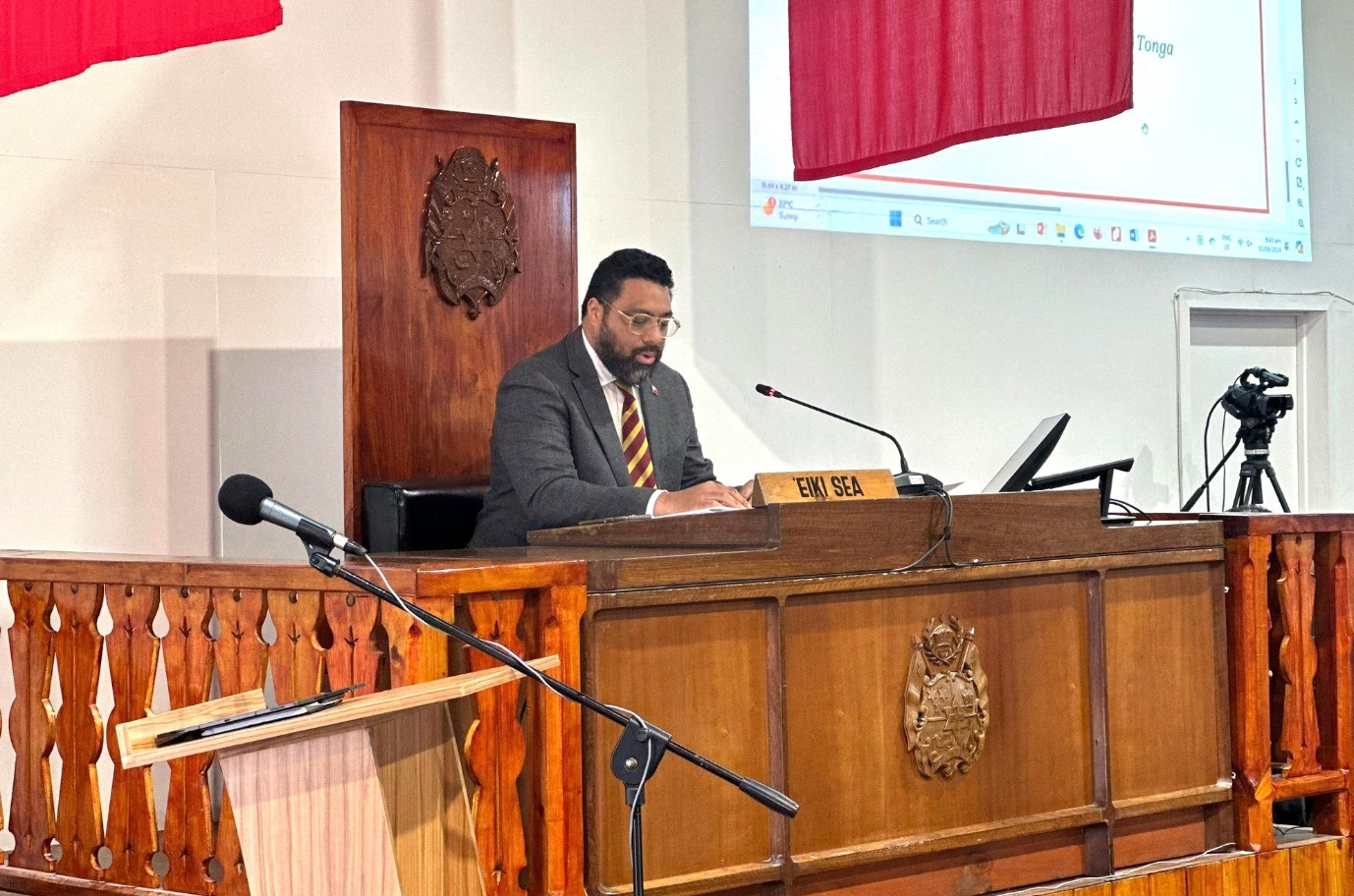
Growing concern over Legislative Assembly Speaker Lord Fakafanua’s involvement in a proposed citizenship-by-investment programme has prompted a wider examination of how power is exercised in Tonga. What began as a confidential policy proposal has expanded into serious questions about conflict of interest, public accountability and the credibility of key democratic institutions.
A leaked proposal, prepared with global investment migration firm Henley & Partners, estimated that Tonga could raise up to USD 400 million over five years by granting citizenship in exchange for substantial financial contributions. Although citizenship investment schemes are used in a number of jurisdictions, the political sensitivity in Tonga arises from the position held by the individual who is reported to have supported the idea privately while occupying a constitutionally delicate office.
Accounts from senior public servants indicate that lobbyists linked to the scheme met repeatedly with high-ranking officials between 2023 and 2025. Those approached reportedly included Tonga’s Permanent Representative to the United Nations, the former Prime Minister, the Attorney General and Lord Fakafanua himself. It has also been alleged that the Speaker and lobbyists made representations to the previous government both collectively and individually. The proposal was ultimately rejected.
Lord Fakafanua has said he simply outlined possible solutions to Tonga’s persistent fiscal pressures. He argues that reliance on external donors creates uncertainty and that new revenue options should be explored to support investment in essential services.
However, the situation took on greater significance after it became known that the wife of the Speaker’s first cousin sits on the board of the company promoting the scheme. The link does not by itself establish wrongdoing, but it raises legitimate questions about proximity and influence. In a small country where political and family networks are closely interconnected, even the perception of partiality can erode confidence in the decision-making process.
Additional concerns relate to Lord Fakafanua’s prominent roles outside Parliament. As Chairman of Tonga Rugby League 13, he leads a code that has received significantly higher levels of government funding than other sports. Several sporting organisations have criticised this distribution and have pointed to the Ministry of Internal Affairs, within which the Ministry for Sports sits. The Ministry’s Chief Executive Officer is Lord Fakafanua’s aunt, a fact that has contributed to broader concerns about how funding decisions are made.
A long-serving staff member within the Ministry told colleagues that he was moved aside after raising questions about internal governance and funding allocations. Whether his account is fully accurate or not, it has added to a perception that critical voices are discouraged at a moment when oversight is vital.
This debate comes at a significant political moment. Parliament is preparing to elect a new Prime Minister, and for the first time in several election cycles the possibility of a noble entering the race has unsettled expectations. Previous reporting suggested that the Monarch encouraged nobles to avoid direct political leadership. A candidacy from the Speaker would represent a clear change from recent practice.