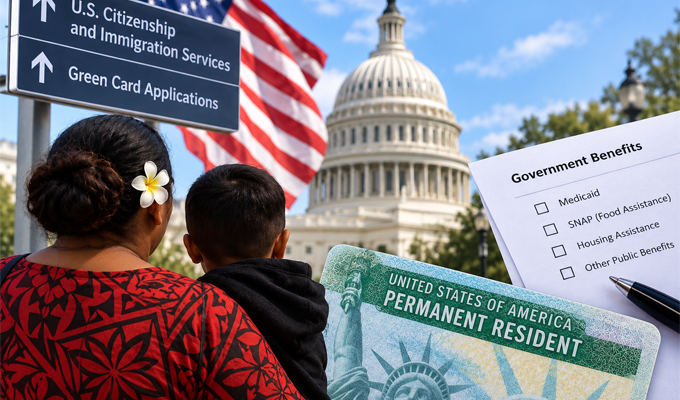
Tongans seeking permanent residence in the United States could face tougher scrutiny over their use of government benefits under a new immigration rule that took effect on September 18.
The latest change comes four months after another Trump administration immigration announcement initially raised concerns that many foreigners already in the United States could be required to return to their home countries to complete their Green Card applications.
The Department of Homeland Security later clarified that most applicants who legitimately qualify for adjustment of status would still be able to seek permanent residence from within the US, with applications continuing to be assessed individually.
The May announcement nevertheless highlighted the Trump administration’s increased emphasis on the discretionary nature of adjustment of status, the process that allows eligible immigrants already in the United States to apply for permanent residence without leaving the country.
This week’s change concerns a separate immigration requirement known as the “public charge” test, used to determine whether certain immigrants seeking admission to the United States or permanent residence are likely to become primarily dependent on government assistance.
The Trump administration has rescinded the narrower 2022 public-charge regulation introduced under former President Joe Biden, restoring broader discretion to immigration officers when assessing applicants.
Under the new rule, immigration officers may consider whether an applicant receives means-tested government benefits, including Medicaid, when deciding whether the person is likely to become dependent on public assistance.
However, receiving such benefits does not automatically disqualify someone from obtaining a Green Card. Officers must look at the applicant’s overall circumstances, including their age, health, family situation, income and other financial resources, employment, education and skills.
This means the use of public benefits is only one factor in the decision. Immigration authorities will weigh it together with the other factors before determining whether an applicant is likely to become what US immigration law describes as a “public charge”.
The new rule applies to relevant benefits received or applied for on or after September 18. Benefits received before the rule took effect are not considered under the expanded approach.
States challenge new rule
The new immigration rule is already facing major legal challenges from state and local governments.
A coalition of 22 states and the District of Columbia has sued the Trump administration seeking to block the public-charge rule, while New York City is leading a separate challenge involving cities and counties including Chicago, San Francisco, Seattle, Santa Clara County and King County.
The challengers argue that the policy gives immigration officers excessively broad discretion and could discourage immigrant families from using healthcare, food, housing and other public assistance for which they are legally eligible.
The Trump administration says the change restores immigration officers’ ability to consider all relevant circumstances and promotes self-reliance among immigrants.
The public-charge requirement does not apply equally to every immigrant. Humanitarian categories including asylum seekers are among those not affected, while the consequences for other applicants depend on their immigration pathway and individual circumstances.
For Tongan families in the United States, the latest rule therefore introduces another consideration for those seeking permanent residence, particularly applicants who receive or apply for means-tested government assistance.