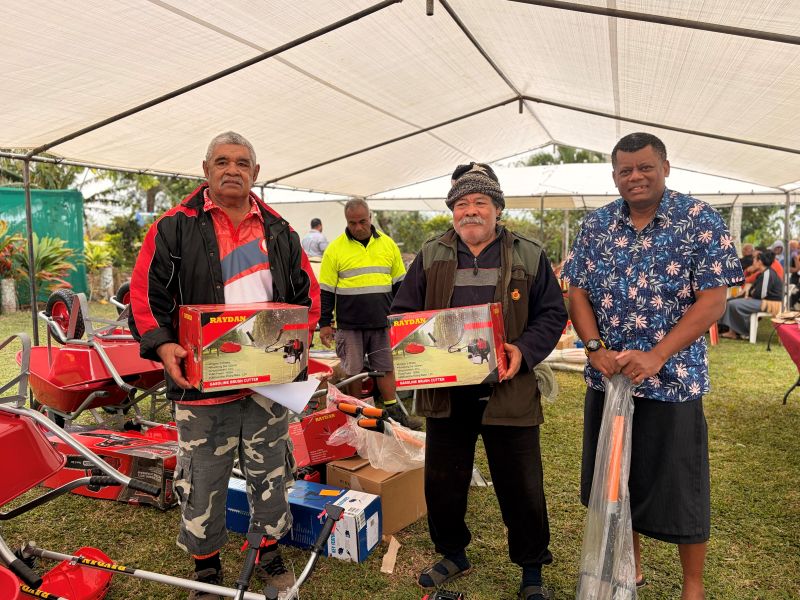
Seventy-eight organic farmers in Tongatapu and Vavaʻu have received new farming equipment to strengthen agroecological practices and improve productivity as seasonal migration continues to affect communities.
The equipment, distributed through the Pacific Organic Learning Farms Network (POLFN), includes machetes, soil augers, drip irrigation systems, chainsaws and weed eaters.
For farmers in some communities, the support comes as households adjust to the loss of working-age family members who have taken up seasonal employment in Australia and New Zealand.
Melesila Weilert, a farmer and women’s group leader in Tongatapu, said many of the people remaining in her village were women who continued to carry responsibility for household livelihoods.
“With a population of around 226 people in our village, many have joined the seasonal worker programmes overseas. Those of us who remain and are still able to do the physical work are mostly women,” she said.
She said access to equipment would help women maintain farming activities and support their families.
POLFN Farm Advisor Amanaki Funaki said the tools would help farmers adopt agroecological practices while reducing reliance on chemical inputs.
Project Implementation Officer Emosi Cagi said providing equipment alongside farmer training would help turn lessons into practical changes on farms.
In Vavaʻu, farmer and church leader David Lolohea said he hoped the support would encourage more farmers to adopt organic methods and share knowledge within their communities.
SPC has previously described POLFN as a regional effort to strengthen resilient, agroecological and organic farming systems, including through farmer-led learning and demonstration farms.
The equipment distribution is part of the wider POLFN project under the KIWA Initiative, which supports climate-resilient and nature-based approaches across the Pacific.