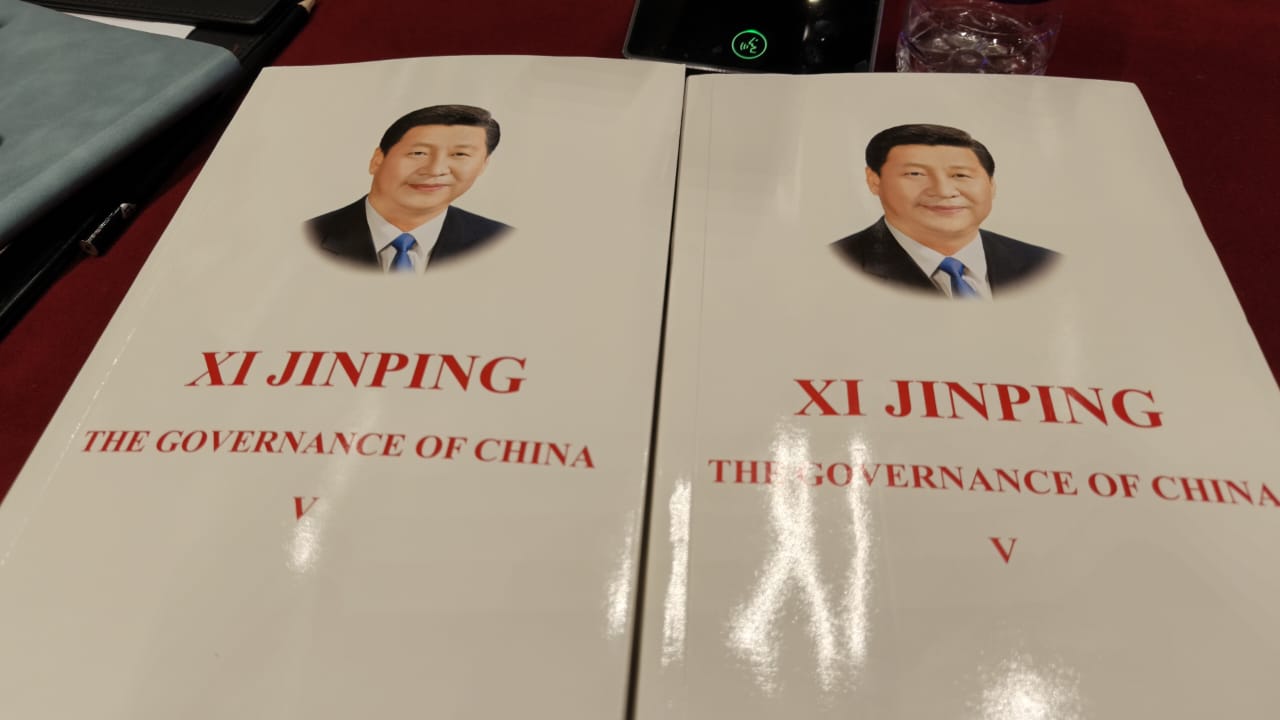
In a rapidly changing world, small nations face complex challenges in governance, economic development, political reform, and international relations. Xi Jinping’s The Governance of China, Volume V offers important perspectives on these issues. This opinion reflects on the book’s key ideas and considers how small nations can learn from China’s experience while adapting relevant lessons to their own national realities, interests, and development priorities.
The 39th group study session of the Political Bureau of the Communist Party of China (CPC) emphasized the importance of gaining a deeper understanding of China’s historical and cultural heritage. History and culture are essential elements for understanding identity, experience, and the development path of a society.
In my view, this is also an important lesson for small nations. A nation that seeks to build its future must understand its past. Through historical study and research, societies can learn from past experiences, understand their successes and failures, and use those experiences to guide decisions for the future.
History is not merely about events that have already taken place. History can serve as a guide for governance, education, national unity, and development. Therefore, historical consciousness and cultural confidence should be important components of nation-building.
Constitutional Reform and Political Reform
The 19th National Congress of the Communist Party of China (CPC) represented an important moment in China’s development process. China continued to pursue the objective of National Rejuvenation.
Through political and institutional processes, China revised its Constitution, promoted reforms within state institutions, developed socialism with Chinese characteristics, and modernized its governance system and governance capacity. China also formulated a 14-year economic and development plan, with a long-term vision extending to 2035.
From my perspective, an important lesson is that political and institutional reforms must have clear objectives and respond to the needs of the people. Reform is not simply about changing institutions or laws; it is also about improving the capacity of the state to deliver effective public services, increase the efficiency of governance, and protect the public interest.
Development with Quality
Through the implementation of a new development philosophy, China has placed strong emphasis on promoting high-quality development across all sectors. This approach does not focus solely on economic growth, but also considers sustainability, innovation, and benefits for the people.
In my view, this is an important point that small nations should seriously consider. Development cannot be measured solely by economic growth figures. Attention must also be given to the quality of education, infrastructure, opportunities for young people, productivity, food security, and the overall quality of life of the population.
A nation may experience economic growth, but if its benefits do not reach the majority of its people, we must ask: Development for whom, and for what purpose?
Marxism, Socialism, and National Realities
Marxist ideology has played an important role in the history of the Communist Party of China. Under the leadership of Xi Jinping, China continues to affirm Marxism as an important foundation for the Party’s political thinking and development orientation.
However, the lesson I consider particularly important is the need to adapt principles and theories to the concrete realities of each nation. This demonstrates that a political theory or governance model cannot simply be copied from one country and applied unchanged to another.
China has sought to develop socialism with Chinese characteristics according to its own realities, history, and national needs. From this, small nations can learn that development requires their own identity, direction, and priorities.
The People as the Fundamental Force
In the process of national development, the people must remain at the center. The people are the fundamental force and a decisive element in determining the stability and future of a nation.
Therefore, good governance must maintain a strong relationship with the people. Public policies should be based on the real needs of the population, while state decisions should be guided by responsibility and transparency.
I believe that a nation cannot develop through government alone; development requires the contribution of government, the private sector, academia, young people, and society as a whole.
Reform and Openness
The policy of reform and opening up has been an important element in China’s transformation and development. China’s experience demonstrates that a nation cannot achieve sustainable development through isolation from the world.
At the same time, openness does not mean abandoning national interests. Openness must be pursued strategically, protecting national interests while taking advantage of opportunities for international cooperation.
For small nations, openness and international relations are extremely important. However, they need an independent, balanced, and national-interest-based foreign policy, enabling them to engage with both major and small nations on the basis of mutual respect and mutual benefit.
Final Reflection
China’s experience offers important lessons concerning governance, reform, development, openness, and long-term planning. However, these lessons should not be understood as a model that small nations must simply copy. The important lesson is that we must learn, analyze, and adapt according to our own national realities.
In a constantly changing world, small nations need to move forward with wisdom: neither isolated nor dependent; neither closed to the world nor willing to lose their identity; learning from the world while continuing to choose a path appropriate to their own national realities.
I believe that the future of small nations depends greatly on their ability to learn from the experiences of other countries, but above all, on their capacity to think independently, plan with a long-term vision, and work together in the interests of their people and their nations.
— Augusto Sarmento
Opinion for the Public and the Media