Thailand’s economy is buckling as the US-Iran war drives fuel shortages, shuts petrol stations, halts services, and pushes up air fares, while Israeli strikes kill top Iranian figures and Tehran vows retaliation, deepening fears of a wider, prolonged conflict.
Thailand’s economy is beginning to show clear strain as the war in the Middle East between a United States–Israeli alliance and Iran intensifies. The conflict has escalated sharply and turned increasingly bitter, with confirmation in recent hours in Tehran that two key security chiefs were killed in Israeli strikes on Monday night. The attacks launched on February 28th by American and Israeli forces have not clarified their aim. However, only regime change in Iran or a retreat by the United States can now bring it to an end. It is a dangerous and pivotal moment in history.
Thailand’s economy strains as the US-Israel war with Iran escalates. Israeli strikes kill top security chiefs in Tehran, deepening a bitter conflict with no clear end yet in sight. (Source: Thai Rath/BBC)
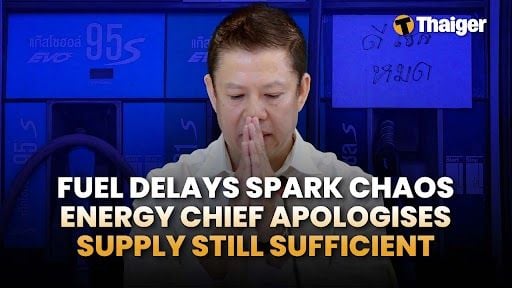
There are rising fears within the government that the US-Iran conflict is destabilising the Thai economy. With petrol stations closed across the kingdom, there was a report on Tuesday from Kanchanaburi where garbage truck disposal had to be halted due to a lack of fuel for vehicles.
Already, Bangkok Governor Chadchart Sittipunt has been forced to take action to prevent a similar situation from developing in the capital. Meanwhile, Middle Eastern airlines such as Emirates are flying near-empty planes to their flight hubs such as Dubai. This all means fewer European visitors to Thailand and rising air fares.
In addition, the de facto shortage of diesel and fuel across Thailand, despite government announcements, is impacting day-to-day trade. Temples cannot get fuel for cremations, while maintenance contractors cannot power generators.
Thai fuel shortages disrupt services and travel as conflict’s impact spreads across economy nationwide
In the meantime, despite government assurances, there are fears that the country’s plastic packaging industry will come to a standstill, while farmers search for scarce supplies of fertilisers.
In the meantime, all eyes are on both the United States and Israel, who are waging a war that can only be successfully concluded with regime change in Tehran. However, the regime has cracked down on street protests with extreme force and has, in effect, placed its population under the gun.
On Tuesday, hosting the Irish Taoiseach, US President Donald Trump told reporters that the United States would be leaving the Iran operations “very soon”. Certainly, if that happens, it remains to be seen whether the present conflict will recede.
Undoubtedly, Israel has been pushing an agenda of regime change. The situation remains volatile. On Wednesday, the elusive new Iranian Supreme Leader, Mojtaba Khamenei, spoke of defeating the United States and Israel and bringing both countries “to their knees” in the war.
Iran leadership signals defiance as conflict deepens and global attention shifts to Tehran
The 56-year-old is widely believed to have been seriously injured in the opening February 28th attacks on Tehran, which killed his father and wiped out his family. There are persistent reports that he has been evacuated for treatment in Moscow.
It is not clear if the United States can so easily disengage without losing enormously in terms of prestige and influence, which matters greatly in the Middle East.
In the meantime, the war between Iran and an alliance of the United States and Israel is escalating further. On Monday night, Israeli airstrikes struck central Tehran. As a result, senior figures in Iran’s security structure were killed. According to Israeli officials, the targets included Ali Larijani and Gholam Reza Soleimani. Both men held critical roles within Iran’s internal command system.
Israeli Defence Minister Israel Katz confirmed the strike soon after. He said the operation relied on precise military intelligence. Furthermore, he stated that Israeli aircraft hit command positions in Tehran.
Israeli strikes in Tehran kill senior security figures and escalate pressure on Iran’s leadership
The objective, he said, was to eliminate leadership directing internal security forces. In addition, Israeli military sources identified the Basij structure as a key target. Therefore, the strike focused on figures central to domestic enforcement.
Larijani served as secretary of Iran’s Supreme National Security Council. Previously, he was the speaker of parliament. Moreover, he led Iran’s nuclear negotiations with Western countries. Most recently, he appeared in public last Friday.
He attended a Quds Day parade alongside President Masoud Pezeshkian. Meanwhile, Soleimani commanded the Basij paramilitary force. This force operates under the Revolutionary Guard and enforces internal control. For that reason, both men were central to Iran’s internal security system.
At the same time, Israeli officials said the strike marked a significant development. Now confirmed, Larijani’s death will be the second most senior loss in the conflict since it opened up. Previously, the largest loss followed the killing of Ali Khamenei on February 28. That operation was also attributed to joint US-Israeli action. As a result, the latest strike would deepen the impact on Iran’s leadership.
Iran vows retaliation after strikes while conflicting reports emerge on leadership casualties
Meanwhile, Iran has issued direct threats of retaliation. Army chief Amir Hatami released a statement after the strike. He warned of a decisive and deterrent response. Moreover, he said both the United States and Israel would be targeted. He added that those killed would be avenged. Furthermore, he described them as martyrs. As a result, the statement points to further escalation.
However, initially, Iranian authorities did not issue a formal confirmation. Instead, state media released a handwritten note attributed to Larijani. The note mourned Iranian sailors killed in a separate US attack. Nevertheless, officials did not clarify his status. Consequently, uncertainty remains despite Israeli claims.
Shortly after, Iran’s Revolutionary Guards reported missile launches. According to AFP, missiles were fired toward central Israel. The action was described as retaliation for Larijani’s killing. However, independent confirmation remains limited due to restricted access. At the same time, Israeli operations have continued. Reports indicate repeated strikes on Basij positions in urban areas. In particular, Tehran remains a primary focus.
Lockdown tightens in Iran as protests are suppressed and internal divisions remain difficult to verify
Meanwhile, conditions inside Iran are tightly controlled. A broad lockdown is in place across major urban centres. Consequently, reliable information is difficult to obtain. Communications are restricted, and movement is limited. In addition, checkpoints have been established across Tehran and other cities. Residents are receiving mass warnings not to protest. Furthermore, deadly force has been used at early signs of demonstrations.
Despite these measures, there are reports of internal strain. Specifically, there are sporadic accounts of defections within Iranian forces. Some reports suggest movement within the Revolutionary Guard structure. However, these claims remain unverified. As a result, the internal situation remains unclear.
At the same time, Israeli strikes have increasingly targeted the Basij. This force has played a central role in suppressing unrest. Therefore, its leadership has become a priority target. The pattern of strikes suggests sustained pressure on internal security structures.
Meanwhile, US President Donald Trump addressed the possibility of an uprising on Friday, March 13. He described the conditions facing Iranian protesters. Specifically, he said armed personnel are deployed in the streets. According to Trump, these forces use machine guns against protesters. He identified the Basij as a key enforcement arm. As a result, he said, civilians face major barriers to protest.
Trump signals slow internal change in Iran as US weighs exit and Israel presses ongoing operations
However, Trump also said change inside Iran is likely over time. Nevertheless, he stressed it would not occur quickly. “It’ll happen,” he said. “But maybe not immediately.” His remarks came as reports of unrest continued under heavy restrictions.
In parallel, reports suggest possible shifts in US involvement. There are indications that Washington may be preparing to disengage. Specifically, this would involve declaring its objectives achieved. As a result, such a move could provide political relief for President Trump. However, it could also be viewed as a setback.
Iran War brings Thailand closer to the United States on trade and energy as it secures critical supplies
Anxiety about oil supplies and prices as economic growth in 2026 now dependent on the US Iran War
Meanwhile, Israel appears to be continuing operations. Its focus remains on weakening Iran’s internal control mechanisms. Therefore, further strikes on security structures remain likely. Overall, the situation remains volatile. Key facts, including confirmation of senior deaths, are still contested. Nevertheless, military actions and retaliatory threats continue to intensify the conflict.
Ultimately, the United States and the White House have two choices. Either go all out to remove the Iranian regime or retreat behind the slogan of “mission accomplished.” The latter will spell defeat for the United States in the Gulf and a decline in influence. The former may involve sending in troops. For Thailand, either will spell relief as its economy shudders but has not yet been stalled.
Receive all our stories as they come out on Telegram here
Follow Thai Examiner here
Further reading:
Iran War brings Thailand closer to the United States on trade and energy as it secures critical supplies
Anxiety about oil supplies and prices as economic growth in 2026 now dependent on the US Iran War
Ministers scramble to secure oil supplies due to Middle East War. Rationing at petrol stations starts
Thai vessel evacuated in the Strait of Hormuz after coming under fire and suffering engine room damage
Thailand advises all 77k nationals in the Middle East to evacuate the region as the US Iran war ratchets up
Naval war in focus Thursday as US Iranian war widens further leaving Thailand’s tourism sector reeling
US Ambassador Seán O’ Neill briefed Prime Minister Anutin Charnvirakul at Government House on War
Prime Minister Anutin urges calm as real fears grow over a volatile and dangerous war in the Middle East
Visa waivers, discounted hotel stays and 2,000 baht a person per day for stranded tourists announced
US fighting for regime change in Tehran as the Middle East conflict throws airline industry into chaos
Thailand faces Middle East instability as Khamanei is killed and US Israeli forces push regime change
Major war breaks out between United States and Iran causing chaos for air travel to Thailand at this time