Bangkok Governor Chadchart Sittipunt is heading for another landslide as two major polls predict a crushing re-election victory, cementing the former coup detainee’s rise as Thailand’s most successful independent politician after a dominant first term.
Former Bangkok Governor Chadchart Sittipunt appeared set for one of the most commanding re-election victories in the capital’s history on Sunday as two independent polls projected another landslide, cementing his extraordinary rise from military detainee after Thailand’s 2014 coup to the country’s most successful independent politician. With official results due within seven days, the election has become not only a verdict on his widely praised first term but also a powerful test of whether competence, administrative performance and personal credibility can continue to outweigh traditional party politics in Thailand’s biggest and most influential city with over 10 million souls.
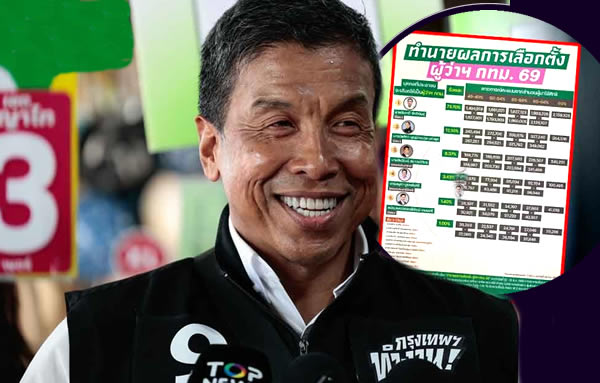
Bangkok’s Chadchart Sittipunt is heading for a crushing re-election victory, completing a remarkable rise from 2014 coup detainee to Thailand’s leading independent politician. (Source: Khaosod)
Former and outgoing Bangkok Governor Chadchart Sittipunt appeared on course for a resounding second election victory on Sunday as two major opinion surveys predicted another landslide in the capital.
The hugely popular incumbent, a former Pheu Thai cabinet minister now standing as an independent, resigned before the expiry of his first four-year term and immediately launched a disciplined re-election campaign.
By polling day, the contest had become less a battle for survival than a test of the scale of his expected mandate. Moreover, both independent surveys suggested he remained comfortably ahead across virtually every voter group, reinforcing his status as Bangkok’s dominant political figure.
Election officials report smooth polling as surveys point towards an overwhelming Chadchart victory
Election Commission Secretary-General Sawaeng Boonmee said on Saturday that preparations had been completed without significant problems. Polling stations across Bangkok were ready to open as scheduled.
Officials on Sunday reported that the poll itself had passed largely without incident. Meanwhile, the Election Commission confirmed that certified results would be announced within seven days after voting. Although counting would continue into the evening, political attention had already shifted towards the expected size of Chadchart’s victory and the shape of the next Bangkok Metropolitan Council.
The strongest endorsement came from the National Institute of Development Administration, better known as NIDA Poll. Its final survey, titled “Predicting the Results of the 2026 Bangkok Governor Election,” pointed towards an overwhelming victory for the incumbent.
Researchers interviewed 3,000 eligible voters between June 22 and June 25. The sample covered all 50 Bangkok districts and included residents from different educational, occupational and income backgrounds. In addition, NIDA said it employed probability sampling from its master database using multi-stage techniques.
Data was gathered through telephone interviews, producing a margin of error of no more than 0.05 at a 97% confidence level.
NIDA poll gives Chadchart a commanding lead as Mallika overtakes Chaiwat to secure second place overall
The findings placed Chadchart on 73.70%, a level of support rarely recorded in a competitive Bangkok election. Independent candidate Mallika Boonmeetrakul Mahasuk emerged as the clear runner-up on 12.10%.
Significantly, she overtook People’s Party candidate Chaiwat Sathavorawichit, who finished third on 8.37%. Democrat Party candidate Anucha Burapachaisri followed with 3.43%, while independent M.L. Korkasivath Kasemsri secured 1.40%. The remaining 1% was divided among other independent candidates and voters intending to cast a Vote No ballot.
Those remaining votes were shared between a lengthy list of lesser-known candidates. They included Samai Lalerd, Pongsak Puapronpong, Komsan Phanchatikul, Prateep Wacharachokkasem and Police Lieutenant General Charntep Sesavej of the Economic Party.
Others included Phisal Kittiyawamarn, Phasapong Chaiwirinyavanich, Prayoon Krongyot, Veerapoj Lueprasitsakul and Somchai Charoenworakiat. Collectively, they made little impact on a contest dominated throughout by Chadchart’s commanding lead.
Separately, NIDA released extensive demographic information illustrating the breadth of its survey. Every respondent was registered in Bangkok. Women represented 54.57% of the sample, while men accounted for 45.43%.
The city’s ageing electorate was also evident. Residents aged 60 years and above formed the largest voting group at 29.29%. They were followed by voters aged between 46 and 59 at 25.60%. Meanwhile, respondents aged between 36 and 45 represented 17.57%, while those aged 26 to 35 accounted for 16.87%. Younger voters aged between 18 and 25 comprised 10.67%.
Education, occupations and income data reveal the broad demographic profile behind the NIDA survey sample
The educational profile reflected Bangkok’s relatively skilled workforce. Nearly half of the respondents held bachelor’s degrees or equivalent qualifications. Another 11.17% possessed postgraduate qualifications. Secondary education graduates accounted for 24.57%, while associate degree holders represented 7.57%.
Primary education graduates made up 10.83%, and only 0.47% reported receiving no formal education. Likewise, occupational data showed a broad cross-section of the capital. Private sector employees formed the largest group, followed closely by business owners and self-employed residents.
Income levels also demonstrated the city’s economic diversity. Almost one-quarter reported having no monthly income, reflecting students, retirees and others outside the workforce. The largest earning group received between 10,001 and 20,000 baht each month.
Respondents were then spread across progressively higher income brackets reaching more than 80,000 baht monthly. Just over 7% declined to disclose their earnings. Although those figures varied considerably, Chadchart’s support remained consistently strong across the survey.
Survey also predicts a decisive Chadchart victory while projecting the new Bangkok council composition
A second survey produced by the King Prajadhipok Institute reached essentially the same political conclusion. Although the projected winning margin was smaller, it also showed Chadchart well ahead of every challenger.
Researchers interviewed 2,150 eligible voters between June 22 and June 25 across every Bangkok district. The institute said the research followed principles of neutrality, truthfulness, usefulness and academic standards. Furthermore, it stressed that the exercise sought to measure public opinion rather than influence it.
The King Prajadhipok Institute placed Chadchart on 53.6%. Chaiwat Sathavorawichit ranked second with 12%, while Mallika Boonmeetrakul Mahasuk followed on 9.8%. Anucha Burapachaisri secured 6.6%, and M.L. Korkasivath Kasemsri attracted 2.3%.
Other candidates collectively received 9.9%, while 4.9% of respondents remained undecided shortly before polling day. Despite the differing percentages, both major surveys projected the same outcome: Chadchart remained comfortably on course for another decisive mandate.
Beyond the governor’s race, the King Prajadhipok Institute also forecast the composition of the Bangkok Metropolitan Council. The People’s Party was projected to emerge as the largest bloc with 22 seats. The Bangkok Workers’ Group was expected to secure 10 seats.
Polling shows Chadchart dominating across parties, districts and age groups despite a divided council outlook
Pheu Thai and the Democrat Party were each forecast to win six seats. Meanwhile, the Better Bangkok group was projected to capture two seats, while independent candidates and smaller groups were expected to take the remaining four seats. Consequently, the next governor could again face a politically diverse council despite an overwhelming personal mandate.
Researchers also examined how voters had shifted between political parties and previous elections. Chadchart continued to attract support across almost every political constituency. More than 80% of residents who backed him in 2022 intended to vote for him again.
By contrast, supporters of former challenger Viroj Lakkhanaadisorn showed a stronger tendency to move towards People’s Party candidate Chaiwat Sathavorawichit. Looking at the February 8, 2026, general election, Chadchart again attracted the largest share of support from almost every major party base. The principal exception involved People’s Party supporters, who remained more likely to support Chaiwat.
Geography also favoured the incumbent. Chadchart led comfortably across Bangkok’s inner, middle and outer districts. His support measured 54.4% in the inner city, 51.9% across the middle districts and 54.8% in the outer districts.
Chaiwat achieved his strongest showing in the middle zone. Likewise, Chadchart maintained remarkably consistent support across every age group. Chaiwat’s strongest performance came among younger voters aged between 18 and 27. Even so, the overall lead remained firmly with the incumbent.
From engineer and minister to independent governor, Chadchart built a unique political identity in Bangkok
Those polling figures reflected more than simple name recognition. Chadchart has become one of Thailand’s most recognisable political figures despite operating outside the country’s traditional party system. Certainly, his election campaign was slick, faultless and executed on the basis of his established popularity.
Although he served as a senior minister under a Pheu Thai government, he has spent recent years carefully building an identity based upon administrative competence rather than party loyalty. That transformation has made him one of the country’s most successful independent politicians and helped broaden his appeal far beyond traditional political boundaries.
Born in Bangkok on May 24, 1966, Chadchart first established himself as an engineer rather than a politician. He graduated in civil engineering from Chulalongkorn University before pursuing advanced studies at the Massachusetts Institute of Technology and the University of Illinois Urbana-Champaign.
Afterwards, he returned to Thailand and built a respected academic career specialising in engineering and transport systems. His technical expertise later opened the door to national politics during the Yingluck Shinawatra administration.
He first served as deputy transport minister before becoming transport minister in October 2012. During that period, he oversaw ambitious transport planning and major infrastructure proposals designed to modernise Thailand’s transport network.
However, those plans were interrupted by Thailand’s military coup on May 22, 2014. Following the seizure of power by General Prayut Chan-o-cha, Chadchart was among dozens of ministers ordered to report to military authorities. Like many cabinet colleagues, he was immediately detained after complying with those orders.
Military detention after the 2014 coup reshaped Chadchart’s political career and future electoral strategy
He remained in military custody for several days without criminal charges. Afterwards, he was released after accepting conditions imposed by the junta, including restrictions on political activity and overseas travel.
The detention became one of the defining episodes following the coup as the elected Yingluck government was removed from office. Nevertheless, Chadchart gradually rebuilt his public profile after leaving government. Instead of returning through party politics, he chose a markedly different route.
In 2019, he announced that he would pursue his future as an independent politician. That decision fundamentally reshaped his political identity. Consequently, his campaign for Bangkok governor in 2022 focused almost entirely on practical administration rather than ideology.
He promoted transparency, direct public engagement and better city management. Extensive neighbourhood visits, relentless social media activity and constant interaction with residents became defining features of the campaign. The strategy proved extraordinarily successful.
Chadchart secured approximately 1.38 million votes in the 2022 election. He won 52.65% of all ballots cast and carried every one of Bangkok’s 50 districts. No governor had previously achieved such comprehensive electoral dominance.
Moreover, the result demonstrated that an independent candidate could decisively defeat rivals backed by established political parties. It immediately transformed Chadchart into one of Thailand’s most influential elected executives.
Hands-on leadership and visible city management defined Chadchart’s first four years as Bangkok governor
His first administration adopted a highly visible management style. Residents regularly saw him conducting inspections before sunrise, visiting construction projects without advance notice and travelling on public transport.
Videos showing him examining drains, pavements and neighbourhood infrastructure became familiar across social media. Supporters argued those appearances reflected direct engagement rather than political theatre. Critics, however, maintained that deeper structural problems still required long-term solutions.
Administratively, the Bangkok Metropolitan Administration prioritised flood prevention, drainage improvements, cleaner pavements, expanded green spaces and stronger waste management. Emergency response systems also received increased attention.
In addition, the administration introduced wider use of technology to monitor municipal services and expanded access to performance data. Officials simultaneously sought to strengthen accountability across city departments. Although traffic congestion and flooding remained persistent complaints, Chadchart consistently retained exceptionally high approval ratings throughout his first term.
Bangkok works campaign seeks second term built on continuity, technology and a powerful personal mandate
As his mandate approached its conclusion, Chadchart resigned before the expiry of his term to allow a fresh election. He then launched a campaign branded “Bangkok Works”. Rather than promising sweeping new policies, he emphasised continuity, infrastructure projects and technology-driven administration.
Hundreds of detailed policy initiatives formed the basis of that campaign. Against that backdrop, Sunday’s election increasingly became a referendum on his first four years in office rather than a contest between competing political visions.
Rail crash in central Bangkok kills eight. Train struck a bus stuck in traffic. Junction barriers failed to lower
Bangkok governor uses AI and a new smart traffic light system to cut traffic wait times by 10 to 41%
Both major opinion surveys suggested Bangkok voters were prepared to endorse that record decisively. While official counting will determine the final margin, Chadchart appeared set to secure one of the strongest electoral mandates in the capital’s history. Certified results are expected within seven days. If those projections are confirmed, Bangkok’s best-known independent politician will begin a second consecutive term with overwhelming public backing.
Join the Thai News forum, follow Thai Examiner on Facebook here
Receive all our stories as they come out on Telegram here
Follow Thai Examiner here
Further reading:
Bangkok governor uses AI and a new smart traffic light system to cut traffic wait times by 10 to 41%
Police crack the whip on Bangkok taxis just 24 hours before showdown meeting over Airport closure threat
Government will not tolerate any attempt to blockade Suvarnabhumi Airport by taxis over ride-hailing apps
Bangkok taxis threaten to close down Suvarnabhumi Airport if Ministry does not ban ride-hailing apps
Australian tourist injured by an angry Pink Taxi driver using a cutter to enforce a compensation demand
Taxi man adamant Taiwanese star in extortion case was loud and drunk on the night concerned in Bangkok
Confidence and trust in Thailand damaged by Chinese VIP tourist services advertised online
Viral Chinese video says VIP arrival with a police escort can be bought when holidaying in Thailand
US and Thai agencies forge closer ties as cabinet tackles corruption within the Royal Thai Police national ranks
Royal Thai Police Sergeant Major arrested on Ko Samui, charged with the rape of female detainee