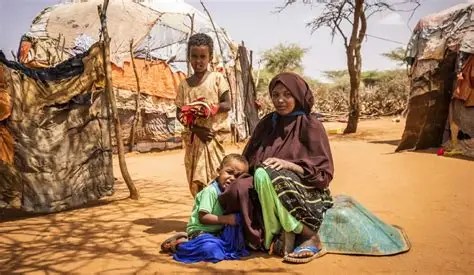
In 2026, over 811 million people, at the ratio of 1 in 10, continue to live on less than US$3.00 a day.
This rate remains unchanged since 2019.
More than half the extreme poor live in nine economies, and by 2030, over 87 percent of them will be in Sub-Saharan Africa, in fragile and conflict-affected situations, or both.
This is according to the Poverty, Prosperity, and Planet Report which is the World Bank Group’s flagship biennial publication that tracks global progress on ending extreme poverty and boosting shared prosperity on a livable planet.
Without stronger per capita growth, the number of people in extreme poverty is projected to be higher in 2030 than it is today.
Despite the reduction seen in past decades, escaping extreme poverty has not meant reaching security.
Nearly half of humanity, 3.7 billion people, still lives on less than US$8.30 a day, most of them one shock away from falling back.
Climate-related shocks threaten the progress against poverty
Of the 4.6 billion people living in areas exposed to major climate-related hazards, more than a billion are in a highly vulnerable situation because they lack social protection or access to basic infrastructure.
While the high-risk share declined from 1 in 3 people in 2010 to 1 in 6 people in 2024, the number of people exposed rose by about 550 million.
Climate risk is widespread and emissions are rising where the poor are not
Ending extreme poverty would barely add to global emissions
The effort to eradicate extreme poverty is estimated to add less than 5 percent to global emissions. The extreme poor contribute the least to global emissions but are the most vulnerable to the consequences of climate change.
More jobs and better-paid jobs are needed to reduce poverty
Nearly all poor households hold a single productive asset: human capital.
This makes employment — quantity and quality — the central lever for poverty reduction.
Closing employment gaps in poor households to a benchmark of 75 percent of working-age adults would reduce extreme poverty by a fifth, with the gain going mainly to workers above the extreme poverty line — where the nonworking adults are mostly women.
Raising the earnings of poor workers toward what comparable nonpoor workers earn could cut poverty by nearly half, with the gain going mainly to the poorest households.
Change in the probability of escaping poverty from a move into wage employment, by income group.
The world has made remarkable progress in reducing extreme poverty in the past 75 years.
Between 1950 and 2025, the world has experienced remarkable progress in reducing the proportion of the population living in extreme poverty from 60 percent to 10 percent.
Consider the lifetime of someone in their 70s today.
When they were born, six out of ten people were living in extreme poverty globally. Today, one out of ten people are living in extreme poverty.
The world has made remarkable progress in reducing extreme poverty over the past 75 years, despite the global population more than tripling (from 2.5 billion to 8.3 billion). \
Today, more than 800 million people are living in extreme poverty; that is, they live on less than $3.00 a day (2021 PPP).
The changing patterns in reducing extreme poverty are driven by a few regions in the world.
Extreme poverty has been consistently low in Europe, North America, and Latin America since 1990; rapid progress against extreme poverty is explained by East Asia and the Pacific and South Asia, while the recent stagnation is driven by Sub-Saharan Africa and the Middle East and North Africa.
The historic progress in reducing extreme poverty in the world has stalled in the last decade.
In the past decade, progress in reducing extreme poverty has stalled amid a polycrisis, including the COVID-19 pandemic, climate-related shocks, geopolitical tensions, resulting in rising extreme poverty in the Middle East and stagnation in Sub-Saharan Africa.
The first Sustainable Development Goal (SDG) to end extreme poverty in the world by 2030 was inspired by a lot of optimism in the development community until 2015 when the SDGs were adopted.
Unfortunately, in the decade that followed, progress in reducing extreme poverty stalled. Not only had China eradicated extreme poverty, but the global economy would be hit by several crises, including the COVID-19 pandemic, increasing frequency and severity of climate-related shocks, and geopolitical tensions, such as the Russian invasion of Ukraine.
Conflicts in parts of the Middle East contributed to worsening poverty outcomes in affected countries. Sub-Saharan Africa has been vulnerable to these global shocks and recovery has been slow. Consequently, economic growth has been too low in Sub-Saharan Africa to compensate for high population growth.