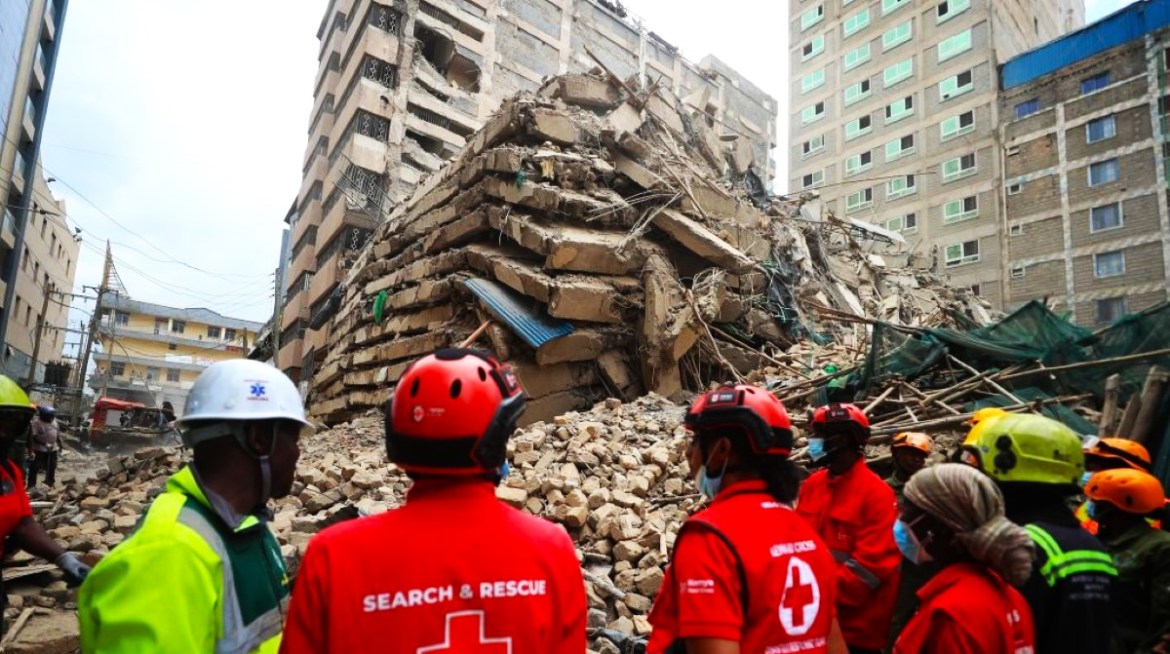
The number of people feared to be still trapped under the rubble of the collapsed building in the Kenyan Capital of Nairobi remains unknown.
However, rescue operations continued late into the night.
The multi-storey building which was under construction in Nairobi’s Eastleigh neighborhood collapsed on Friday afternoon of October 23.
Somalia’s Facility for Talo and Leadership (FTL) outcried the fact that the accident occurred at the heart of a district which is normally regarded as the economic lifeline and essentially also residency for Kenya’s Somali community and a vital commercial bridge to Mogadishu.
The building, located on 9th Street, came down at approximately 1:00 p.m. local time.
According to an official statement from the National Construction Authority (NCA), the project was registered on July 30, 2025, under Land Reference Number 36/II/40.
The developer on record is 9th Street Plaza Limited, and the contractor is Stromax Holdings E.A Limited. The registered professionals are Architect Emmanuel Mwangi Maina and Engineer Joseph Muturi Mugu.
Somalia’s envoy to Kenya, Jabril Ibrahim Abdulle, visited the scene and described the incident as a tragedy for the Somali community.
He confirmed to the Somali National News Agency (SONNA) that lives had been lost and businesses destroyed, noting that the full extent of the damage to Somali-owned enterprises would only be known once rescue operations concluded.
“This is a sad day that I share with the Somali community in Nairobi,” Ambassador Abdulle said, emphasizing that Eastleigh is home to a large Somali population whose livelihoods depend on the commercial activity in the area.
A Commercial Hub in Ruins
Eastleigh is not merely a residential neighborhood; it is a densely packed commercial engine.
The ground floor of the collapsed building had been rented out to an electronics shop, a butchery, and a grocery store, all of which were operating while construction continued on the upper floors.
The destruction of these businesses represents an immediate loss of income for Somali traders and their families.
The economic stakes are substantial. Somali investors have injected over US$1.5 billion into Nairobi’s economy over the last two decades, according to the Kenya National Chamber of Commerce and Industry, as reported in FTL Somalia’s coverage of Somali investment in Kenya.
Eastleigh is the primary hub for much of that capital.
The destruction of a building in this commercial zone represents not just a human tragedy but a significant blow to the economic ecosystem that connects Somali businesses in Nairobi to networks across East Africa and the diaspora.
Witnesses described the chaos. Muhiyadin Abdi, a Somali shop owner whose business is adjacent to the collapsed structure, said he and others saw cracks forming and tried to warn people.
“We saw the walls crumbling little by little for several minutes. We tried to scream, to warn people, but no one listened,” he said. “Then there was a huge noise, accompanied by a large cloud of dust. And the building collapsed.”
Another resident noted that because the collapse occurred around the time of Friday prayers, many workers and shoppers were at the mosque, potentially reducing the death toll. However, engineering experts at the scene warned that many workers were still inside conducting finishing work, and that the number of trapped individuals could be significant.
The Regulatory Failure Behind the Tragedy
The collapse has exposed the dangerous regulatory environment that Somali businesses and residents navigate in Eastleigh.
Nairobi Governor Johnson Sakaja confirmed that while the building had been approved for construction, it did not possess an occupation certificate.
This means the businesses operating on the ground floor were doing so illegally, and the county government failed to enforce the law that would have kept them out of a construction site.
“This building has no occupation certificate… this has potentially cost lives,” Sakaja said, acknowledging that lenient penalties for developers amount to a “slap on the wrist.”
Experts point to a pattern of corner-cutting. John Ogallo, vice-president of the Institution of Engineers of Kenya, stated that distress signs, such as cracks, were observed before the collapse.
“If you build with the wrong materials, it becomes a time bomb,” he warned. A report by the Kenya Institute for Public Policy Research and Analysis found that 86 buildings collapsed in Nairobi between 2009 and 2019, killing an estimated 200 people, with audits showing that the vast majority of buildings in the city fail to meet safety standards.
What This Means for Somalia and Its Diaspora
For Somalia, the Eastleigh disaster is a direct economic and human blow.
The neighborhood is the primary destination for Somali nationals traveling to Kenya for medical treatment, business, and education.
It is also a critical node in the informal financial networks that connect the diaspora to the homeland.
The destruction of businesses and the loss of life in this specific location will be felt deeply in Mogadishu and across Somali communities worldwide.
The tragedy also underscores the vulnerability of Somali migrants and diaspora communities in Kenya.
Many Somalis in Eastleigh operate in the informal economy, with limited access to formal insurance or legal recourse when disasters occur.
The fact that the building was occupied illegally, with the tacit tolerance of county authorities, highlights a system where regulatory oversight is weakest in the very areas where Somali enterprise is most concentrated.
The incident occurs against the backdrop of a complex but deepening bilateral relationship.
As reported in FTL Somalia’s coverage of Somalia-Kenya security talks, the two governments have been actively strengthening cooperation on security, trade, and cross-border movement.
The reopening of border crossings and the push for a trade facilitation agreement have been central to this rapprochement.
For the Somali community in Eastleigh, these diplomatic developments are not abstract. They determine the ease with which they can travel, trade, and access services in both countries.
As rescue teams continue to dig through the rubble with excavators and improvised tools, the Somali government and community leaders will be watching closely.
The response to this disaster, and the Kenyan government’s willingness to hold the developer and the county officials accountable, will determine whether Eastleigh’s residents can trust that the buildings they live and work in are safe.
The collapse of the 9th Street Plaza is not an accident.
It is the predictable result of a construction boom in Nairobi that has outpaced the capacity and will of regulators to enforce safety standards.
The NCA’s publication of the developer, contractor, and engineer names is a necessary step, but it is the bare minimum.
The Governor’s admission that the building was occupied without a certificate, and his call for stronger enforcement powers, suggests that the county government knows the system is broken.
For the Somali community, this is a moment of grief and anger.
Ambassador Abdulle’s visit to the scene was appropriate, but it must be followed by concrete action.
The Eastleigh tragedy is a reminder that the Somali diaspora’s economic success in Kenya, which has injected billions into the local economy, is built on foundations that are too often unsafe.
Until the regulatory environment changes, the community will continue to bear the risks of a system that treats enforcement as optional.