Tajikistan’s Ministry of Education and Science has established a special working group to improve the teaching of the traditional Persian script in schools following instructions from President Emomali Rahmon.
At a government meeting on May 29, Rahmon instructed officials to improve the quality of teaching the “ancestral script” in educational institutions. He said the initiative should be implemented as part of efforts to study, promote and popularize Aryan history and culture.
Responding to a question from an Asia-Plus journalist, Minister of Education and Science Rahim Saidzoda said the ministry was considering ways to strengthen the teaching of the script.
“This is the Tajik language, not another language — it simply needs to be mastered in this script. Following instructions from the country’s leadership, we have established a working group under the Ministry of Education and Science to determine what should be done to improve the teaching of the ancestral script,” Saidzoda said.
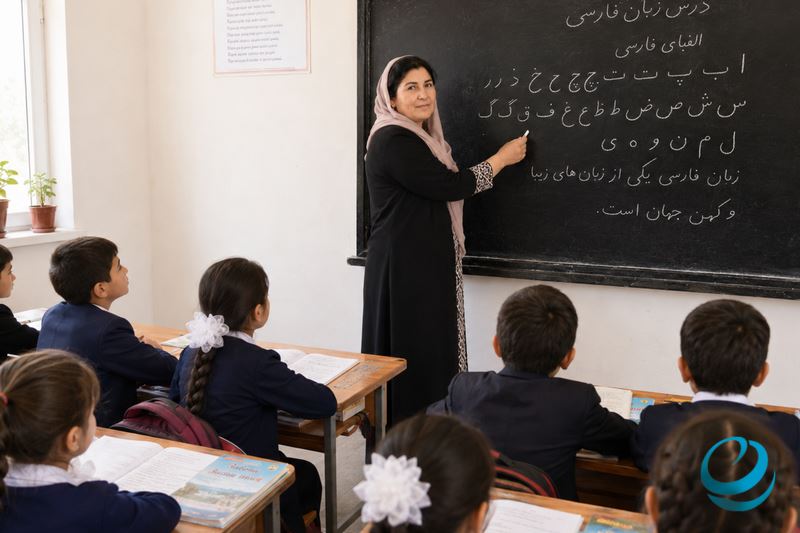
He noted that seventh- and eighth-grade students currently study the traditional alphabet for two hours a week.
“We may further revise the curriculum. Work in this area is already underway,” the minister added.
Saidzoda did not specify what other measures the ministry was considering.
“More than 1,200 years of our history were written in this script”
Sakhidod Rahmatullozoda, chairman of Tajikistan’s Committee on Language and Terminology, also addressed the issue at a press conference on July 10.
“More than 1,200 years of our written history were created in this script. If we do not know it, who will read this heritage? For whom does it exist?” Rahmatullozoda said.
He acknowledged that Cyrillic is easier to learn because it represents all sounds, while short vowels are usually omitted in traditional Persian writing or indicated with special marks.
“But knowing the ancestral script means knowing our history, culture and outstanding literary heritage, which is more than a thousand years old,” he said.
Rahmatullozoda expressed the view that everyone should be able to read the script.
“Personally, I fell in love with it as a child. I have read many books written in this script. I taught it for four years at school and for more than ten years at universities,” he said.
According to him, people can also learn Persian script independently.
“Anyone who loves their homeland and values national traditions can learn it on their own, even at the age of 100. It is not difficult. Reading is very easy, while writing is slightly more complicated,” Rahmatullozoda said.
Higher Attestation Commission plans Persian- and Arabic-language publications
Earlier, Saifiddin Davlatzoda, chairman of Tajikistan’s Higher Attestation Commission, said the agency intended to allow scholars to publish academic articles in Persian and Arabic.
He said the initiative reflected the fact that a significant part of Tajikistan’s classical cultural heritage had been preserved in these languages, while public interest in the ancestral script was growing.
“In the near future, we plan to allow articles in Persian and Arabic to be published in the humanities section of our academic journal,” Davlatzoda said.
The possible expansion of Persian-script teaching has long been discussed by Tajik scholars and public figures. The script was widely used in the territory of present-day Tajikistan until the introduction of Latin and later Cyrillic writing during the Soviet period.
Some experts support gradually replacing the current Cyrillic alphabet with the traditional Persian script. Others argue that such a transition would be difficult and costly.
Supporters of restoring the historical script say it would provide Tajik readers with direct access to centuries of classical literature and written heritage. They also note that, unlike the Latin alphabet being adopted by some other Central Asian countries, Persian writing has deep historical roots in Tajik culture.
For many representatives of the Tajik intelligentsia, the debate over a possible return to the ancestral script therefore remains open.