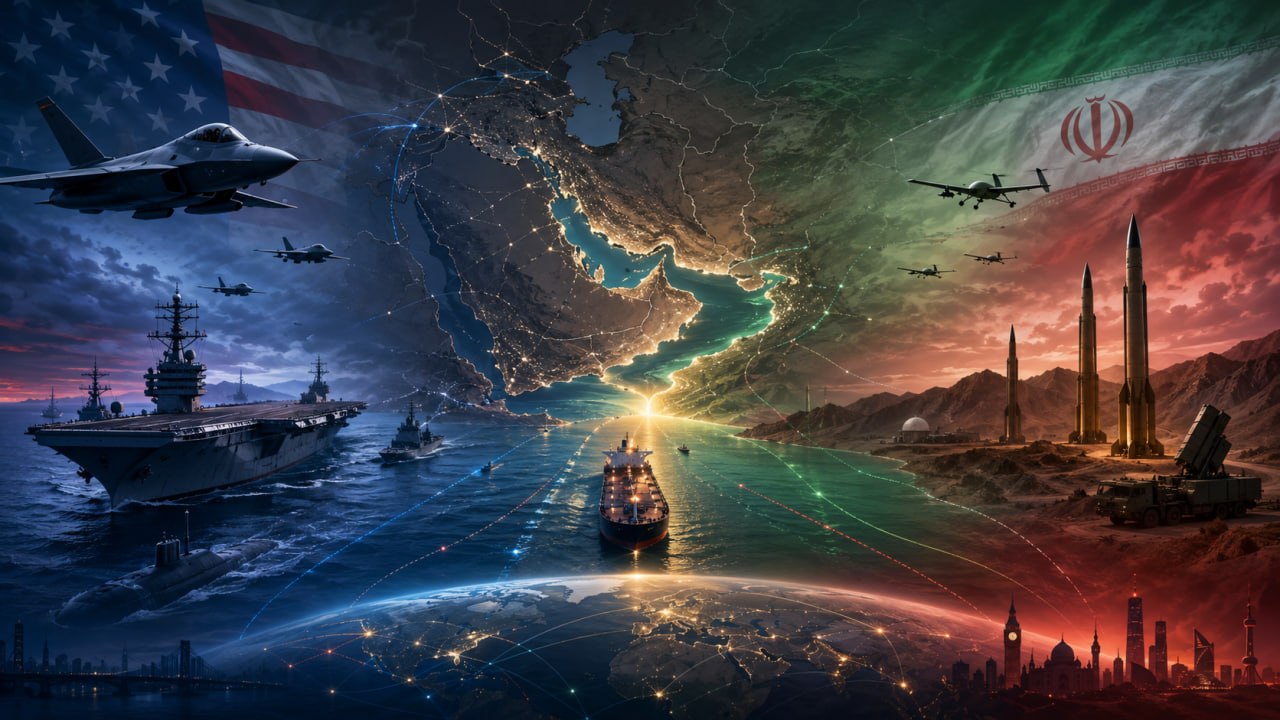
The resumption of military confrontation between the United States and Iran marks a new phase of instability in the Middle East. This is no longer just about the long-standing conflict between Washington and Tehran, but about the struggle for the future security architecture and balance of power in one of the world’s key regions.
Why did the memorandum between the United States and Iran fall apart? Can the current confrontation escalate into a major regional war? What position will Arab countries, Russia, and China take? And what does the new escalation mean for the global economy and the energy market?
From Memorandum to Airstrikes
Before the new escalation began, the parties signed a memorandum intended to ease the crisis. However, deep mutual distrust, clashing interests, and domestic and external political pressure prevented the process from reaching a successful conclusion.
For more than a week, the United States and Iran have been carrying out airstrikes against each other’s facilities and infrastructure, resulting in casualties. Under these circumstances, the central question for both sides is their ability to control the costs of the conflict and secure more favorable positions in shaping the future security order in the Middle East.
The new phase of military confrontation between the two countries began after Washington accused Tehran of violating a temporary agreement on ensuring the safety of navigation in the Strait of Hormuz. Iran rejected these accusations, stating that it was with U.S. support that vessels from certain countries began ignoring the rules established by the agreement, which led to the current crisis. In Tehran’s view, under the terms of that document, ensuring the safety of navigation in the Strait of Hormuz falls within Iran’s jurisdiction.
The Strait of Hormuz, one of the world’s most critical energy arteries, has once again become the center of fierce geopolitical rivalry. Control over this strategic route means the ability to directly influence the global energy market and the world economy. From this perspective, even a limited armed conflict could have serious consequences far beyond the region.
The renewed closure of the Strait of Hormuz and the possibility of further escalation have already led to reduced oil supplies and rising global prices, inevitably drawing major powers and states with a stake in regional stability into the crisis.
Why Iran Is Not Ready to Make Concessions
Following the million-strong farewell ceremony and funeral of Ayatollah Sayyid Ali Khamenei, who was killed on February 28 in a joint U.S.-Israeli airstrike, the domestic political atmosphere in Iran has changed noticeably. The ceremony went far beyond a religious and political event, becoming a demonstration of national unity and the society’s capacity for large-scale mobilization. The red flags carried by many participants in the funeral procession are perceived in Iranian political and religious tradition as a symbol of vengeance.
On July 13, many members of the Iranian parliament, which exerts considerable influence over the country’s foreign policy, also appeared in the chamber carrying red flags.
Furthermore, at the memorial ceremony for Ayatollah Khamenei held earlier in the city of Qom, Sayyid Ali Khomeini — the grandson of the founder of the Islamic Republic, Ayatollah Ruhollah Khomeini — made a harsh statement, calling a traitor anyone who would negotiate with the United States in pursuit of peace.
Most likely, this message was not directed at specific political figures or groups, but rather reflected the position of a significant portion of the Iranian clergy. In other words, negotiations with the United States have ceased to be exclusively a matter of foreign policy and have become a domestic political issue, which will further complicate diplomatic efforts.
Nevertheless, resolving the crisis remains an objective necessity that neither Washington nor Tehran can ignore. This is precisely why the ongoing contacts between representatives of the two countries through the mediation of various capitals indicate that neither side is interested in completely severing channels of communication.
Why the United States Is Striking Iran’s Transportation Routes
The new phase of confrontation between the two countries indicates that the nature of their rivalry has changed significantly compared to the past. During the latest wave of strikes against Iran, the United States attacked a bridge in Golestan Province on the Inche-Burun–Turkmenistan railway line. From a geopolitical standpoint, this strike carried considerable symbolic weight.
This route is part of the eastern branch of the International North–South Transport Corridor, connecting Iran with Central Asian countries as well as with Russia and China. It is possible that the strike was intended to weaken Iran’s ties with Eurasian transportation networks. As maritime shipping becomes more restricted, the importance of overland routes increases significantly.
“
If the United States continues to strike Iran’s transportation infrastructure — including railways, ports, bridges, and energy facilities — such actions will go far beyond an ordinary military operation. The destruction of strategic and economic infrastructure is aimed at reducing Iran’s role as one of the most important transit hubs and gateways to the open seas.
In effect, Iran’s geographic position between Central Asia, the Caucasus, the Persian Gulf, and the Indian Ocean allows it to become one of Eurasia’s main connecting links. Therefore, limiting the country’s transportation potential carries not only military but also exceptionally important geopolitical significance.
A legitimate question arises: can such measures force Iran to change its strategy? Most likely, no. As already noted, the domestic political atmosphere in the country has changed noticeably. Moreover, decades of living under international sanctions have significantly increased Iran’s resilience to external pressure. It is therefore most likely that Tehran will continue to strengthen its deterrence capabilities, seeking not only to preserve its existing positions but also to expand its regional influence.
The Gulf States Do Not Want a Major War
Another important question is whether the current confrontation will escalate into a large-scale regional war or whether the parties will limit themselves to continuing the conflict within its current parameters.
If Israel does not directly enter the conflict at this stage, the confrontation between the United States and Iran will most likely continue in the form of a controlled war of attrition. Through air, naval, and cyber operations, the United States is seeking to increase Iran’s military and economic costs. Despite Donald Trump’s loud declarations about destroying the Islamic Republic, judging by the current nature of the military operation, Washington is not yet considering the deployment of ground troops.
In addition to the country’s vast territory and its complex natural and geographic conditions, the demonstration of national unity by Iranian society during the farewell to Ayatollah Khamenei makes a potential ground operation extremely risky. Under such circumstances, a decision to invade would amount to political and military suicide for the United States.
Iran, in turn, will continue to raise the cost of the American military presence in the Middle East through missile strikes, drones, cyberattacks, and other means. At the same time, this will reinforce the conviction among regional states that the presence of American military bases no longer guarantees their security.
“
The Arab states of the Persian Gulf remain concerned about Iran’s growing regional influence, particularly its missile and drone capabilities. However, after Iran managed to withstand two major military attacks in less than a year, they no longer take seriously the earlier claims about its “imminent defeat.”
At the same time, the economies of Arab countries are directly dependent on oil and gas exports, the security of maritime communications, and the inflow of foreign investment. A prolonged war would inevitably damage all of these vital areas.
Despite their close military and political ties with the United States, signals coming from the capitals of Arab Gulf states indicate their reluctance to become an arena for a direct war with Iran. The presence of official delegations from these countries at the farewell ceremony for Iran’s leader only confirms this trend. Moreover, some regional states — most notably Oman and Qatar — are already undertaking diplomatic efforts to resolve the current crisis between Washington and Tehran.
At the same time, the Arab monarchies cannot ignore another reality. If the United States expands its strikes against Iran’s military and economic infrastructure, Tehran’s response will most likely not be limited to American military bases, missile systems, and command centers. Economic facilities, transportation infrastructure, ports, power plants, and other vital assets belonging to Washington’s regional allies could also come under attack.
Furthermore, if Israel takes a more active and direct part in the conflict, the scale of the war will inevitably grow. However, such a development poses a serious threat to Israel itself, as it would inevitably provoke retaliatory action from Iran and its regional allies.
Why Moscow and Beijing Will Support Tehran
One of the most important aspects of the current confrontation between the United States and Iran — one capable of profoundly influencing the future of the Middle East — is the role of extra-regional powers, primarily Russia and China. Although Moscow and Beijing build their relations with Tehran with certain limitations and their own national interests in mind, they have a strong interest in preventing the weakening of Iran’s position or any change in the existing balance of power in the region.
For Russia and China, Iran is far more than just an economic or political partner. Its unique geographic position as a connecting link of Eurasia, its transit potential, its rich energy resources, and a host of other factors give the country exceptionally important strategic significance.
This is precisely why, even if Moscow and Beijing do not directly intervene in the current conflict, they will undoubtedly continue to use diplomatic, political, and economic tools to facilitate its resolution.
Russia and China’s desire to preserve Iran’s position in the regional system of the Middle East is entirely understandable, since a shift in the existing balance of power could damage their economic, geopolitical, and strategic interests.
In a broader sense, the confrontation between the United States and Iran is no longer simply a bilateral conflict. It is an open and covert struggle over the formation of a new world order — one in which Russia and China, regardless of their own wishes, objectively find themselves closer to Iran’s position.
Not Victory, but Managed Rivalry
The current confrontation between the United States and Iran indicates that the Middle East has entered a new geopolitical phase of its development. In this phase, what matters is no longer military power alone, but also economic potential, control over international transportation corridors, the level of technological development, and the ability to ensure the resilience of the national economy.
“
Under the current circumstances, neither side has the ability to quickly achieve the complete defeat of its adversary. The United States maintains unquestionable superiority in the military sphere and in high technology. However, the experience of Iraq and Afghanistan clearly demonstrates that military superiority does not always lead to a definitive political outcome. Moreover, in some cases it is entirely incapable of delivering victory.
This is especially true of Iran, which over recent decades has managed to develop a high level of military, economic, and social resilience to external pressure. This is precisely why the most likely scenario in the short and even medium term appears to be a model of “competitive coexistence,” in which the parties continue fierce strategic rivalry while avoiding all-out war.
Such a model will not eliminate the existing contradictions, but it could prevent the current crisis from escalating into a large-scale regional conflict whose consequences would affect not only the Middle East but the entire international security system.