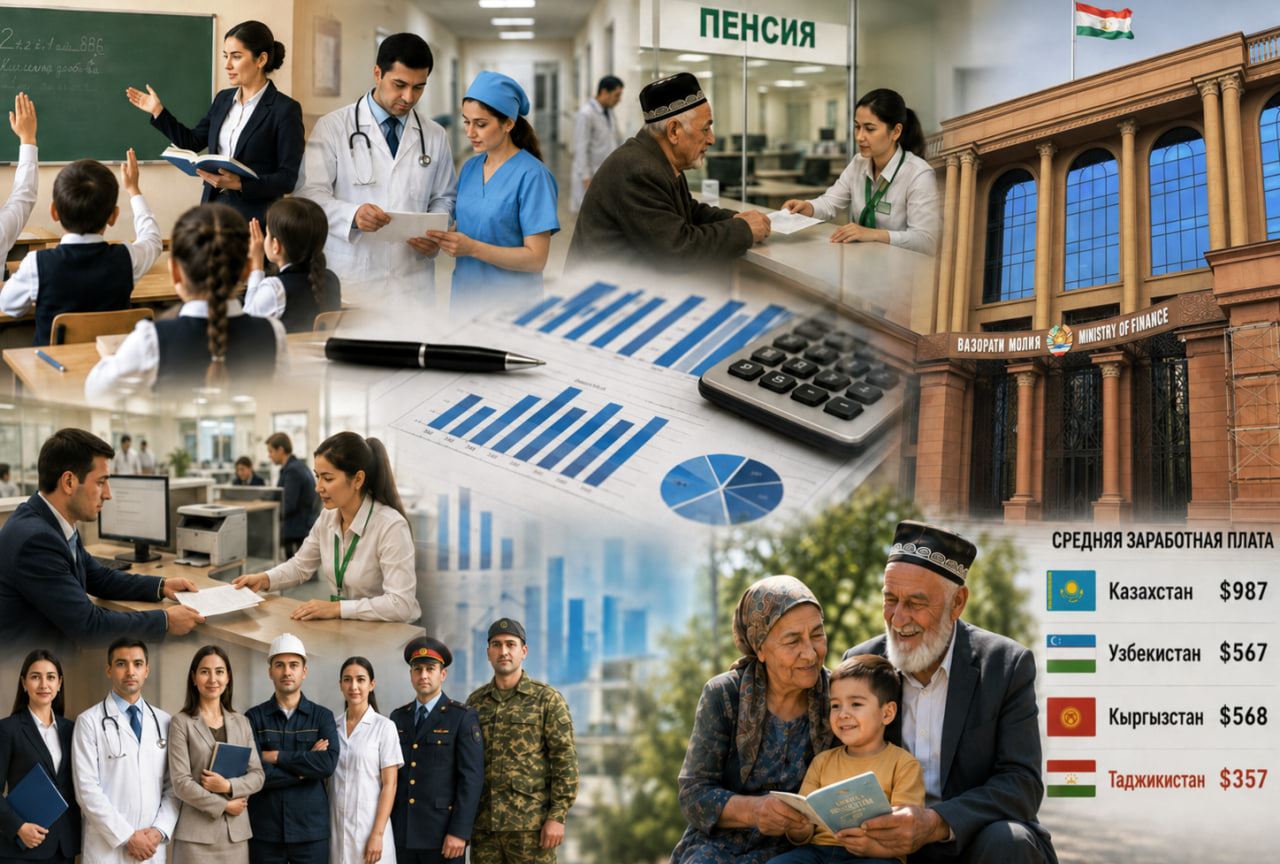
Tajikistan spent approximately 11.9 billion somoni on public-sector wages, pensions, scholarships, benefits and compensation payments in the first half of 2026, accounting for nearly 40% of total state budget expenditure.
According to the Ministry of Finance, wages for employees of state-funded organizations amounted to 8.5 billion somoni, or about 28% of all budget spending.
A further 2.8 billion somoni was spent on pensions, 451.6 million somoni on benefits and compensation payments, and 122 million somoni on scholarships.
Total state budget expenditure exceeded 30.3 billion somoni in January–June 2026.
Of this amount, 13.7 billion somoni, or approximately 45%, was allocated to the social sector.
Education received 6.5 billion somoni, social insurance and social protection 3.6 billion somoni, healthcare 2.3 billion somoni, and culture and sport 1.3 billion somoni.
Increases skipped only three times in a decade
Tajikistan has raised public-sector wages, pensions and scholarships in almost every year over the past decade.
There were no simultaneous across-the-board increases for most public-sector employees, pensioners and students in 2017, 2019 and 2021.
No increase was introduced in 2017. The previous adjustment had taken effect in July 2016, while the next was implemented in September 2018.
In 2019, the Ministry of Finance said the state budget did not include funding for higher wages, pensions and scholarships.
There was also no general increase in public-sector wages in 2021. However, scholarships for undergraduate, master’s and postgraduate students and doctoral candidates rose by 30%.
Pensions for people with disabilities since childhood and children with disabilities were increased by 20%, while pensions for people with Group I disabilities rose by 50%.
Since 2022, the government has implemented broad increases in public-sector wages, pensions and scholarships every year.
Another increase scheduled for September
The next round of increases will take effect on September 1, 2026.
Under a presidential decree:
- wages for employees of preschools and general education schools will rise by 25%;
- wages for employees of other educational, scientific, cultural, sports, healthcare and social;
- protection institutions, government bodies and other state-funded organizations will rise by 20%;
- salaries of military personnel and law enforcement officers will increase by 20%;
- student, presidential and other scholarships will rise by 20%, except for scholarships paid to cadets at certain military educational institutions;
- insurance, labor and social pensions, pension supplements and the base pension will be indexed in line with the 2025 inflation rate, but by no less than 15%.
The national minimum wage will increase from 1,000 to 1,300 somoni per month.
Average wage reaches 3,304 somoni
Tajikistan’s average nominal monthly wage stood at 3,304 somoni in May 2026, equivalent to approximately $357 at the official exchange rate on July 23.
This was nearly 20% higher than in May 2025.
The highest average wages were recorded in:
- financial intermediation and insurance — 8,186.51 somoni;
- information and communications — 6,907.60 somoni;
- electricity, gas, steam and air-conditioning supply — 5,229.08 somoni;
- mining and quarrying — 5,121.20 somoni.
The lowest average wage was recorded in agriculture, forestry and fishing, at 1,346.47 somoni per month.
Outstanding wage arrears, including debts carried over from previous years, amounted to 12.26 million somoni at the end of May 2026.
Tajikistan still trails neighboring countries
Despite recent growth, Tajikistan’s average wage remains substantially lower than those reported in neighboring countries.
According to the latest official figures available for different periods of 2026, the average monthly wage was:
- 461,486 tenge, or approximately $987, in Kazakhstan;
- 6.826 million soum, or approximately $567, in Uzbekistan;
- 49,660 som, or approximately $568, in Kyrgyzstan.
Tajikistan’s average wage was therefore about 2.8 times lower than Kazakhstan’s and approximately 1.6 times lower than the figures reported in Uzbekistan and Kyrgyzstan.
Direct comparisons should be treated with caution, however, because the figures relate to different reporting periods and may be calculated using different national methodologies.
Comparable recent data on the absolute level of average wages in Turkmenistan are not publicly available. The country’s official statistics generally report only wage growth rates.