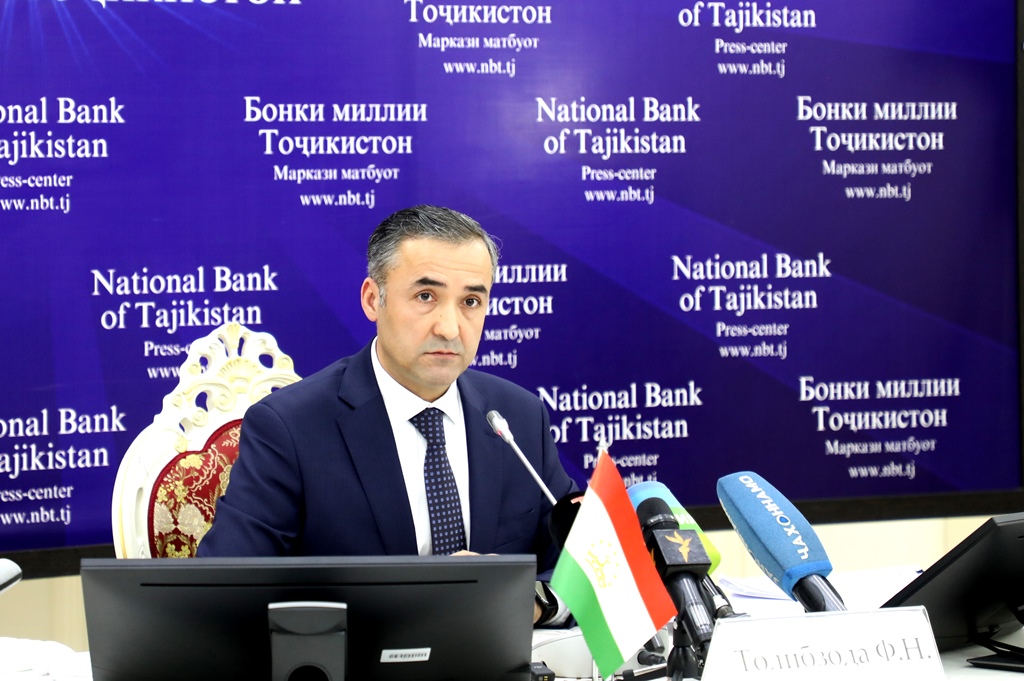
Firdavs Tolibzoda, Chairman of the National Bank of Tajikistan (NBT), has suggested that journalists use the broader term “financial inflows” instead of “remittances.” He made the statement at a news conference in Dushanbe on July 20 while responding to a question about the volume of money entering Tajikistan from abroad.
He said the broader term would be more appropriate, although he did not explain which types of funds it would include or provide data on their volume.
A journalist referred to an assessment by the Eurasian Development Bank, which said remittances continue to support domestic demand and remain one of the factors driving economic growth in Tajikistan.
The journalist asked whether the funds cited by the bank primarily consisted of money sent home by Tajik labor migrants and requested at least general figures on their volume.
According to the EDB, remittances to Tajikistan increased by 5.2% year on year in the first quarter of 2026. In the fourth quarter of 2025, growth had reportedly reached 62%.
Despite the slowdown, the volume of personal transfers entering the country remains close to a record level, the bank said.
The EDB expects remittance inflows to continue supporting domestic demand. Taking this and other factors into account, it forecasts Tajikistan’s economy will grow by 8.3% in 2026.
Tolibzoda said he did not have the requested figures.
“I cannot give you a figure because I do not have the data at the moment. We have also read that review — yes, it exists. But we should gradually change this term, ‘remittances.’ It would be better to use ‘financial inflows’ more often. That would be more appropriate, because remittances are one thing, while financial inflows are a broader concept,” he said.
When asked whether he could provide the growth rate as a percentage, Tolibzoda again said he did not have the relevant data.
What is the difference?
Remittances are funds transferred between individuals. In Tajikistan, the term most commonly refers to money sent by labor migrants to their families.
“Financial inflows” is a broader concept. Depending on the methodology used, it may include personal transfers as well as foreign investment, loans, grants and other funds entering the country from abroad.
Remittances may therefore form part of financial inflows, but the two indicators are not equivalent.
Tolibzoda’s remarks left it unclear which types of funds the National Bank proposes to include under the term “financial inflows” and whether the regulator will continue publishing separate data on transfers made by individuals.
Tajikistan’s dependence on remittances
Tajikistan remains one of the world’s most remittance-dependent economies.
At the end of 2024, the country ranked first globally in terms of remittances as a share of gross domestic product, with the figure estimated at around 45%.
According to data cited in the report, Tajik migrants sent approximately $5.8 billion home in 2024. This was equivalent to almost three-quarters of the country’s total imports.
Remittances are also a major source of income for households. According to the International Bank for Reconstruction and Development, money received from abroad accounts for up to 30% of household income in Tajikistan.
Families spend around 80% of these funds on food and a further 7–10% on healthcare, housing and education.
Remittances support household incomes, domestic consumption, trade and the service sector. They also provide foreign currency and help finance imports.
However, Tajikistan’s heavy dependence on such transfers makes its economy vulnerable to developments in the countries where its citizens work, primarily Russia.
Changes in the ruble exchange rate, demand for labor, migrants’ earnings and migration regulations can directly affect household welfare and domestic consumption in Tajikistan.
Labor migration helps support the country’s economic and social stability, but it also preserves its dependence on foreign labor markets.
Experts have also warned that remittance growth could slow in the coming years.