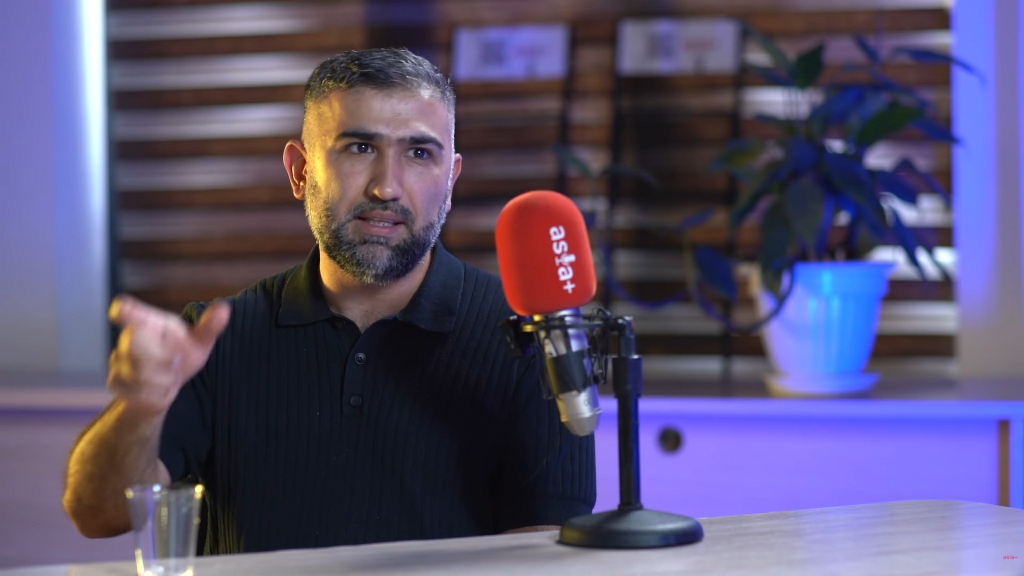
Firuz Zainidini, a practicing marketer and co-founder of the AVVAL marketplace, was a guest on the TajTech project by “Asia-Plus”. They discussed the development of e-commerce in Tajikistan, working with the local audience, the influence of AI, and the experience of participating in the Star Venture startup support program by the EBRD.
— For you, marketing is not so much a profession as a way of life and a worldview. Is that so? How did you come into marketing?
— I got into marketing, like many other stories in my life, by accident. A close acquaintance invited me to work at an advertising agency that had just opened. That’s how I ended up in this field. It was in 2006, and soon it will be 20 years.
Why did marketing become a way of life for me? Because in an advertising agency, you can’t just come to a client and promise something without results. We had to be accountable for everything we said, offered, and tested.
— At the same time, advertising is often perceived by society as lies, deceit, or manipulation. How do you feel about this?
— We had strong role models in the profession. One of them was David Ogilvy, one of the most famous advertisers in the world. We adhered to his approach. He said: “If your wife wouldn’t buy it, don’t advertise it.”
Therefore, in my opinion, advertising should be approached honestly.
— So, is it important in marketing to rely on facts and data? Or is the main thing still to influence emotions?
— In my courses, I always start with the phrase: marketing is evil. Why? Because through this tool, you can do both good and evil.
“
Marketing is also psychology. In my opinion, it is at the intersection of three major sciences. The first is biology, because we are biological beings. The second is psychology. The third is algebra, that is, mathematics.
All these directions intertwine because marketing simultaneously involves numbers, emotions, and human needs.
— You have repeatedly said that “all marketers will go to hell.” Why, if marketing itself is not necessarily a bad thing?
— Because marketing involves psychology. And if a person is well-versed in psychology, they have a tool for influence, including manipulation.
— So, is marketing impossible without manipulation?
— It all depends on how you use this tool. It’s like poison in medicine: it can poison, or it can heal. It all depends on the dose and the purpose of use.
— Besides marketing and its connection with mathematics, biology, and psychology, you have extensive experience in project and team management. How much does this experience help you in marketing?
— It helps a lot. We were not pioneers — the first were those who opened the first commercial companies 25–35 years ago. I rather consider myself part of the second wave of specialists who began to develop this field in Tajikistan. We learned through practice and were, as I say, “many-handed.” We had to be able to do everything. I can work in Corel, Photoshop, write advertising text, come up with a script, and organize filming.
Now there are separate specialists: targetologists, content managers, scriptwriters, producers. But back then, you were just a manager who had to handle the entire process: write a script for a video, find a team, select actors, conduct casting, participate in filming, production, and post-production.
If you look at commercials from fifteen years ago, you can often see me somewhere in the background. If there was a lack of extras, I had to appear in the frame myself.
— How much does such experience help in creatively interpreting advertising? After all, advertising, in my opinion, should be creative.
— Advertising definitely should be creative. And you rightly noted: creativity is a very important part of marketing.
“
But creativity is not an exact science. You never fully know how it will work. I’ve had many cases where I came up with an idea that seemed very strong to me. We analyzed it in a focus group, and it turned out that it just didn’t work.
You can be inspired by an idea and think: “This will definitely work.” But then it turns out that the audience perceives it completely differently. So creativity is important, but in advertising and marketing, a lot can be calculated. You need to rely on numbers, psychology, audience behavior, and tools for influencing brand perception.
Creativity helps to quickly capture a person’s attention, but for me, it is not always the top priority. More important are data, strategy, and the volume of advertising that you can competently launch.
— So, creativity can essentially be imitated?
— Yes, of course. Advertising often works through repetition. There’s a saying: if you tell a person the same thing a hundred times, at some point, they will start to believe it. That’s roughly how advertising and marketing work. Repetition forms recognition, habit, and attitude towards the brand.
Is there a “Tajik marketing”?
— How universal are the laws, rules, and techniques of marketing? Can we talk about the existence of “Tajik marketing”?
— Yes, definitely. Tajik marketing exists.
For example, people here often pay attention to crowds. If there’s a big queue or many people around a place, it sparks interest. A person thinks: if there are many people there, then there must be something important or interesting.
Of course, this technique works not only in Tajikistan, but here it has its own specifics.
“
Another important factor is language. I came across a study that said most people in Tajikistan think and perceive information primarily in the Tajik language. Therefore, many companies make a mistake when they build communication only in Russian.
This is especially true for fashion brands. In pursuit of a certain audience, they may miss a large part of potential customers.
— On the other hand, the Tajik language varies slightly for everyone. This is not scientific data, but rather my personal observations, but in the regions, the language really differs. Often, large brands, when advertising in Tajikistan, use not the living Tajik language, but a literal translation from Russian or English. As a result, phrases appear that no one uses in real life.
— Yes, it depends on the specialists who handle the adaptation. I’ll give an example. About 15 years ago, Snickers came to us with the slogan “Don’t slow down — grab a Snickers.” It was impossible to translate it literally into Tajik.
We discussed options for a long time, and one very strong specialist suggested a successful adaptation: “Sust naku, Snickers khur.” It worked because the expression “sust naku” sounds natural to the Tajik audience. It conveys the meaning of “don’t slow down,” but is not a literal translation.
This is the difference between translation and adaptation. Good advertising should take into account the language, region, familiar expressions, and how people actually speak in everyday life.
— So it’s not that difficult?
— Actually, it is difficult. For quality adaptation, you need a team of specialists who understand the language, culture, and audience well. It’s like with the English language: we can know it and understand the general meaning, but if a precise and lively translation is needed, it’s better to turn to a native speaker.
The same goes for advertising — it’s important that the text sounds natural to the people who will read or hear it.
TOP 7 commercials of all time according to Edpit agency
— Another important aspect of marketing is creating value. You also talk about this in your courses. What does this concept mean to you?
— Creating value means making a product that is truly useful to people. I always ask a simple question: would you buy this product yourself? If the honest answer is “no,” then it needs to be improved. In pitches, people often say: “our product is unique,” “irreplaceable,” “one of a kind.” But the main question remains: are you willing to pay for it yourself?
For example, right now at “Aval,” we are testing a food ordering and delivery service. We first test it on ourselves. If delivery takes an hour and a half — we don’t like it, so the client won’t like it either. If the dish arrives cold — that’s a problem that needs to be solved. That’s why we even measure the temperature of the food: what it was at dispatch and what it was when it arrived at the client.
“
For me, value is when a product is convenient, high-quality, and solves a real problem. If you enjoy it yourself, there’s a higher chance others will like it too.
— What if you are not the target audience for your product? For example, a man produces women’s lingerie — he won’t buy it himself.
— Then you need to find those who will buy it. There are always people around you to whom you can give the product for testing: acquaintances, friends, representatives of the target audience.
— So the first step in marketing is to sell the product to relatives or acquaintances?
— In a sense, yes. But even better — sell the product before it appears.
— Is that even possible? Are there examples?
— Yes, of course. I already told a case about a cleaning company. It didn’t exist yet, but the team pre-sold services a month in advance. They just correctly chose the target audience and called potential clients.
They said: “We have VIP cleaning, all slots for this month are already booked, but we are forming a calendar for next month. Would you like to book?” People left applications, some made prepayments. So they tested the demand even before the launch, then bought equipment and started working.
— That’s definitely one of the reasons to end up in hell?
— Yes, one of the reasons. Now we are launching a burger joint in a similar way: testing burgers, observing people’s reactions, and checking how the product might work.
— So it’s an individual approach?
— Definitely. And here I would like to emphasize: everything I talk about, and even the books I write, is not an attempt to teach anyone. It’s my worldview, my notes, my experience, and observations that I record. Someone might find it useful or inspiring.
But I don’t see it as a way to make a million from a book. For me, it’s just notes and thoughts that I share.
10 funny burger commercials – an example of creative marketing
AI is changing marketing
— Returning to product promotion and value creation: one of the tools of marketing is advertising. But it seems to me that entrepreneurs who turn to specialists like you often confuse marketing with advertising. For them, it’s the same thing. Or is there now an understanding that these are different things?
— If we talk about the situation 20 years ago, many didn’t understand the difference at all. 10 years ago, only a few began to understand it. Now, there are noticeably more entrepreneurs who differentiate between marketing and advertising.
“
Advertising is just one of the tools of marketing. In marketing, there are different stages: you need to understand the product, the audience, the value, the positioning, the promotion channels — and only then move on to advertising. But many still want to start with promotion right away: launch ads, make banners, videos, promotion. Meanwhile, the product itself or a clear service may not yet exist.
For hypothesis testing, this approach sometimes works. But if we talk about fundamental business, starting with advertising is not always right. First, you need to build the product itself and its value for the client.
— How much time is needed for entrepreneurs to better understand marketing? And which model is more effective: having your own department or outsourcing?
— In the next five years, the model will change significantly. Marketing will move towards “smart agencies” operating on the basis of artificial intelligence. There will be fewer classic specialists, and prompt engineers — people who understand marketing and can correctly set tasks for AI — will become more important. Companies that start implementing AI now, work with data, and quickly test solutions will win. Large marketing departments will likely no longer be as necessary.
— AI can change not only the work of agencies but also consumer behavior. If one AI agent sets up advertising, another can help a person choose and buy goods. How will this affect marketing?
— I think in the next five years, the market will reach a new balance. AI is already starting to behave almost like a human: analyzing, making decisions, sometimes making mistakes. The main advantage will be for those agencies that correctly assemble and configure their databases: on consumers, the market, media, and advertising channels. Without data, AI will not be able to work effectively. In Dushanbe, there are already at least two agencies developing such “smart” advertising systems. They use data, analyze the market, and form advertising solutions based on it.
— So this is already working here?
— Yes, it’s already working. At least two agencies are engaged in this.
— So, some AI agents will sell, and others will buy?
— Yes, that’s quite a logical next step. Previously, to launch an ad, you had to go to an agency, sign a contract, calculate the budget. Then social networks appeared, where you can launch an ad with one button — for example, through Boost Post. The next step is when an AI agent can do everything itself: determine the audience, select media channels, create creatives, launch ads, and pay for promotion with an authorized card. So marketing will become even more automated.
— So AI can replace marketers and marketing departments in companies?
— I think this is already a reality.
— So a business doesn’t necessarily need to hire a marketer — it’s enough to set up its AI agent once?
“
— It all depends on the needs of the business. Of course, for some time, there will be a habit of managers personally intervening in marketing: asking to see creatives, texts, approving every detail. But over time, I think this will also fade away.
Through practice and experiments
— Speaking of your project Aval.tj: how did this idea come about and what are you striving for?
— Initially, we wanted to develop an e-commerce ecosystem based on Babylon-Mobile. We gathered market participants and offered them to launch marketplaces, food delivery, online pharmacies, online stores. We said: this is the future. But many were skeptical.
The question often arose: if it’s so promising, why don’t you launch it yourself? As a result, our team decided to create our own marketplace — as an example that such a project can be launched in Tajikistan. The idea was to provide entrepreneurs, for example, sellers from “Korvon,” with a platform for online sales. But the market was not ready then: people were afraid, didn’t know how to work in e-commerce, there were many barriers.
“
Today, our task is to make the service as convenient as possible for the user, so they can receive goods within an hour, at most two. We constantly test hypotheses, simplify processes, see what works, draw conclusions, and move forward. Aval.tj is not a franchise, but a Tajik startup that develops through practice and experiments
— How is Aval.tj related to the hybrid sales model you often talk about? What is it and how do they complement each other?
— Many business owners mistakenly believe that a marketplace will solve all problems. In fact, a marketplace is just one of the sales channels. Roughly speaking, it’s the same “bazaar,” only in digital space. A product can be sold on “Korvon,” on a marketplace, on Instagram, and through its own offline point. Hybrid sales are when a business uses several channels at once: offline, online, marketplaces, social networks, and other platforms. For digital sales, a quality photo, description, and price of the product are often enough.
We still have an Eastern mindset: if there is a physical space, then there is a business. But digital space is also a full-fledged place for trade. The market is currently in a transitional stage. Therefore, it’s important not to choose between offline and online, but to combine them. The hybrid model helps a business gradually transition into the digital environment without losing old sales channels.
— How well has this idea been conveyed to the audience? You said the market needs evolution. But if we compare it to biology, evolution often occurs through the survival of some and the disappearance of others. Will it be the same in business?
— Yes, most likely, that’s how it will happen. In the next three years, many projects that are actively developing now may close, be reborn, or transform into other businesses. But for the evolution of the market, not only time and mistakes are needed, but also money. Unfortunately, local players don’t have the resources to educate the entire market and change the behavior of millions of consumers. This role can be played by large players — Wildberries, Ozon, AliExpress, and others. If they enter our market and invest in it, they will start changing consumer habits and accelerate the development of e-commerce in Tajikistan.
— There is currently noticeable growth in cargo companies delivering goods from China, including from Chinese marketplaces. Despite the language barrier, people actively use them because the goods are significantly cheaper there. How ready are local marketplaces for such competition?
— Here, it all comes down to user experience. The buyer makes a choice: pay less but wait longer, or pay more but get the product faster. The first model is used by Chinese and Russian marketplaces. People are willing to wait if the price is significantly lower.
But it’s important to understand: local marketplaces in Tajikistan often sell the same Chinese products. The difference is that the product is already inside the country — in warehouses or with sellers. Therefore, their advantage is speed. If a person needs a product quickly, they are willing to pay more. If it’s not urgent, they can order directly from China and wait. This is how competition will be built: price versus delivery speed. Most of the mass market is still produced in China, the question is just where the product is at the time of purchase.
AVVAL, Star Venture, and the hybrid model of the future
— Avval.tj is participating in the Star Venture program of the European Bank for Reconstruction and Development. What does this give the project?
— It was a surprise for us to get into this program because the competition was strong: only five companies were selected from all participants. Star Venture gives us access to networking, experts, and consulting support. The program helps to address specific business tasks — from developing a mobile app to marketing, market analysis, and finding partners. In addition, the EBRD can finance business trips if they are important for the project’s development. This is a very powerful tool, the main thing is to use it correctly.
— How are you already using these opportunities?
— We have traveled twice with the team to Dubai, where we established partnerships and sought additional investments. We also visited an exhibition in Turkey, found partners for clothing, and are now setting up processes to deliver goods from Turkey to Tajikistan in one or two days, instead of waiting for months. This is especially important for us because the Tajikistan market is small. Therefore, we are looking more broadly — at Central Asia and products that may be of interest to the entire region.
— Is it mainly clothing?
— Yes, clothing. But we are not building a marketplace “for everything.” We have a different concept: we choose specific niches and work specifically with them.
— How has participation in Star Venture influenced the strategy of Avval.tj? Have there been changes in the project’s vision?
— Yes, there were important meetings with analysts, and they gave us valuable feedback. One of the main pieces of advice was not to remain just a marketplace, but to expand the ecosystem. For example, to develop separate directions: delivery, medicine, food, and other services. We are now gradually moving in this direction.
— So it will not be one big super app, but an ecosystem of separate applications?
— Yes, exactly an ecosystem. We believe that different directions are better developed through separate solutions. We are currently refining the application.
— What would you advise new participants of Star Venture? What should they pay attention to during the pitch?
“
— The main thing is that the startup should solve a real mass problem. The more people face this “pain,” the stronger the idea. Secondly, the project should be scalable. You need to show how it can grow and what value it can create in the future. During the pitch, it’s important not just to beautifully present the idea, but to prove: there is a real problem, and your product truly solves it.
— You mentioned that Avval is a marketplace, but at the initial stage, the project is not about profit. Then why was it launched?
— Initially, the idea was to create a demonstrative project and prove: e-commerce can be developed in Tajikistan. A marketplace is a complex field. It requires large investments, infrastructure, experts, and a strong team. We were the first to decide to enter this direction and show other companies that it is possible to go there. Now we already see that after us, new marketplaces have appeared, attracting investments and developing.
For us, the main goal is not just to be a marketplace, but to build an ecosystem. Money in the future should come through it. At the same time, we realistically look at the market. We don’t have the idea of becoming marketplace No.1 at any cost. It’s important to understand your niche, your market volume, and develop the project sustainably.
What awaits Tajikistan’s trade?
— Is the main problem of marketplace development the lack of infrastructure? Or are there other reasons: legislation, population readiness, internet access?
— It’s a complex of problems, not just one reason. But the trend is positive: people are already ordering goods through Instagram, marketplaces, and other online platforms. My dream is for digital trade to reach not only cities but also villages. So that a person in any kishlak can order the necessary product and receive it, regardless of where they live.
— Can there be not only competition but also cooperation between marketplaces? For example, when people order goods from China cheaper, bring them here, and sell them through local platforms.
— Yes, this is already happening. Such people are called buyers. In Uzbekistan, for example, there are already entire communities of buyers working with specific niches: diapers, sneakers, clothing, and other goods. They buy goods, bring them, and sell them on the local market. I think a similar evolution will gradually occur in Tajikistan.
— So this is a real scenario that can already be observed?
— Of course. There are already teams of buyers who have occupied specific niches — for example, household chemicals, cosmetics, masks, and face creams. There are many such directions, and there are still free niches.
— You mentioned your book “Wake Up.” Who do you want to awaken with it?
— The idea is very simple. When you enter sales departments, you often see tired, “sleepy” employees. I always want to say: “Guys, wake up!” That’s how the book’s title came about. Its main message is to wake up, start acting, and selling. The market is ready, there are many opportunities, you just need to use them.
— Why does the world need another book about marketing?
— This book is not exactly about marketing. Rather, it’s my notes on life, business, sales, and people. In 17 years of working in marketing, I’ve seen different companies from the inside: some grew, some closed, some made the right moves, and some made unnecessary mistakes. I just recorded these observations for myself. That’s how the book came about.
— So it’s not a book about “successful success,” where only successful cases are analyzed and everyone is encouraged to repeat them?
— No, I’m actually against “successful success.” I don’t teach people how to quickly become millionaires, and I don’t believe in such promises. For me, work, experience, mistakes, and real actions are more important. Of course, there are people who were in the right place at the right time and changed the market. But for most, success is not magic, but daily work. I don’t like info-gypsyism and phrases like: “Today I will teach you how to earn a million.” If I knew exactly how to earn a million, I wouldn’t sell this secret, I would use it myself.
— How do you see the market for marketplaces, marketing, and e-commerce in Tajikistan in the next five years?
— I won’t speak for the whole world, it’s better to talk about Tajikistan. I think in the next five years, marketplaces will penetrate the lives of most of the population. More than 80% of people will use them and order goods at least once a week. Also, I am sure logistics within the country will develop significantly. The main part of the goods will still be from China because China is only increasing production and supply rates.
At the same time, the usual model of bazaars and shopping centers will begin to change. Shopping centers will likely become more entertainment spaces. Bazaars will still remain because we are Eastern people, and for many, going to the bazaar is part of the culture.
— Does this also depend on the development of payment systems?
— Payment systems are already developed here. The question is rather that their usage level is still lower than expected.
— Do you think the attitude towards digital goods — music, online books, movies — will change? Now people are more often willing to pay for a physical product they can receive in hand than for a digital product.
— I think there are several reasons here. The first is consumer habits. The second is legislation and the availability of free content. As long as a person can download a movie, music, or book for free, they often see no point in paying. Especially if there are torrents and other open sources.
But the situation will change as the quality content in the Tajik language grows. When services officially offering Tajik films, music, or books appear, there will be interest in protecting this content.
For example, the online cinema “Kino Plus” has launched, positioning itself as the first Tajik online cinema. As far as I know, they have signed agreements with “Tajikfilm,” “Sugdsinamo,” and other rights holders. If entrepreneurs invest money in such a service, they will be interested in protecting the content and developing the legal market.
— So it’s primarily about Tajik-language content?
— Yes, primarily. But most likely, such platforms will have not only Tajik but also foreign films. The main thing is that the content is officially placed and can be paid for legally.