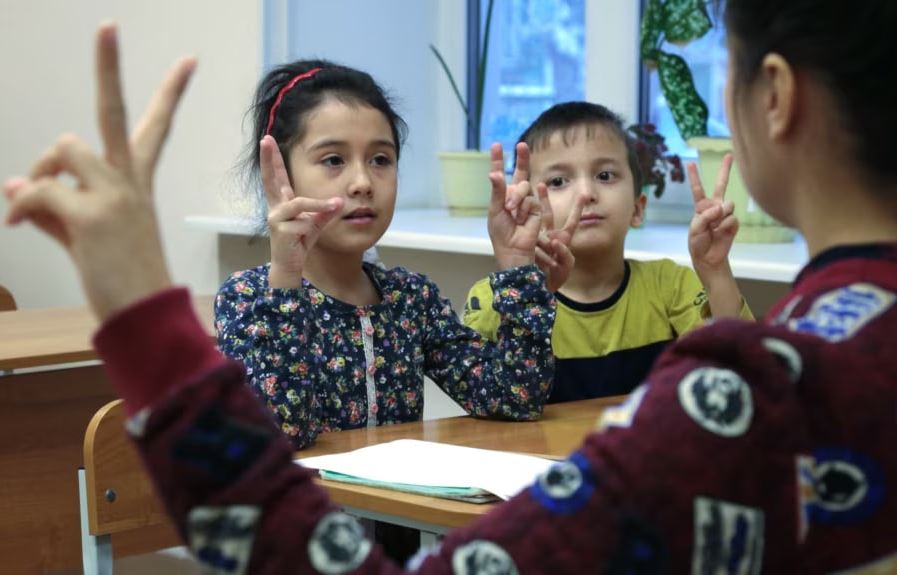
As the new school year approaches, Central Asian migrant families face a difficult choice: bring their children to Russia and risk them being denied admission to school under stricter Russian-language requirements, or leave them with relatives at home.
When Rahmat travels to Russia for work in August, he plans to take his two children, aged seven and nine, with him. They have spent several months preparing to attend school in Russia, according to a report by Azattyq Asia.
“My wife hired a teacher from our village to tutor the children. They also watched Russian television channels to improve their language skills before the move,” said Rahmat, who asked for his surname not to be published.
Before they can enroll in a Russian school, his children will have to pass a mandatory language test.
“I have permanent residency in Russia and want my family to live with me. But I’m afraid that if my children fail the exam, I’ll have to send them back to Tajikistan to live with their grandparents,” he told Radio Free Europe/Radio Liberty.
Rahmat’s concerns reflect a wider problem facing Central Asian migrants in Russia.
Ahead of the new school year in September, parents are deciding whether to take their children to Russia or leave them at home because of fears that they may not meet the new admission requirements.
Foreign pupil numbers fall
Russia introduced stricter rules for admitting migrant children to schools in April 2025. Foreign pupils must now pass a Russian-language test and provide documents confirming their legal status in the country.
The impact was immediate. According to Russia’s Education Ministry, the number of foreign children attending Russian schools fell by around 44,000 during the 2025–2026 academic year.
Children from Central Asia account for the largest share of foreign pupils. In the previous school year, Russian schools enrolled about 48,000 children from Tajikistan, 22,000 from Uzbekistan and 19,000 from Kyrgyzstan.
Russian government data show that the total number of pupils from the three countries fell by 27% over the year, from 122,000 to 89,000.
Millions of Central Asian citizens live and work in Russia, which has remained the region’s main destination for labour migration for decades because of limited employment opportunities at home.
Russian officials say the new rules are intended to support educational standards and help foreign children integrate into schools.
Human rights groups and education specialists, however, argue that the language and documentation requirements prevent many children from receiving an education. They also say the rules are separating migrant parents from children who must remain with relatives in their home countries.
The changes come amid growing pressure on Central Asian migrants in Russia, including legal restrictions, discrimination and violence.
Anti-migrant sentiment intensified after the March 2024 attack on the Crocus City Hall concert venue near Moscow, which killed around 150 people. Russian authorities accused several Tajik citizens of carrying out the attack, which was claimed by Islamic State-Khorasan.
Pressure on schools in Tajikistan
Tajik Education Minister Rahim Sayedzoda previously said that around 9,000 children who had been unable to enroll in Russian schools had returned to Tajikistan.
Some remained outside the formal education system for several months after returning, he said.
The arrival of returning pupils has also placed additional pressure on Tajikistan’s already crowded schools.
Anvar, a resident of Bokhtar, the capital of Khatlon province, said his daughter’s classroom became overcrowded last year. Instead of two pupils sharing a desk, three children were seated together.
“When I asked the teacher what had happened, she said several children had returned from Russia and there was not enough space for everyone,” Anvar said. “She told me they were working to solve the problem.”
Kyrgyzstan develops alternatives
Migrant families from Kyrgyzstan face similar uncertainty.
The Kyrgyz Education Ministry has not disclosed how many children returned from Russia over the past year after failing to enroll in schools there.
However, the ministry told RFE/RL on July 28 that more than 140,000 children whose parents work abroad were currently attending schools in Kyrgyzstan.
The government has also approved a five-year program aimed at encouraging Kyrgyz labour migrants to return home. It includes employment assistance, vocational training and social support.
Kyrgyzstan is developing distance-learning options for children who cannot attend school in person. The state-run online school Tunguch was launched as a pilot project in 2025 for children of Kyrgyz citizens living abroad.
Around 2,540 pupils were enrolled during the 2025–2026 academic year.
Despite the uncertainty, Russia remains the preferred destination for families such as Rahmat’s.
“Yes, there are many problems in Russia, but we do not have better alternatives at home,” he said.