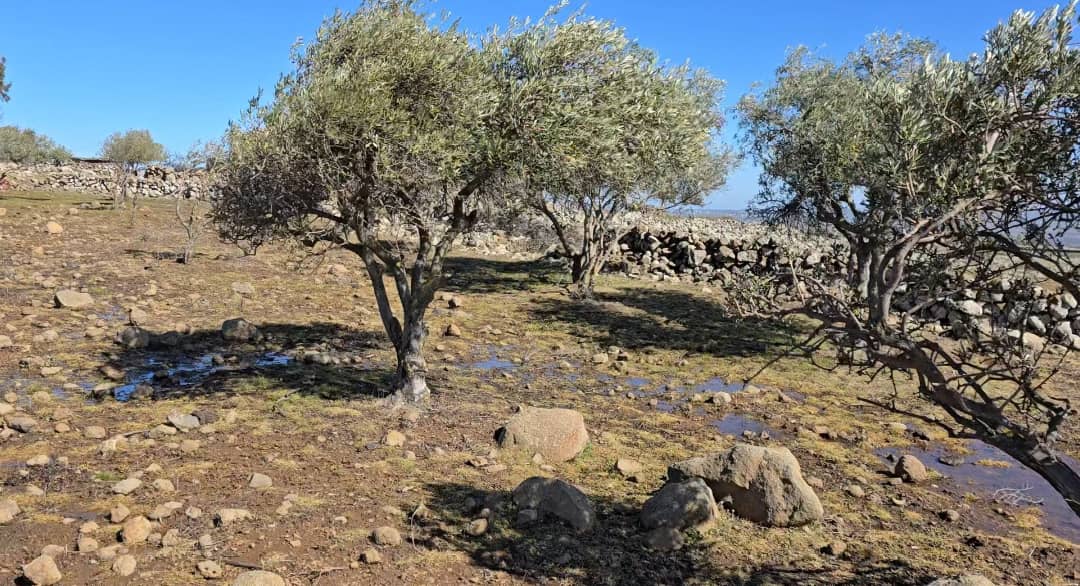
QUNEITRA/PARIS — All that once grew on Abu Taha’s 200 dunums (200,000 square meters) of farmland and pastures has yellowed and died, after Israeli aircraft sprayed large areas of Syria’s southern Quneitra province with herbicides at least three times in late January.
Abu Taha, who is in his 60s, farms and raises livestock in al-Rafid, a village just meters from the border between Syria and the Israeli-occupied Golan Heights. His home lies within the once-demilitarized buffer zone between the two countries, which Israel invaded and occupied when the Assad regime fell in December 2024.
On January 25, 27 and 30, Abu Taha watched as Israeli planes flying at a low altitude sprayed the land with unknown substances. It was not his first encounter with the country’s forces.
Several months ago, Israeli forces shot Abu Taha in his foot while he was grazing his sheep near al-Rafid. His 14-year-old grandson was also detained for four days. For more than a year, the occupying forces have regularly fired on herders, carried out arrests and raids and bulldozed farmland in border regions of Syria’s Daraa and Quneitra provinces.
“Not content with preventing us from grazing our sheep and shooting at us, the Israeli occupation sprayed our land with chemicals,” Abu Taha told Syria Direct.
The spraying, which extended from the Quneitra villages of Taranja and Jubata al-Khashab in the north to Saida in the south, damaged land belonging to 297 farmers, Muhammad Rahhal, who heads the Quneitra Agricultural Directorate, told Syria Direct. The affected area included 937 dunums of crops, 2,891 dunums of pastures and 855 dunums of fruit trees.
An analysis of three independent spectral vegetation indices, using data from the Sentinel-2 satellite, shows a simultaneous decline in vegetation cover in the Quneitra village of Kudna over the weeks after herbicides were sprayed.
The normalized difference vegetation index (NDVI), a measure of plant health and density, fell from 0.47 on January 19—showing winter vegetation was in good condition before the spraying operations—to 0.34 on February 8 and 0.15 on February 13.
The advanced vegetation index (AVI) and soil-adjusted vegetation index (SAVI) show a similar trend, bolstering evidence that the decline is an actual change in plant activity, not merely an effect of soil exposure or atmospheric disturbance.
The Syrian Ministry of Agriculture analyzed water, plant and soil samples taken from the affected areas, but did not specify the nature of the substances detected in its February 11 statement announcing the results, raising questions about what herbicides were sprayed and what their long-term effects could be.
Israeli forces conducted similar spraying operations in southern Lebanon over the same period. Laboratory tests there confirmed the use of highly concentrated glyphosate, which directly damaged crops and soil fertility, according to Lebanese government statements.
Plants growing on agricultural land in the southern Quneitra village of al-Isha yellow and dry in an area sprayed with herbicides by Israeli aircraft, 4/2/2026 (Syria Direct)
‘All the land turned yellow’
Israeli agricultural planes continued spraying herbicides for hours in Kudna and the surrounding Quneitra countryside this past January, recalled Abu Zeid, a farmer and livestock breeder from the village. “The planes sprayed a sticky white substance for around six hours, at a low altitude, over our houses, pastures and lands,” he added.
The effects of the substance did not appear until three days later, especially as rain fell. Grasses and crops gradually yellowed, until “all the land turned yellow, as if it were summer,” Abu Zeid said.
As a result, Abu Zeid lost 17 dunums of wheat, seven dunums of barley and six dunums of vetch, used as feed for his livestock. He estimated that around 3,000 dunums in all, including grazing areas, were damaged.
To protect his sheep from eating grasses sprayed with herbicides, Abu Zeid had to confine them inside his house and buy feed at elevated prices, before finally being forced to sell a large portion of his flock to be able to keep and care for those who remained.
Abu Taha, in al-Rafid, sold all his livestock because he could not afford to buy alternative feed. “We lost everything,” he said. “I put all the grain I have in the ground this season, and have nothing left to plant next year. We don’t know if anything will grow after these herbicides.”
During the same period, some of Abu Taha’s sheep were infected with the ovine rinderpest (PPR), a contagious disease that affects sheep and goats, and died as a result, though no link was clear between the illness and the spraying.
A comparison of NDVI images of the Kudna area from January 19 and February 18, 2026 show a striking change in lands west of the village. This area has turned from dark green—reflecting healthy plant activity—to light green, indicating a sharp decrease in vegetation density.
Reacting with the rain
Three Quneitra farmers told Syria Direct the effects of the materials sprayed by Israeli forces did not appear immediately, but on the third day, after rain fell. “The plants began to yellow with the first rain,” Hassan Saaduddin Ahmad, from the village of Jubata al-Khashab, said.
“The more rain fell, the more its effect increased, the more the plants yellowed and burned,” Ahmad added. The material sprayed by the planes adhered to the stones, soil and plants, and slowly dissolved with the water, severely burning leaves, he said.
Ahmad and a number of his neighbors took a small stone and tried to wash it with water, but noticed “the chemical dissolved very little and slowly, which means its effectiveness will continue after every rainfall,” he added.
Alongside total losses of wheat, barley, lentils, lupine beans and vetch in the areas that were sprayed, the leaves of olive trees showed signs of yellowing, Ahmad said. He personally lost 50 dunums of winter crops.
Herbicides work by “disrupting the physiological structure of the plant, which can be compared to blood vessels in the human body that transport raw materials to a manufacturing area or organ, then transfer the nutrient in its absorbable form to the body or organ that will use it,” explained Mwaffak Chikhali, a natural resource management consultant and general manager of a regional environmental consulting firm.
“Herbicides destroy the nutrient transport network, whether for raw materials or compounds produced during photosynthesis, leading to the plant’s death from lack of water and nutrients,” Chikhali told Syria Direct.
White dots cover plants and grasses hours after they were sprayed with herbicides by Israel in pastures near Quneitra’s Kudna village, 25/1/2026 (Syria Direct)
What was sprayed in Quneitra?
Syria’s Ministry of Agriculture explained the results of its soil, water and plant analyses last month without releasing the test results or disclosing the nature of the herbicides sprayed in Quneitra.
“All samples were non-toxic, according to approved acute toxicity tests,” the ministry said in its statement, adding “no harmful organic materials were found in the water samples, according to the analytical methods used.” It did note traces of herbicides found in some plant samples.
“Plant and soil samples taken after receiving complaints from people showed the presence of two types of agricultural herbicides: 2,4-DB [dichlorophenoxybutyric acid] and Diuron,” said Rahhal, from the Quneitra Agricultural Directorate.
Used to control broadleaf weeds and grasses, 2,4-DB is a powerful agricultural herbicide that inhibits photosynthesis, leading to the yellowing and death of the plant, Rahhal explained. “It can have a severe impact on olive trees, causing stunting, leaf drop and deformities,” he added. The herbicide also affects wheat spikes and reduces their productivity.
“The spraying came at the start of wheat emergence and tillering—an important phase in the plant’s growth—leading to widespread yellowing and leaf burn,” he added.
As for Diuron, it is a systemic herbicide that inhibits photosynthesis, causing plants to yellow, burn and die, Rahhal added. Its use in wheat fields is prohibited because of its lethal effect on the crop, and it also affects olive trees and weakens their roots.
According to the Safety Data Sheet (SDS) that typically accompanies herbicides, “the mode of action differs between glyphosate [the herbicide sprayed by Israel in Lebanon] and Diuron,” Chikhali said. “The former is a broad-spectrum, systemic herbicide that kills weeds from the roots,” whereas Diuron “is a systemic herbicide that is more selective toward broadleaf plants, and works through the roots and soil to inhibit photosynthesis.”
Glyphosate easily dissolves in water, with a “solubility of around 10.5-11.6 grams per liter at a temperature of 20 degrees Celsius, which makes it an effective systemic herbicide that is easy to mix with water for agricultural spraying,” he added.
Diuron is “less soluble in water, with a solubility of 42 milligrams per liter, and therefore is more persistent,” Chikhali explained. “It acts as a broad-spectrum herbicide (before and after emergence) and algaecide, and its effects persist in the soil. Given its low solubility, there are risks of slow leaching into water sources,” he said.
Glyphosate breaks down in the soil over a period ranging from a few days to several weeks, as “the average half-life is between three and 130 days,” decomposing more quickly in warm, moist soils though it “may persist for months in cold or dry conditions,” Chikhali said.
Diuron, by contrast, has a half-life of around 30 days in aquatic systems and between 133 and 212 days in fields, though this may reach up to 328 days. “It is thus considered a relatively prolonged and stable pesticide,” he added.
“The safety procedure card for both glyphosate and diuron indicates the possibility of a carcinogenic effect, and they also have local toxicity risks to the eyes and mucous membranes,” he said.
Based on photos and videos of the spraying operations and the herbicides’ effects on crops in Quneitra, “it may be that what was used is a mixture of the two compounds, as the effect of yellowing after a few days points to glyphosate, while local farmers’ accounts of the herbicide adhering in granular form to the rocks and slowly dissolving in water points to Diuron,” Chikhali said.
“Farmers and residents should avoid direct contact with herbicide residues left on rocks, if present,” as “according to the specifications of both pesticides, factors such as heat, humidity and soil bacteria are sufficient to break them down over time,” he concluded.
Additional reporting by Ahmad Abu Ali.
This report was originally published in Arabic and translated into English by Mateo Nelson.