Syria’s Ministry of Finance has released its first-half 2026 budget report, showing public revenues rising to $2.7 billion — an increase of 111 percent compared with the same period last year. Yet spending grew far faster, surging 331 percent to $3.7 billion, leaving the government with a fiscal deficit exceeding $1 billion in just six months.
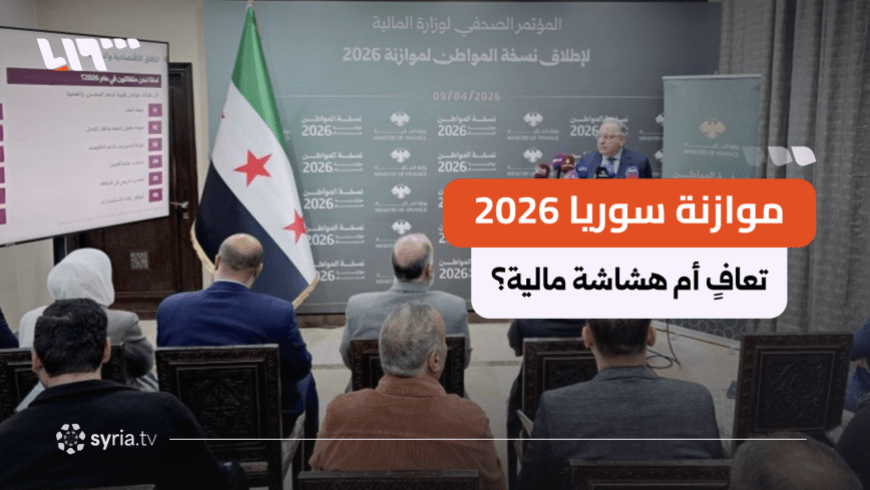
Finance Minister Mohammad Yusr Barnieh announced the figures during the launch of the Citizen’s Guide to the 2026 Budget in Damascus. According to the report, monthly public expenditures averaged $617 million, driven primarily by salaries and wages, which accounted for 36 percent ($1.34 billion) of total spending. Administrative costs reached $1.03 billion, investment expenditures $1.02 billion, and social subsidies $315 million.
On the revenue side, customs duties remained the government’s most significant income source, generating $1.1 billion — roughly 40 percent of total revenue. State investments contributed $763 million, while oil and gas revenues totaled $601 million. Direct and indirect taxes made up only 9 percent of income, or $252 million. The ministry projected that total revenues could approach $8 billion by year-end, noting that tax collections typically rise in the second half of the year.
Economic analysts offered mixed interpretations of the data:
- Structural Imbalance: Economist Radwan al-Dibs observed that for every $100 in revenue, the state spent $137. He warned that the government’s dependence on customs duties creates a structural bias toward an import-heavy economy, rather than expanding domestic production and the tax base.
- Fiscal Fragility: Economist Mohammad Oulabi argued that customs duties function as a regressive consumption tax, pushing up prices for a low-income population. He noted that 64 percent of total spending went to administrative operations and civil-service payrolls, rather than long-term capital investment or social protection.
- Transparency Concerns: Both analysts highlighted gaps in the ministry’s summary, including the absence of sector-specific spending details, unreleased baseline budget targets, and vague explanations of how the $1 billion deficit was financed — beyond references to short-term investment instruments maturing within a year.
Looking ahead, analysts stressed that Syria’s central fiscal challenge in the second half of 2026 will be shifting away from emergency customs-based revenue toward a sustainable, production-driven tax system capable of supporting long-term economic stability.
This article was translated and edited by The Syrian Observer. The Syrian Observer has not verified the content of this story. Responsibility for the information and views set out in this article lies entirely with the author.
The post Syria’s Mid-Year 2026 Budget Report Shows Sharp Revenue Gains but a $1 Billion Deficit first appeared on The Syrian Observer.