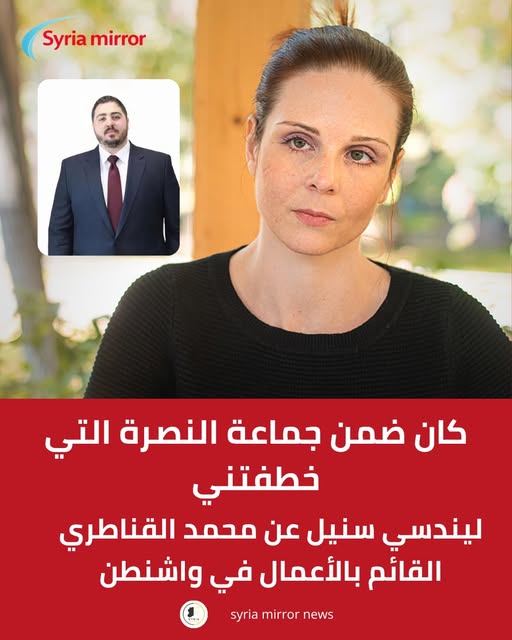
Mohammad Qanatri, the newly appointed Chargé d’Affaires at the Syrian Embassy in Washington, is facing renewed scrutiny after American journalist and filmmaker Lindsey Snell alleged that he was part of the al-Nusra Front unit that abducted her in northern Syria in 2016.
Snell released archival footage from an interview she conducted with Qanatri shortly before her kidnapping. In the video, he appears masked in front of an al-Nusra Front flag, discussing the group’s objectives and distinguishing its ideology from that of ISIS. Al-Nusra Front, at the time, was the Syrian branch of al-Qaeda and is responsible for extensive violence and human rights abuses.
Snell says she first encountered Qanatri in July 2016, when the group seized her in rural Aleppo. Although he insisted on covering his face during the interview, she later identified him by his voice, eyes, and manner of speech.
In the footage, Qanatri outlines al-Nusra’s aim to establish an Islamic state governed by Sharia law. In the years that followed, he moved into the political affairs wing of Hay’at Tahrir al-Sham (HTS), the successor organization to al-Nusra, and later held positions within the Salvation Government and the Ministry of Foreign Affairs. He was appointed Chargé d’Affaires in Washington in early 2026.
Three Days Before the Abduction
Snell entered Syria in mid-July 2016 on her seventh reporting trip since 2014, intending to document the impact of Syrian and Russian airstrikes on civilians, medical facilities, and rescue workers in the Aleppo and Idlib countrysides.
She stayed with the Thuwar al-Sham faction in Kafr Halab, a town in western Aleppo province where al-Nusra exercised dominant security control. Her fixers had secured prior approval from al-Nusra for her entry and filming, giving her an initial sense of safety.
Over three days, Snell filmed inside hospitals, interviewed doctors and rescue teams, and spoke with children wounded in airstrikes. During this period, she recorded the masked interview with Qanatri.
On the night of July 20, al-Nusra forces arrested her Syrian media assistant and began searching for her. Thuwar al-Sham fighters attempted to hide her in a nearby home, but al-Nusra checkpoints blocked every route out of the town.
About an hour later, roughly ten armed men arrived at the house and took her into custody. The unit was led by an Iraqi commander known as “Abu Taroub,” who accused Snell of working with U.S. institutions and ordered an investigation into her for alleged espionage.
Detention, Transfer, and Escape
Snell was initially held in an isolated safehouse, where interrogators questioned her about her reporting, her religion, and her contacts inside Syria. A week later, she was moved to a cave-like prison and held in solitary confinement for two days.
As fighting intensified around Aleppo, her captors relocated her to a house where the wives and children of al-Nusra fighters were living. Snell gradually earned the trust of several women and managed to use their mobile phones to contact her husband and coordinate an escape.
She arranged a pickup with a contact linked to the Ahrar al-Sham faction, who agreed to meet her on a nearby road with a motorcycle. To create a plausible pretext for leaving the house, Snell released a cat she had been caring for; if guards questioned her absence, she planned to claim she was searching for the animal. She then fled through an olive grove for about ten minutes to reach her contact.
After hiding near the Syrian-Turkish border for two days, Snell crossed into Türkiye, where she was arrested on August 6 for entering a restricted military zone. She spent 67 days in Turkish custody — including 17 days in solitary confinement — before being deported to the United States on October 12, 2016.
Questions Over Diplomatic Vetting
The release of the footage has revived concerns about the pathways through which individuals formerly affiliated with al-Nusra Front or HTS have transitioned into official or diplomatic roles without public disclosure of their past activities.
Neither Qanatri nor the Syrian Embassy in Washington has commented on Snell’s account. Snell says she plans to release a second instalment of the video containing additional footage from her 2016 interview.
This article was translated and edited by The Syrian Observer. The Syrian Observer has not verified the content of this story. Responsibility for the information and views set out in this article lies entirely with the author.