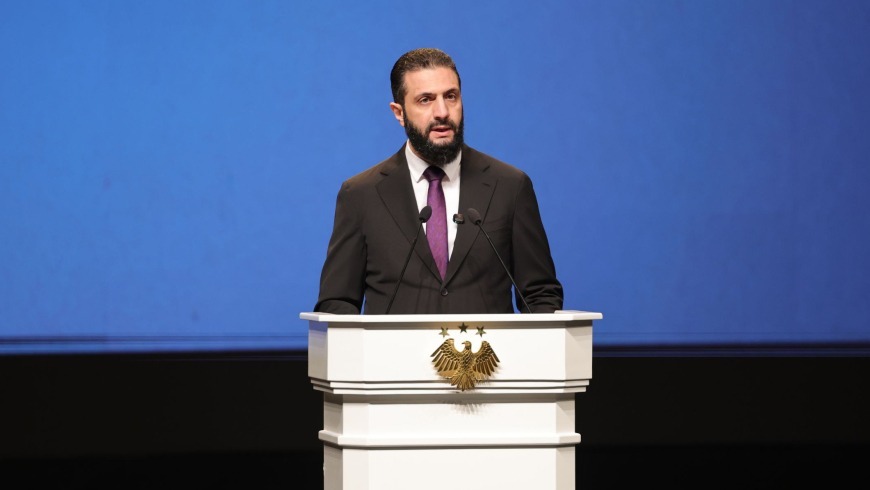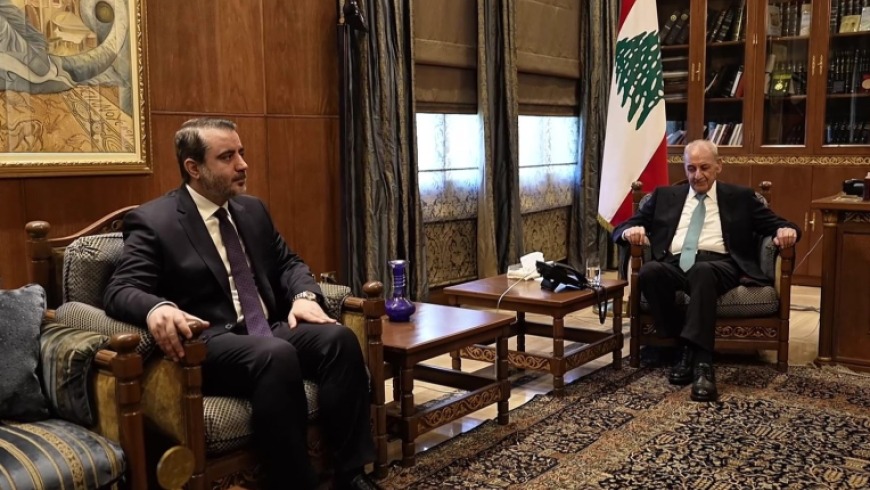
Syrian Foreign Minister Assaad Shibani is breaking with decades of entrenched patterns in Syrian-Lebanese relations. From the moment he arrived in Beirut, the tone of the visit appeared different — in both form and substance. The language was one of mutual respect, cooperation, and shared interests, far removed from the vocabulary that once defined the relationship between the two countries.
This was not a protocol visit, nor a tightly choreographed round of meetings. There were no visible red lines, no restrictions on whom he could meet, and no hesitation to engage with any political actor when the moment required it. From the president to the prime minister and the speaker of parliament — and through a wide array of political forces — Shibani’s schedule expanded to include nearly every major Lebanese player, with the notable exception of Hezbollah, an exception that may not hold if circumstances shift.
What Damascus seems intent on signaling is that Lebanon is not confined to two rigid political poles. There is a broader space — long neglected — that Syria now wants to explore.
A New Approach: Politics Instead of Security
The significance of the visit lies not only in breaking the ice or easing mutual anxieties. It reflects an emerging attempt to redefine Syria’s role in Lebanon. This time, the approach is political, diplomatic, and institutional — not the security-driven or military-backed influence that shaped the relationship for years.
The message distilled from the visit is clear: Syria is trying to return to Lebanon through official suits, not military uniforms.
This shift appears rooted in a different reading of Lebanon’s internal landscape. For years, the Lebanese crisis was framed as a binary confrontation: one camp anchored in a cross-border “resistance” project that transcends national identity, and another seeking to avoid war and pursue political compromise at almost any cost. Over time, this duality hardened into the lens through which most Lebanese crises were interpreted.
Damascus now seems to be saying that Lebanon is not limited to these two options. There is room for alternative approaches — ones that do not rely on one side eliminating the other, but instead aim to produce a political formula capable of absorbing Lebanon’s contradictions rather than amplifying them.
Revisiting Taif — Not as Scripture, but as a Framework
For this reason, political conversations behind the scenes increasingly reference the foundations of the Taif Agreement — not as a sacred text, but as the only framework that managed, despite repeated shocks, to organize Lebanese political life for more than three decades. Whether such ideas are viable remains uncertain, but Shibani’s visit has undeniably revived debate over the future of Lebanon’s political system.
Regardless of immediate outcomes, the visit appears to be an attempt to open a new page with Lebanon’s political actors — a page built on dialogue rather than alignment, and on searching for political solutions rather than managing or postponing crises.
Shared Crises, Shared Stakes
Between Syria and Lebanon lies far more than a border. Their relationship carries a long history of convergence, friction, mutual influence, and periodic misunderstanding. Today, both countries face similar pressures: porous borders, economic crises, competing regional projects, an adversary with clear expansionist ambitions, and the constant risk of sliding into confrontations whose consequences neither side can fully control.
In this context, Shibani’s visit is less about immediate agreements and more about presenting a different image of the role Syria wants to play in Lebanon.
A Different Message from Damascus
There is still no definitive information about the initiatives Shibani carries or their chances of success. His tour may not produce tangible understandings in the near term. But its importance lies elsewhere: in signaling a shift in Syria’s posture.
If the relationship between the two countries was long defined by security influence and sharp political polarization, the message Damascus is trying to send today is markedly different: partnership instead of guardianship, politics instead of security tools, and a search for compromises that prevent both war and collapse — rather than merely managing conflict until it erupts again.
This article was translated and edited by The Syrian Observer. The Syrian Observer has not verified the content of this story. Responsibility for the information and views set out in this article lies entirely with the author.