Syria marked a pivotal step in its national transition this week, announcing a sweeping integration agreement with the Syrian Democratic Forces (SDF) that encompasses military restructuring, administrative unification and formal recognition of Kurdish cultural rights. The move has drawn broad regional and international support, signalling a new phase in Damascus’s efforts to consolidate state authority and rebuild national cohesion.
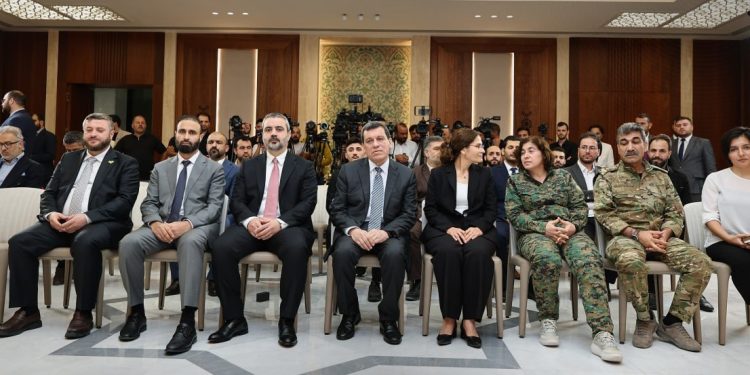
The breakthrough was confirmed on Tuesday at the People’s Palace in Damascus, where SDF Commander-in-Chief Mazloum Abdi declared the dissolution of the SDF as an independent military entity and the winding down of the Autonomous Administration. Under the agreement reached with Syrian President Ahmed al-Sharaa, former SDF fighters are being incorporated into the Syrian Armed Forces.
Abdi described the development as a transition from autonomous military action to direct participation in state-building. “The SDF has fulfilled its mission,” he said, framing the move as a shift toward unified national institutions.
In parallel with the security arrangements, an informed source told 963+ that Damascus and Kurdish representatives have agreed to adopt Kurdish as an official language alongside Arabic in Kurdish-majority regions. The framework includes seven optional weekly class periods dedicated to Kurdish language and literature—three focused on language instruction and four on literary studies.
Abdi emphasized that mother-tongue education has long been a central aspiration for Syria’s Kurdish population, noting President al-Sharaa’s openness to institutionalizing native language instruction. “We will work to implement this decision during the current year to build upon it in the near future,” he said.
Regional and International Reactions
The peaceful absorption of the SDF and its administrative bodies into Syrian state structures has prompted a wave of international endorsements.
France
President Emmanuel Macron congratulated Syria on Wednesday evening, praising the peaceful integration of forces and commending both President al-Sharaa and Mazloum Abdi for their leadership and sense of responsibility.
United Kingdom
Acting British Special Envoy to Syria Barry Peach welcomed the dissolution of the SDF as an independent force and its alignment with state institutions, calling the step “crucial for achieving a unified, peaceful and stable Syria.”
Qatar
The Qatari Foreign Ministry expressed support for the integration into Syrian military institutions, reiterating Doha’s view that lasting stability requires a state monopoly on weaponry within a unified national army representing all Syrian communities. Qatar praised Syria’s inclusive approach and reaffirmed its support for Syrian sovereignty.
Jordan
Ambassador Fouad Majali, spokesperson for the Jordanian Ministry of Foreign Affairs, said Amman supported the development, stressing its importance for national security, state cohesion and safeguarding the rights of all Syrian citizens.
A Turning Point in Syria’s Transition
The agreement marks one of the most consequential steps in Syria’s post-conflict restructuring, combining military unification, administrative reintegration and cultural recognition. For Damascus, the move strengthens state authority across previously autonomous regions. For Kurdish communities, it represents long-sought acknowledgment of linguistic and cultural rights within a unified national framework.
Taken together, the dissolution of the SDF, the recognition of Kurdish language rights and the international endorsements reflect a moment of rare consensus around Syria’s trajectory—one that could reshape the country’s political landscape and accelerate its path toward national normalization.
This article was translated and edited by The Syrian Observer. The Syrian Observer has not verified the content of this story. Responsibility for the information and views set out in this article lies entirely with the author.