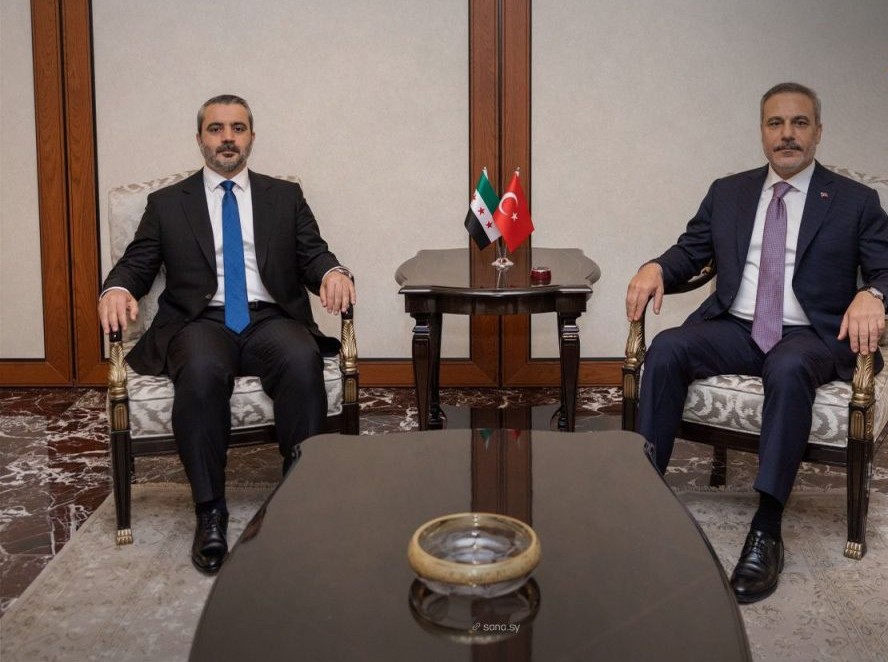
Syrian Minister of Foreign and Expatriates Asaad Hassan Shibani affirmed that Syrian-Turkish relations are advancing at a rapidly accelerating pace. Speaking at a joint press conference in Damascus with Turkish Foreign Minister Hakan Fidan, Shibani said their discussions centred on activating the Joint High Commission so that it may serve as the institutional umbrella governing political, economic, security and service-sector cooperation between the two countries.
He noted that the meeting, which followed several days of consultations in Ankara, reflects a deepening partnership and a strategic trajectory both sides are pursuing. He recalled that Türkiye was among the first states to reopen its embassy in Damascus, re-establish border crossings and restore supply lines after the liberation of Syria on 8 December 2024, while also leading international calls to lift sanctions imposed on the Syrian people.
According to Shibani, bilateral relations have made exceptional strides. He cited dozens of meetings at the presidential and ministerial levels, the signing of forty agreements and memoranda of understanding, and an institutional communication network linking twenty-two Syrian ministries and bodies with their Turkish counterparts.
These efforts have produced tangible improvements for citizens. He pointed to the energy agreement signed in May 2025, the reactivation of road transport and transit through the Bab al-Hawa and Bab al-Salamah crossings, and a partnership twinning Aleppo with Gaziantep. Additional milestones include free-zone projects, a dry port in Idlib, and contributions from the Turkish Cooperation and Coordination Agency (TİKA) toward rehabilitating infrastructure and public services.
Shibani reported that more than seven hundred thousand Syrians have returned from Türkiye since liberation, alongside approximately 1.6 million returning from abroad and nearly two million internally displaced persons going back to their regions.
He explained that the Joint High Commission will operate through co-chairmanship, periodic meetings, a permanent secretariat and specialized sectoral committees. Its agenda encompasses energy, electrical-grid and gas interconnectivity, trade and investment, refugee return, education, culture and diplomatic representation. He added that both countries aim to raise bilateral trade, which approached four billion dollars last year, to ten billion dollars through productive partnerships and joint industrial zones along the border. Damascus, he said, is close to reopening its embassy in Ankara.
Turning to regional security, Shibani condemned recent Israeli strikes, describing the targeting of Abu al-Duhur Airport as a sabotage message intended to obstruct the reconstruction of the Syrian state. He stressed that Syria’s position remains firm regarding the absolute necessity of an Israeli withdrawal to the positions held prior to 8 December 2024.
For his part, Turkish Foreign Minister Hakan Fidan stated that Syrian-Turkish relations have made significant progress over the past two years, particularly in counter-terrorism, and noted serious Syrian efforts to foster stability and economic recovery.
Fidan said both sides agreed to establish a joint committee, chaired by the two countries’ prime ministers, to monitor progress across sectors. He said upcoming engagements between Damascus and Ankara will be intensive, addressing political, economic and military issues alongside broader bilateral ties.
He emphasized that the dissolution of the Syrian Democratic Forces and their full integration into the Syrian state represents an important step forward. He also criticized ongoing Israeli attacks on Syrian capabilities, warning that they undermine stability and positive developments in the country.
Concluding his remarks, Fidan highlighted the importance of expanding energy cooperation, streamlining financing, travel, visas and work permits, and meeting the needs of business leaders through mutual investment and partnership. He added that discussions included an anticipated visit by Turkish President Recep Tayyip Erdogan to Syria.
This article was translated and edited by The Syrian Observer. The Syrian Observer has not verified the content of this story. Responsibility for the information and views set out in this article lies entirely with the author.