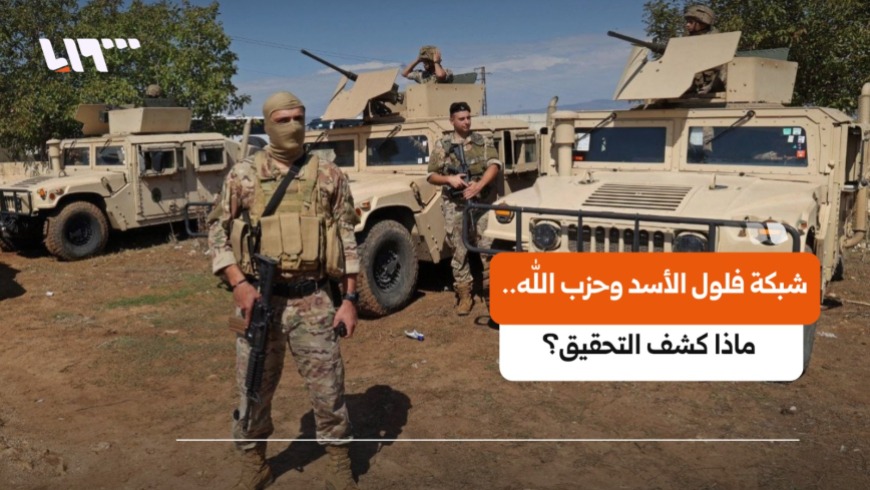
A senior Lebanese security source confirmed to Syria TV on Sunday that preliminary investigations into a network uncovered in Akkar have reached their final stages, with the case file now transferred to the judiciary ahead of formal charges against both detained and fugitive suspects.
According to the source, Lebanon’s Public Prosecutor has completed the initial phase of the inquiry and forwarded the file to the Court of Cassation Public Prosecutor to take the necessary legal measures. The case will then move to Government Commissioner to the Military Court, Judge Claude Ghanem, who will review the indictments prepared against members of the network.
Unmasking “Hajj Alaa” and Issuing an Arrest Notice
Information obtained by Syria TV indicates that the investigation, drawing on detainees’ testimonies and communications analysis, succeeded in identifying a key operative previously known by the alias “Hajj Alaa.” Security agencies suspect he oversaw critical logistical and operational coordination on behalf of Hezbollah within the network’s activities. He is a senior official in the Coordination and Liaison Unit headed by Hezbollah commander Hussein Al-Abdallah.
Following his identification, his name and personal data were circulated among Lebanese security and military agencies to facilitate his arrest.
The source said “Hajj Alaa” was responsible for securing safehouses for operatives in Beirut’s southern suburbs, Zahlé and Haret Saida, overseeing their logistical needs, and channeling funds and salaries to trainees through a charity linked to Hezbollah’s support base.
Data Extraction May Open New Security Files
In parallel with the judicial process, specialized security units continue to analyze confiscated phones and electronic devices. The source reported that extracted data has begun revealing communications and names extending beyond the immediate case, intersecting with other ongoing security files, including the targeting of the Mezzeh Military Airport in Damascus and security incidents along the Syrian coast.
Judicial authorities expect that the forensic analysis will trigger separate investigations and lead to the pursuit of additional individuals not included in the primary list of detainees.
In the next phase, charges are expected to cover the five detained individuals as well as several fugitives sought in absentia, including “Hajj Alaa” and Syrian figures implicated in the testimonies. The dossier will then be transferred to the First Military Investigating Judge to finalize the judicial probe and assign responsibilities within the network.
Background on the Arrests
The case dates back to early September, when a Lebanese judicial source told Agence France-Presse (AFP) that five individuals had been arrested—three Syrians and two Lebanese, including a former colonel in the ousted regime’s intelligence apparatus. Security forces also seized machine guns, hand grenades, sniper rifles and explosives.
The source added that network members had undergone military training in eastern Lebanon administered by Hezbollah fighters, with initial findings suggesting they were preparing operations targeting government forces on the Syrian coast.
Senior Lebanese security sources told Syria TV that the investigation led to the arrest of five primary suspects, most notably Ali Safi, a former Air Force Intelligence officer. Suspicions also surround a former officer linked to the erstwhile “Desert Hawks” militia, who allegedly coordinated external logistics. Investigators are examining possible ties to figures close to Hezbollah and former regime officers residing in Russia.
Information obtained by Al-Sharq Al-Awsat indicated that the network operated under the direction of former Syrian Major General Mohammad Jaber, who resides in Moscow and is closely aligned with the ousted Bashar al-Assad. Preliminary findings revealed a broader network inside Syria comprising more than fifty individuals tasked with orchestrating the entry of fighters into Lebanon and monitoring Syrian troop movements. Sources also noted that the Akkar town of Talbireh served as a staging ground for arrivals from Syria before their transfer to the southern suburbs of Beirut.
This article was translated and edited by The Syrian Observer. The Syrian Observer has not verified the content of this story. Responsibility for the information and views set out in this article lies entirely with the author.