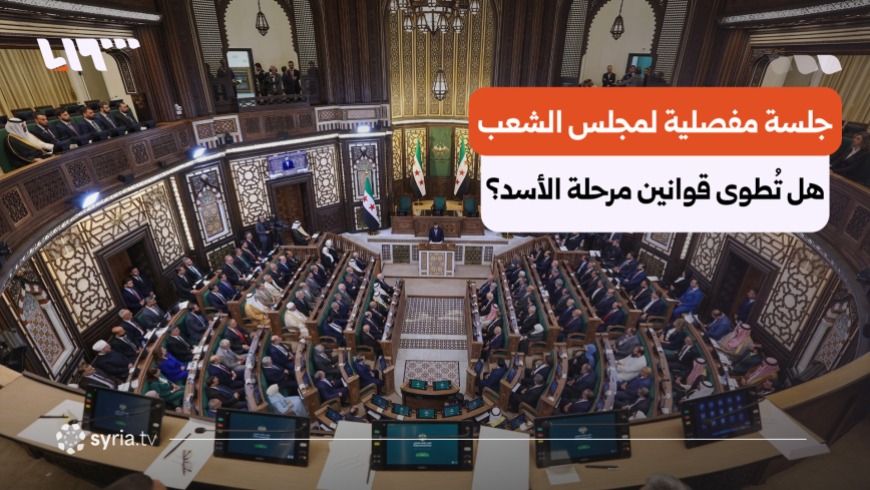
Syria’s People’s Assembly will hold its third session of the first special session on Sunday, September 13, 2026, to discuss a resignation request from Assembly member Modar Hamdan, along with three draft laws referred by the president concerning pension rights, confiscated property, and the repeal of the law establishing the Terrorism Cases Court.
These files come as part of efforts to address the effects of a number of exceptional laws issued under the ousted regime, and to bring them in line with the principles of the constitutional declaration, transitional justice, and rights protection.
The Resignation of Member Modar Hamdan
The Assembly will discuss the resignation request submitted by member Modar Hamdan, which he addressed to the Assembly Speaker last August.
In his request, Hamdan said his decision came in response to what he described as “unjust and systematic online defamation campaigns” targeting his reputation and integrity, adding that the accusations and claims made against him turned out, in his words, to be “fabricated slander and false lies.”
He said the continued controversy surrounding him could affect the work of the People’s Assembly and its legislative mission, explaining that his resignation also stemmed from a concern for “the standing of this legislative institution” and a desire to avoid what he called “bickering unbecoming of its stature.”
Hamdan added that continuing to carry out his parliamentary duties effectively had become difficult, if not impossible, amid “this charged atmosphere,” stressing that his resignation was “voluntary and responsible.”
He said he made his decision “out of genuine concern for the homeland, and in hope that this Assembly will remain a beacon of seriousness and constructive work,” before closing his request by saying he would leave his seat “with a clear conscience and head held high,” wishing Assembly members success in continuing what he called the “march of national service” and in guiding Syria “toward safe shores.”
Ending the Denial of Pension Rights to Those Convicted of Terrorism
The Assembly will also discuss a draft law amending Article 1 of Law No. 20 of 2012, which concerns the dismissal of any worker and the denial of their pension rights upon a final judicial conviction for any act of terrorism.
The draft law proposes keeping the penalty of dismissal in cases of a final conviction, while removing the provision denying the convicted person their pension rights, in addition to repealing Articles 2 and 3 of the law.
The amendment aims to separate the criminal penalty resulting from a conviction from the worker’s pension and insurance rights, so that a criminal judgment does not result in the forfeiture of rights accrued through years of service and contributions.
Exempting Recipients of Restored Confiscated Funds from Taxes and Fees
The People’s Assembly will also discuss a draft law exempting individuals whose funds — confiscated under rulings issued by terrorism courts and military courts between March 15, 2011, and December 8, 2024 — have been returned to them from the taxes, fees, and costs associated with the process of transferring ownership back to them.
According to the draft law, the exemption covers all taxes, fees, and costs linked to transferring ownership of funds that have been restored to their owners after having been confiscated under rulings issued by terrorism courts and military courts during the specified period.
This step comes as part of efforts to achieve transitional justice, restore rights to their owners, and protect individual property, by removing the financial burdens that might otherwise arise from the procedures for re-registering and transferring ownership of funds and property back to their owners.
Abolishing the Terrorism Court
The third draft law provides for the repeal of Law No. 22 of 2012, which established a court with jurisdiction over terrorism cases.
Under the new draft law, Law No. 22 of 2012 would be repealed, and the Supreme Judicial Council would be tasked with nullifying the effects of the unjust rulings issued by the Terrorism Cases Court, including the return of property confiscated under those rulings, while preserving pending cases before that court or referring them to the competent judicial authority, depending on the case.
The three draft laws come as part of a legislative package aimed at addressing the effects of exceptional laws issued in 2012, and bringing them in line with the principles of the constitutional declaration, transitional justice, and rights protection.
This article was translated and edited by The Syrian Observer. The Syrian Observer has not verified the content of this story. Responsibility for the information and views set out in this article lies entirely with the author.