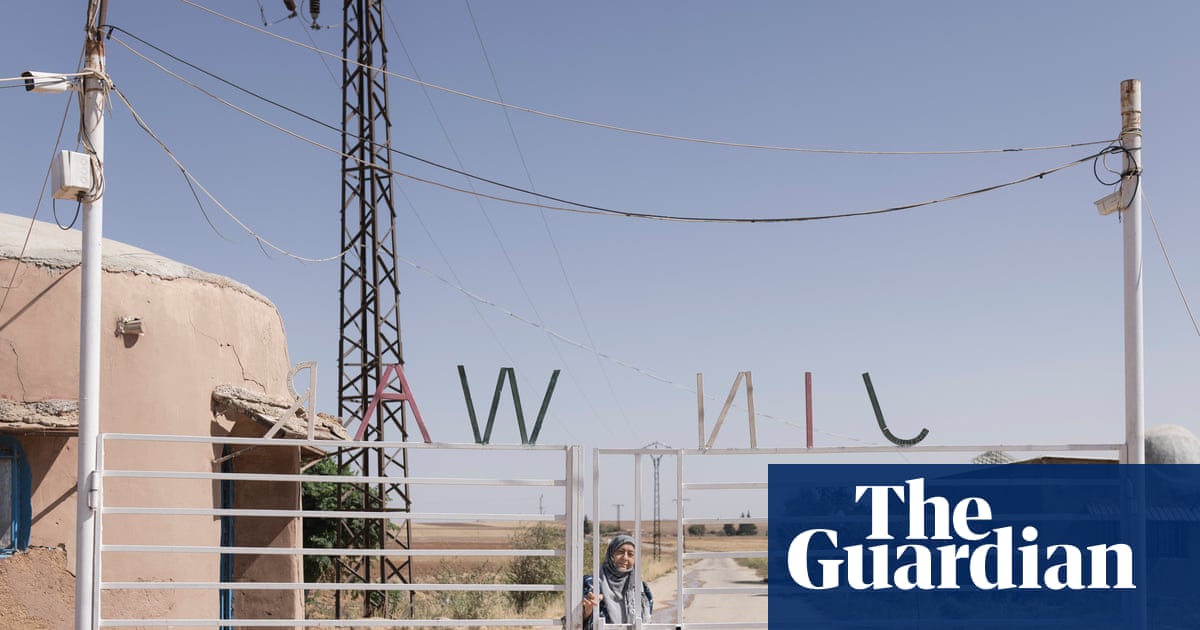
A mother carrying a rifle on her shoulder and gripping a walkie-talkie stands guard at the entrance to Jinwar, a women-only commune in Syria. Beyond the gate, about 30 mud-brick houses dot the desert landscape, their gardens filled with flowers, vegetables and fruit trees.
The village, just outside the city of Qamishli in Syria’s predominantly Kurdish north-east, is a burst of colour amid the dust. Opened in 2018, Jinwar has become a refuge for women from across the region – Kurds, Arabs and Yazidis among them. Some residents arrived after losing husbands to Islamic State (IS); others left abusive marriages in search of safety and independence. It describes itself as “a place for women who want to live a free life with other women and children, women who do not want to get married, women who lost their husbands in war or who were facing violence in their families”.
-
Vegetable harvest in Jinwar, where the women cultivate much of their own food, growing aubergines, tomatoes, peppers, cucumbers, onions and garlic
About 25 women live in the commune, alongside their children and animals, including cows, sheep, chickens and peacocks. They run their own school, have built many of their own homes using bricks formed of earth, water and straw, and cultivate much of their own food, growing aubergines, tomatoes, peppers, cucumbers, onions and garlic. Men from the outside can visit, but cannot live there or stay overnight.
Jinwar was built during the Syrian civil war in response to violence, discrimination and the many challenges faced by women in the region. The name combines the Kurdish words jin (woman) and war (home, land or place), meaning “women’s space”.
The photographer Matteo Trevisan documented the women of Jinwar as part of a wider portrait series of female-led communities springing up across north-east Syria. As well as Jinwar, his images include women from the nearby ecological village of Jarudi (where women lead but men are allowed), members of the women’s civil defence committees (HPC-Jin) in Qamishli, and women working within the region’s environmental institutions.
Welat, 55, arrived a little over a year ago, seeking refuge after separating from her husband. “Life wasn’t going well,” she says. “I could barely get by.”
When she heard about the women-only village, she decided to visit. “Here I found myself – my true self,” she says.
Welat now spends her mornings attending Kurdish-language classes before taking her turn on watch duty at the village entrance. Women share the work of running the commune, while a stream of visitors bring trade and conversation. “Many guests come through. There’s a lot of exchange and activity,” she says.
-
A woman holds medicinal plants at the health centre, called Şîfa Jin (Healing of Women), in Jinwar
The atmosphere, Welat says, is one of solidarity and support. “The mothers work side by side. The relationships among women are beautiful. The psychological environment is good, the spirit very high.”
More than anything, Jinwar offers something Welat says she could not find elsewhere in Syria: safety and peace. “Out there, life is harder,” she says. “Here it’s different. Here I can find myself. Here I can live a good life.”
She hopes the village’s example extends beyond its walls. “I want all the mothers of the world to be aware of their own strength,” she says. “If they have strength, they have freedom.”
Nujîn Mihemed, 57, arrived in Jinwar four and a half years ago, after the death of her husband. Living alone in a village near al-Dirbasiyah and struggling with ill health, she was encouraged by friends to move to the commune.
“I suffered a great deal. I endured a lot of hardship. Both because of so-called ‘morality’ and because of society,” says Mihemed. “Our society has no mercy. Even within my own family: not my mother and father, but my brothers and sisters – they oppressed me.”
-
A woman milks her family’s cow in the village of Jarudi in al-Hasakah, which while not women-only, is organised as a commune with women taking a key role in leadership
Today, Mihemed helps with whatever work needs doing, from baking bread to taking shifts on watch duty. The commune includes a bakery, a small village shop, a healthcare centre and a school.
“We are each different from one another, but we’re all like one household,” she says. “Whatever work there is, we do it together.”
She describes a daily life built around companionship and mutual support. “The mothers gather together – we visit each other, we talk. It’s a good life.”
In Jinwar, she says, she finally found peace and independence. “I came to love this village. My life here is better than anything I had before,” she says.
Jasmin, 28, came to Jinwar from Aleppo five years ago after her marriage ended. At the time, she was preparing to leave Syria for Europe. “I was about to leave for Germany,” she says. “But then I discovered this village and everything changed.”
Jasmin says she found a sense of belonging among women from different ethnic and religious backgrounds. “Women of all religions and peoples live together; all religions are celebrated. For me, this village is an example of revolution and peace for the world,” she says. “The relationship with the women here is unique.”
Jasmin also says she has developed a deep connection to the land. “Now it is hard to imagine myself in a city,” she says.
Her ambitions extend beyond Jinwar itself. She hopes more women will take active roles in public life, from politics to education and community leadership. “We want all women to claim their rights and participate everywhere,” she says. “When women take steps forward, everything changes.”
The nearby village of Jarudi is not exclusively female but, like Jinwar, is organised through grassroots communal structures and cooperatives, with residents – male and female – sharing responsibility for agriculture, local services and daily life. It is one of several rural villages in north-east Syria that, in the face of war and limited state resources, have turned to self-management and ecological self-sufficiency, with women taking a key role in leadership.
In 2013, residents decided to create a public garden in the centre of the settlement in response to widespread destruction. Today, it remains at the heart of village life. Produce grown is sold in nearby markets, with the profits shared.
Nehrîman is a co-chair of Jarudi’s commune, and shares the garden of her home with other family members.
Nesrin Boza, 28, arrived in Jarudi a year ago after hearing about the village while working with women’s organisations in Kobani. Today, she is part of the village council leadership and works at a local centre that focuses on women’s education and social organisation. “I belong to this place,” she says.
Living and working collectively, Boza says, has changed her outlook on life. “Since I came here, my life is less angry and I am stronger in giving to others.”
She describes the village as a place where people are connected not only to one another but also to the surrounding landscape. “We are united with one another, as we are united with nature,” she says. “I feel it inside.”
Boza says it is the strength of the relationships between residents that has convinced her to stay. “We are all on the same level,” she says. “The spirit is strong.”
-
Remziye, Niismiye and Wadhen are members of a group that protects civilians in Qamishli, an area that has seen years of war
Remziye Mihemmed İsmail, Niismiye Eemsedin and Wadhen Husseyn Sexmus are members of HPC-Jin, a women’s civil defence committee in Qamishli that is responsible for civilian protection, monitoring public spaces and supporting social cohesion during periods of conflict and instability. The group operates in a region that has lived through years of war, including the battles against IS.
For these women, participation is a civic duty and a form of political commitment. “I go to commemorations, monitor the streets, the city, the people and funerals,” says Mihemmed İsmail. “As a mother, I don’t want war, but peace.”
Eemsedin says protecting the community is central to her role. “In 2013, I worked in the fields, but in 2023 I decided that self-defence is essential, especially for women – it must come from within,” she says. “Protecting the values of the revolution is important to me. All these people are my children. We don’t care if we lack water and food; we are women, used to hardship, ready to fight.”
Husseyn Sexmus speaks with decades of experience across Kurdish political movements and armed struggle. “I joined the movement in 1987, before the revolution, and spent 40 years working as a messenger for the guerrillas. My brother is a martyr. In 2016, I took part in the Rojava revolution. My husband also died,” she says.
Now she oversees four neighbourhoods, approximately half the city. “I became responsible in my commune for self-defence and for the martyrs’ group,” she says. “We won’t stop until [we have] freedom.”
Rovend Ebdo, 32, heads the ecology department of the Jazira region in north-east Syria. She is attempting to find sustainable solutions after the long-term environmental damage caused by state policies, war and trade embargos.
-
An oil pump extracts water along the Çaxçax River in Qamishli in the Jazira region. Once plentiful, today the water is gone, blocked by Turkey, and what remains is polluted
“The regime … attacked nature. They brought destruction and cut all the trees,” Ebdo says.
She also criticises the impact of sanctions and embargos, which limit access to technology and infrastructure. “If you spend 24 hours a day thinking about how to find water and energy, how can your mind be free?”
Ebdo says her work is part of a longer-term project of rebuilding Syria.
Her aim is to restore balance between people and the land. “What do I dream of for the future? I want peace for the whole world.”