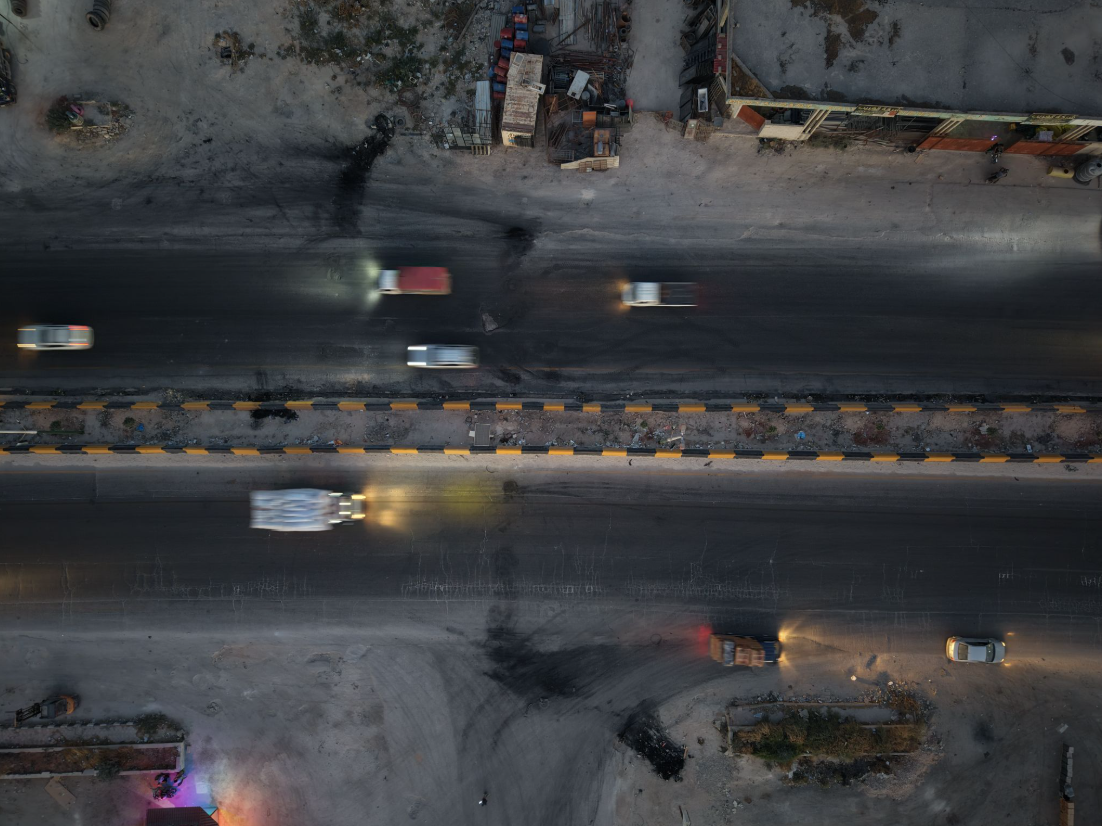
MAARAT AL-NUMAN — A spike in fuel prices has triggered days of mass protests across eight of Syria’s provinces, including Idlib, the historic stronghold of Hay’at Tahrir al-Sham (HTS) in northwestern Syria. The Syrian government increased diesel prices by 40 percent and gasoline prices by 30 percent, citing surging global oil prices. The protests are the most widespread since the fall of Bashar al-Assad in December 2024.
More significantly, economic anger has reached Maarat al-Numan, a small city in central Idlib that repeatedly challenged the movement from which Syria’s current leadership emerged. The city was the first to protest against the fuel hikes on Monday. As in 2011, hundreds of protesters cut off the M5 highway that connects Damascus to Aleppo. The city has a fraught past with HTS, the group formerly led by Syrian President Ahmad al-Sharaa.
HTS—under its prior iterations Jabhat al-Nusra (JAN) and Jabhat Fateh al-Sham (JFS)—engaged in bloody clashes with local Free Syrian Army (FSA) factions before HTS seized full control of the city in 2017. During the group’s rule, residents took to the streets in mass protests demanding its withdrawal. However, Maarat al-Numan remained under its authority until the Assad regime took it in 2020, after a two-month siege.
“Today, there is no barrier of fear and we won’t stay silent,” Jaber al-Adel, 50, a former FSA fighter and organizer of the fuel protests in Maarat al-Numan, told Syria Direct. “If we had solutions we wouldn’t have come out to protest—we came out into the streets out of hunger.”
As fuel prices hit record highs, residents and farmers say all aspects of their lives will be affected and are demanding that the government lower prices. Meanwhile, some economists say the government must radically rethink its entire economic policy to ease popular anger.
‘We want the state to feel for us’
Fuel prices affect all sectors of the economy, from agriculture and transport to heating. They also affect the ability of Syrians to rebuild their lives. “We want to rebuild our homes, but now we can’t even afford cinderblocks and many of us are still living in camps,” al-Adel said.
“Prices increased after the liberation, but we were hopeful the government would reduce them,” said Madhad Darwish, 62, a farmer and father of nine. “There needs to be compassion for the people and support for farmers and citizens.”
Farmer Madhad Darwish sits in his living room, 15/9/2026 (Fared al-Mahlool/Syria Direct)
Nearly two years after the fall of the regime, Syrians’ patience is running thin as prices continue to climb. “We were patient with the new state for two years since they received the country when it was at zero, but we the people are also at zero,” al-Adel added.
Since the fall of Assad in 2024, the prices of key commodities have continued to increase, including fuel, bread and services. “Price increases are a direct result of ending or reducing subsidies and austerity measures that have contributed to increased inflation, pushing the cost of living higher still for Syrians,” said Joseph Daher, a political economist focused on Syria and Lebanon. In 2025, the Syrian government rolled back electricity subsidies, with some electricity tariffs rising as much as 60-fold.
Many Syrians believe fuel, including diesel, gasoline and cooking gas, should be subsidized, as they were under the former regime. “Fuel must be subsidized for citizens—the government is serving the people but the increase in prices affects farmers and the poorest,” Darwish said. “We want the state to feel for us farmers and citizens.”
“The government justifies lifting subsidies by claiming it frees up resources for social spending, but simultaneously dries up the source of funding for that spending through extensive tax exemptions for large investors and the regressive structure of the new tax system,” Daher added. “The result is the elimination of subsidies without the establishment of a safety net, with a net transfer of the burden from the state to the poor family, and from large capital to the average consumer.”
Read more: Oil flows, fuel runs dry: Syria’s paradox as a new energy corridor
Fuel hikes hit farmers
Farmers are already feeling the effects of the fuel hikes in a country where 45 percent of the population depends on agriculture. “We haven’t watered the fields due to the increase in fuel prices,” said Safia Muhammed, 55, a farmer and mother of 12 living on the outskirts of Maarat al-Numan. With the next planting season set to begin in November, she worries about how she will procure fertilizer, which is derived from fuel.
“We came back from Idlib and there were no trees after the regime chopped them down. We had to plant new trees, but until now we haven’t been able to afford to replant them all,” Muhammed said. She now primarily grows vegetables.
“After the liberation [from the Assad regime], we experienced psychological relief, but now the pressure has come back due to growing economic hardship,” Muhammed added. Her husband is already thousands of dollars in debt, having borrowed extensively to rebuild their destroyed home. The house is still under construction, and they are uncertain they will be able to afford to finish it given the increased fuel prices. Muhammed’s nephews still live in tents on a neighboring parcel of land.
Safia Muhammed gestures toward her lands outside her home, 15/9/2026 (Fared al-Mahlool/Syria Direct)
“We need fuel to till the soil and water the crops, as well as for fertilizer,” said Darwish, who grows barley, wheat and lentils on his 13-acre plot of land. He has already decided to till the soil only once rather than twice, which will likely reduce his yields. “There will be a major effect on farmers, both rich and poor,” he added.
However, the state remains ill-equipped to support farmers. A source at the Union for Peasants in Maarat al-Numan, which serves the city and 155 nearby villages, told Syria Direct it had no plan in place to support farmers and mitigate the far-reaching impacts of fuel hikes. The union, like others across the country, is independent of the Ministry of Agriculture and relies on its own funding sources to carry out its work.
In the early 2000s, President Bashar al-Assad enacted neoliberal reforms, decreasing subsidies to farmers and citizens. Daher says a new and improved subsidy system must be built to avoid the pitfalls of the past that fueled the revolution.
“Designing a sustainable subsidy system in Syria must begin with the establishment of a progressive taxation fiscal model and exceptional taxes on the wealthiest sectors of the society to support it,” he said. It must also include “economic initiatives seeking to protect the majority of the population, such as price controls on essential goods and services, and indexing salaries and wages on inflation rates.” Such policies, Daher argues, could help the government build popular support and legitimacy, preventing extremist groups from harnessing popular anger.
“We paid the price with all our blood and we don’t want to fall into the same errors as the previous regime,” al-Adel said.