Aleppo’s Planning and Oversight Committee on public cleanliness held a meeting to discuss solutions for improving sanitation services and waste management in the governorate.
Aleppo Governorate said on 1 February that the meeting reviewed current sanitation conditions, technical readiness, and the equipment needed to raise performance efficiency. Participants also discussed enforcing the law against violators who dump waste outside designated locations and times.
The meeting also addressed expanding sanitation services to cover the entire governorate, reviewing collection fees, and proposals to amend them.
On Monday, 2 February, Aleppo City Council published a video documenting cleaning work carried out by the council’s Cleaning Directorate in several neighborhoods.
The director of the Cleaning Directorate, Bakro Abdullah, said the directorate had deployed all available vehicles as part of an emergency response campaign aimed at “zeroing” all accumulated trash sites in the city.
He added that the next step would be activating evening shifts to ensure the situation remains under control on a permanent basis.
Abdullah also said a number of trash containers had been replaced, while others were moved to a repair center for rehabilitation, as part of the governorate’s efforts to improve services.
Continuity matters most
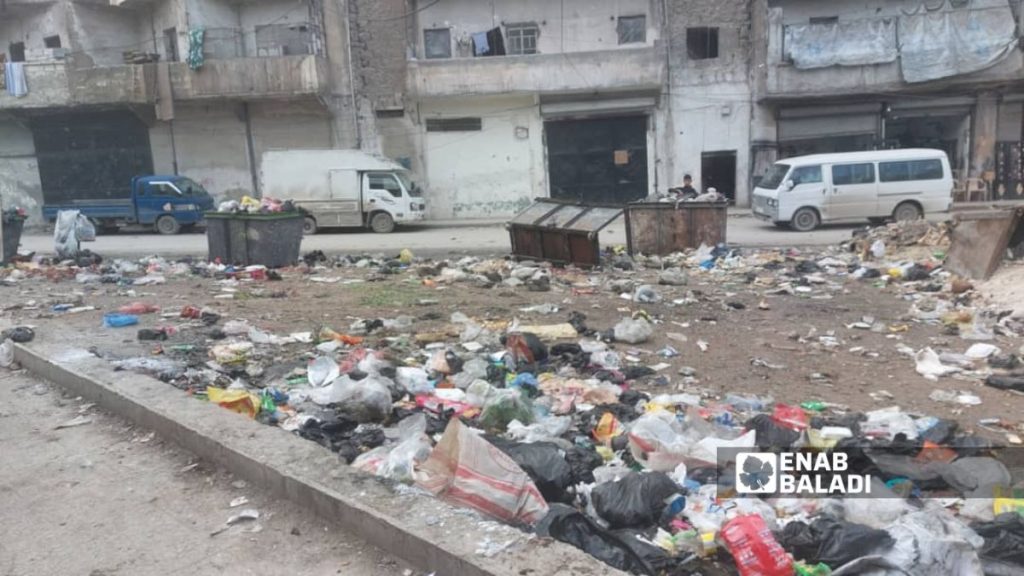
Despite government moves and campaigns to improve cleanliness in Aleppo, their impact on the ground is often limited and quickly fades, especially in the city’s eastern neighborhoods. Scenes of trash piling up in streets and alleys often reappear shortly after each cleaning campaign ends.
In Salah al-Din neighborhood, Mahmoud Tahhan said garbage starts accumulating again only days after campaigns finish, spreading widely and making streets look as if no cleaning took place.
This problem is not limited to the city’s appearance. It poses a public health risk, particularly for children and older adults, due to foul odors and the spread of insects and rodents in areas where waste accumulates, increasing the likelihood of disease.
Tahhan added that residents feel frustrated by the temporary nature of the campaigns. He called for a continuous, sustainable plan that includes daily monitoring of waste, stronger community awareness, and regular, ongoing campaigns.
“It is important for cleanliness to become a fixed part of the city’s daily routine, not a temporary activity whose results disappear after a few days,” Mahmoud said.
In al-Midan neighborhood, Mohammad Youssef said the problem goes beyond a lack of equipment or shortcomings in technical performance.
He told Enab Baladi that the lack of continuity is the main factor behind repeated garbage accumulation. According to Mohammad, official campaigns often begin with strong momentum, then stop after a short period, and the situation returns to what it was, with trash spreading across streets, sidewalks, and remote corners.
This creates a sense of environmental instability and affects residents’ daily quality of life.
He added that continued waste buildup makes it harder to move through some streets, limits the use of some public facilities, and increases pressure on residents who end up dealing with accumulated trash themselves when quick, sustainable solutions from official bodies are not available.
“Zeroing” trash sites
For its part, Aleppo City Council’s media office said current cleanliness campaigns are ongoing across all city neighborhoods, with a focus on eastern areas, where waste accumulation is greater.
The office told Enab Baladi the goal of these campaigns is to “zero” all trash sites in the city.
It also noted that challenges persist, including a shortage of vehicles and dedicated personnel.
Earlier campaigns
The most recent Aleppo Governorate meeting to discuss sanitation was not the first of its kind. A similar meeting was held at the beginning of November 2025 under Governor Azzam al-Gharib to discuss sustainable solutions for improving cleanliness.
At the time, Aleppo Governorate said on its Facebook page that the meeting aimed to develop the working system in the sanitation sector and continuously improve service quality.
Member of Parliament Aqeel Hussein previously told Enab Baladi that Aleppo is “exhausted in terms of infrastructure.”
The sanitation file remains the biggest problem residents face to this day, Aqeel said, adding that the municipality and the governorate have not been able to overcome this obstacle, particularly in the eastern neighborhoods where the problem is clearly worsening.
He said the issue has been raised more than once with the relevant authorities, but the significant shortage of workers and vehicles makes it difficult to achieve tangible results.