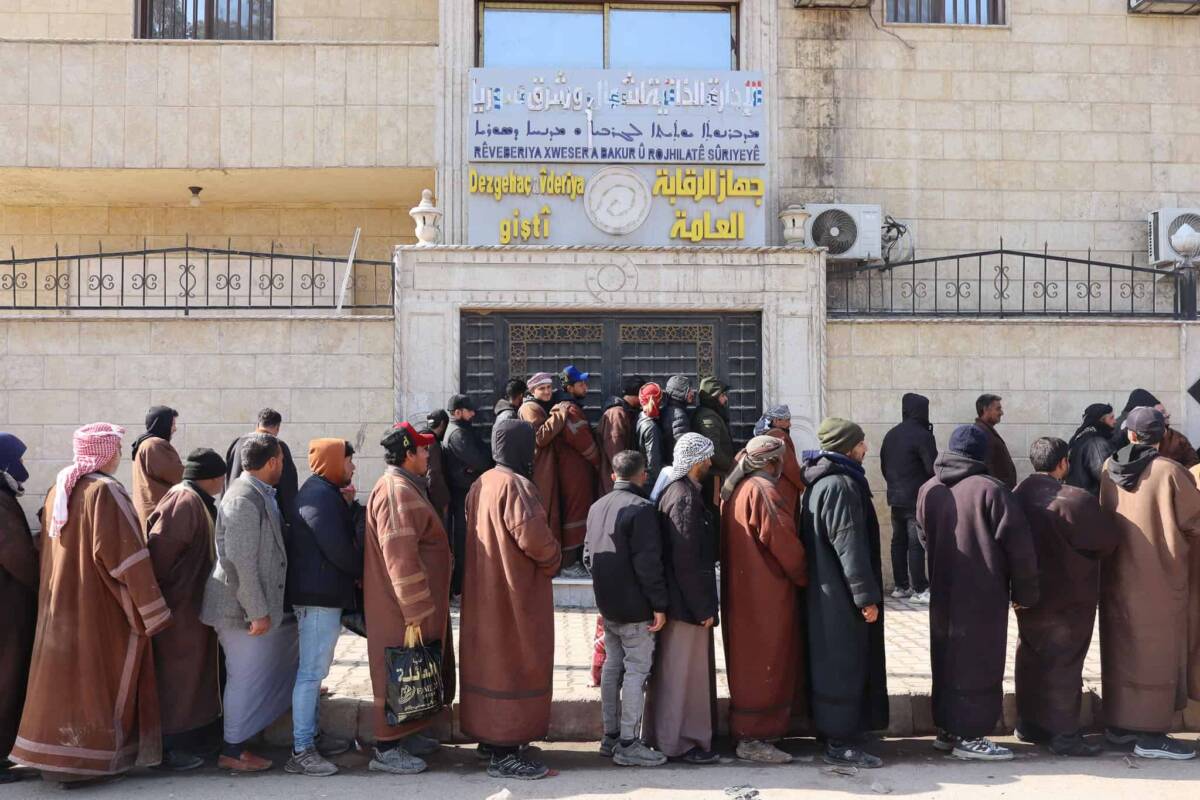
RAQQA — Scores of former members of the Kurdish-led Syrian Democratic Forces (SDF) lined up outside a building in Raqqa city on a crisp, sunny morning last week, waiting to settle their status with the Syrian government.
Many wore farwas, the traditional, wool-lined cloaks warding off the winter chill as they waited for hours. Most were men, while inside the settlement center—a building formerly used by the SDF-backed Autonomous Administration—a dozen women waited to finish their paperwork in a crowded room.
The scene at the settlement center pointed to one important question for the northeastern Syrian city’s transition from SDF control to that of the Syrian government: what the future looks like for former SDF-affiliated fighters, security officers and officials, as well as their relations with their communities.
As of February 3, more than 2,800 people have settled their status in Raqqa, Mustafa al-Issa, the manager of Raqqa settlement center, told Syria Direct.
Damascus took control of Raqqa province and neighboring Deir e-Zor on January 18 after local Arab tribes rose up against the SDF. At the time, government forces were advancing against the SDF after negotiations to integrate it and its affiliated institutions into the state stalled.
Raqqa city’s new reality marks the fourth time the provincial capital has changed hands since the Syrian revolution against ousted president Bashar al-Assad began in 2011. Armed opposition forces first took control of Raqqa in 2013, months before losing it to the Islamic State (IS), which declared the city the capital of its self-proclaimed caliphate the following year. The SDF, backed by US-led coalition forces, drove IS out of the city in 2017.
A week after the latest changeover, Syria’s Ministry of Interior opened the first settlement center in Raqqa on January 26. Similar centers have also opened in Aleppo and Deir e-Zor.
“One can 1770136333 move about at ease, it’s better to come make a settlement,” Ali, 39, told Syria Direct outside the center in Raqqa last Thursday. Ali, who asked to be identified only by his first name, joined the SDF in 2017 and was injured the same year when an IS sniper shot him in the back, leaving him in a wheelchair. “The settlement [process] was excellent—may God reward them with good and bless them,” he added.
Former members of the SDF, Internal Security Forces (Asayish) or Autonomous Administration who complete the settlement process—which involves bringing any identification documents and equipment received from the former authorities—receive a document that allows them to move around the city without being stopped at checkpoints.
A woman at the Raqqa settlement center shows her completed paperwork, 29/1/2026 (Natacha Danon/Syria Direct)
“The committee responsible for settlement work was very polite, ethical and respectful,” echoed Hazem, 24, a former member of the Asayish who asked to be identified only by his first name.
“As for revenge, I do not have any fear or anything like that because I, thank God, did not hurt any civilians. I did not carry weapons against anyone, whether civilian or military,” he added. Hazem says he joined the Asayish in 2024, as the monthly salary of $170 allowed him to support his wife and one-year-old son.
With the SDF out of Raqqa, both Ali and Hazem have no income. “I used to earn $300 in compensation for my injury, now I no longer have a salary and cannot feed my son and daughter, and I cannot work because I am in a wheelchair. We ask the government to look after those injured in the war,” Ali said.
For the time being, Damascus will not integrate former members of the SDF and Asayish in areas it captured militarily last month into its security forces, settlement center manager al-Issa said. “This will take some time until the situation stabilizes, but there is no government policy to prevent them from joining,” he added.
On January 30, the Syrian government and the SDF reached an agreement that allows for the phased integration of Kurdish-led forces in areas the group still controls, such as Qamishli, Hasakah and Kobani (Ain al-Arab), into the state.
Mustafa al-Issa, manager of the Raqqa settlement center sits at his desk, 29/1/2026 (Natacha Danon/Syria Direct)
“The center is a rehabilitation and integration center, not a detention center. It helps those settling their cases go from a life of terrorism to a new life,” al-Issa told Syria Direct.
“The main objective is to integrate former fighters from the SDF and administrative institutions affiliated with the Autonomous Administration into society, protect them from attacks by civilians or current military forces, and control the security situation by collecting their former weapons and any other personal documents,” he added.
The settlement center in Raqqa also accepts people affiliated with the former Assad regime if they wish to settle their status, al-Issa said, adding he takes personal responsibility for any case of assault against those who have done so. A dedicated phone number has been established to report such incidents, though “we have not received any complaints,” he said.
A legacy of division
Raqqa province, like neighboring Deir e-Zor, is home to dozens of predominantly Arab tribes that became divided as the war ran its course. The recruitment of locals, including tribe members, into various factions pitted them against each other, undermining civil peace.
“Alliances in Raqqa shifted repeatedly as power changed…these alignments were mostly about survival, protection and access, rather than ideology,” Haian Dukhan, a lecturer in politics and international relations at Teesside University, told Syria Direct.
“Every change in control left behind grievances that were never resolved. Some people were accused of cooperation, others of resistance, and these accusations often ran inside the same tribe,” he added.
“The effect on civil peace was damaging because trust was never rebuilt,” Dukhan explained. “People kept track of who stood where at each stage, and this produced lasting resentment and fear of revenge, making reconciliation very difficult even after the fighting stopped.”
Under the SDF, Arab fighters—who made up the majority of the Kurdish-led forces—found themselves at odds with local populations who resented its repressive practices and what they saw as Kurdish domination.
Revenge killings have taken place in multiple parts of Syria since the Assad regime fell in December 2024, including against members of Alawite communities perceived as complicit with the former regime. The end of SDF control of much of northeastern Syria opens questions about the possibility of similar revenge attacks against those who collaborated with it.
The settlement process, which places responsibility for the safety of former SDF personnel with the state while leaving the door open for official complaints against those accused of abuses, is one piece of efforts to address this thorny legacy of division.
“The divisions that happened in Raqqa started under the Assadist regime, under which Kurdish citizens were deprived of everything, including citizenship. IS also oppressed the Kurds, while the Kurds [under the SDF] later considered Arabs IS,” said Yusra al-Ahmad, 35, programs manager of House of Citizenship. Her Raqqa-based organization, established in 2019, works to foster community dialogue, social reconciliation and inclusive political participation.
“The SDF sowed hatred between us through discrimination,” Sheikh Hweidi Shlash al-Hweidi, head of Raqqa’s al-Afadleh tribe, told Syria Direct at his headquarters.
“The SDF propagated a narrative that there would be a civil war without them, however they did the opposite—the SDF would not intervene in tribal tensions or control the spread of weapons,” al-Hweidi said. “The greater the divisions [between us], the more the SDF was able to control [us].”
Surrendered SDF weapons line the wall inside the Raqqa settlement center, 29/1/2026 (Natacha Danon/Syria Direct)
Promoting civil peace
“During the war, all components came to Raqqa without exception. We didn’t say you’re Kurdish or Arab,” al-Hweidi said. He and a charity he founded during the war provided aid to displaced families, he added, including Kurds fleeing the 2014 IS siege of Kobani.
Most recently, during the SDF’s withdrawal from parts of eastern Syria, many Kurds fled Raqqa, but some have cautiously returned in recent weeks and recovered belongings they left with Arab neighbors for safekeeping, al-Ahmad said. Under the SDF, her organization also held Arab-Kurdish dialogue sessions.
“The day following the liberation [from the SDF], we welcomed socially influential figures and activists into our community center, made a statement in the name of the people of Raqqa against hate speech targeting Kurds and gave them reassurances. We visited Kurdish households and encouraged their communities to return,” she said.
On January 18, al-Hweidi went on television to warn Raqqa residents against seeking revenge, saying they should rely on the courts.
“Today, out of personal interest, some sheikhs are causing trouble, accusing their enemies of having been with the SDF. However, tribal notables are wiser than that—the tribe is civil peace,” al-Hweidi said.
“Tribal networks still matter socially, and they can help calm tensions, mediate disputes, and discourage revenge, especially at the local level where formal institutions are weak or absent,” Dukhan echoed.
However, their role must be under clear parameters, he says. “Their contribution to civil peace depends on whether they are involved in reconciliation and mediation—not in punishment or exclusion—and on whether there is a clear state framework that sets boundaries and prevents tribal justice from turning into collective revenge,” he added.
Al-Ahmad also sees the aims of the Syrian government as complementary with those of local elites. “The tribes and notables are trying to work on civil peace initiatives, while the state is trying to advance coexistence,” she said. “Through these settlements, the Syrian state is trying to open a new page with all Syrians.”
For Dukhan, however, coexistence has its limits. “The settlement process can help, but only if it is handled carefully, distinguishes between ordinary members and those involved in abuses, and avoids placing former SDF personnel in positions that bring them back into direct contact with communities that suffered under their rule,” he said.
Many human rights organizations have argued that civil peace will remain elusive without a true transitional justice process. While the Syrian government has highlighted the crimes of the Assad regime, many civil society actors stress that transitional justice must also apply to other actors in the conflict, whether the SDF or opposition factions.
“There must be accountability and transitional justice because without it there will be anxiety and hatred. There might be a small number of revenge killings but if there is accountability they will stop,” al-Ahmad noted. “The tribes will help against personal revenge [killings] because if one person is killed the whole tribe will pay the price—there will be tribal wars.”