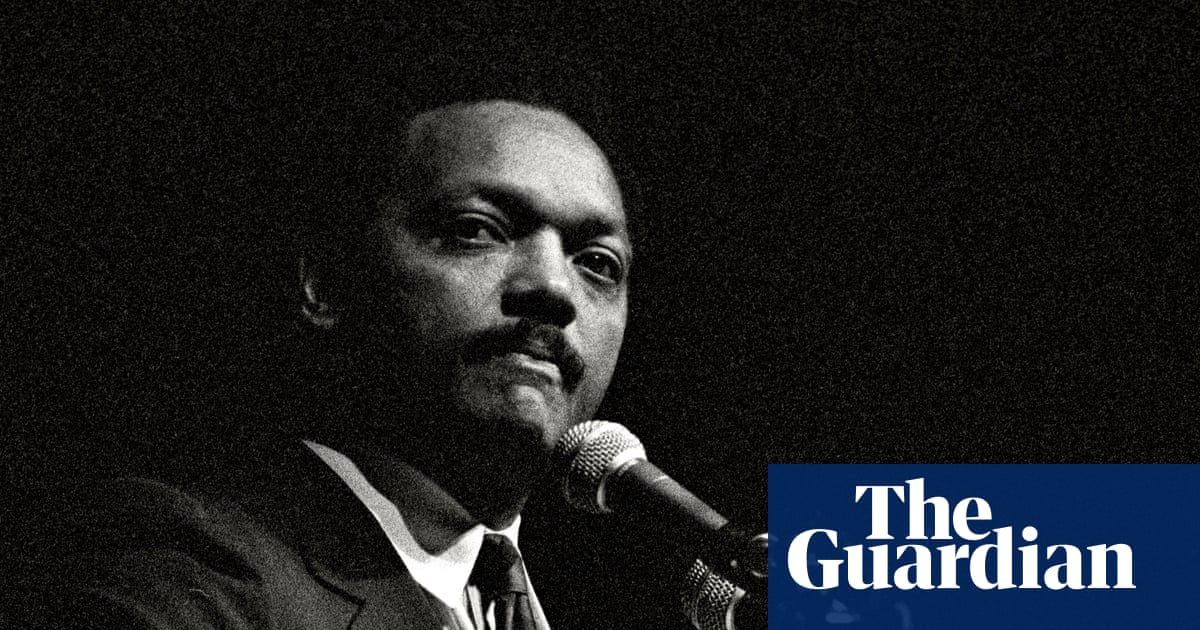
When Jesse Jackson called for the Democratic party platform to include Palestinian statehood, the pushback was fierce. “While we had strong support from delegates at the convention, there was still a fear factor that the issue couldn’t be discussed,” recalls James Zogby, who was deputy manager of Jackson’s presidential campaign. “I was told by the [nominee Michael] Dukakis negotiators, if you even say the P-word, you’ll destroy the Democratic party.”
Jackson’s effort did not succeed at the 1988 Democratic National Convention in Atlanta. But 10 Democratic state parties had already passed resolutions in favour of Palestinian self-determination. And as the decades rolled by, more and more progressives came to share Jackson’s stance. Zogby, founder of the Arab American Institute, reflects: “He was way ahead of the base. Even the activists who supported Palestinians did not have the same depth of understanding.”
When Jackson died on Tuesday at the age of 84, many tributes understandably focused on his contribution to the domestic civil rights struggle and how he bridged generations between Martin Luther King and Barack Obama. But perhaps uniquely for a non-president, his passing was also mourned around the world, from Havana to Johannesburg to Ramallah.
Jackson was a man ahead of his time who blazed a trail for the progressives of today. He was a true internationalist, a trenchant critic of US imperialism and believer in the solidarity of oppressed people everywhere. He was an advocate of normalising relations with Cuba, a scourge of racial apartheid in South Africa and a prominent voice for Palestinian rights. He also embarked on missions to Syria, Iraq and Serbia to free US prisoners.
Martha Biondi, a professor of Black studies and of history at Northwestern University, said: “Jesse Jackson is described typically as a civil rights leader, as somebody who helped pave the way for the election of Barack Obama, and, while all of that is true, in some ways it’s more helpful and illuminating to see Jesse Jackson as one of the most prominent figures of the American left in the 20th century and into the 21st century.
“In that sense, he paved the way not only for Barack Obama but he was a precursor to Bernie Sanders. He’s very much in that very progressive, economic, populist mould. If you see him in that light, then it’s not confusing that he was an early advocate of Palestinian rights.”
When Andrew Young, the US ambassador to the United Nations, was forced from his post in 1979, the row reverberated far beyond Washington. Young had held a clandestine meeting with a representative of the Palestine Liberation Organisation (PLO) – then regarded by the US government as beyond the pale. Under intense pressure, he resigned.
Among Young’s most ardent champions was Jackson. In the immediate aftermath of the controversy, Jackson led a delegation to the Middle East, where he met Israeli officials as well as figures from the PLO, including its leader, Yasser Arafat.
Jackson argued that Washington should abandon its policy of isolation and negotiate directly with the organisation. At the same time, he drew careful – if unmistakable – parallels between the Palestinian cause and the African American struggle. “We understand the cycle of terror, the cycle of pain,” he said.
Sam Klug, an assistant teaching professor of history at Loyola University, Maryland, noted: “He said, when he was visiting essentially a Palestinian refugee camp outside Beirut, that it reminded him of some of the conditions that he had grown up in under Jim Crow. It was clear that he saw a link between his work in the civil rights movement, his work against racial oppression in the United States and his support for the Palestinian people.”
Some Jewish people in the US were appalled by Jackson’s embrace of Arafat. But he played a vital role in mainstreaming the Palestinian cause among African American leaders, shifting the perspective from a purely nationalistic dispute to a profound issue of human rights.
For Zogby, it was about humanity and bridging the gap between the established civil rights movement and the anti-colonial liberation struggles of the global south. He said: “Watching him in the West Bank or Egypt or Kuwait, he was as comfortable with people there as he was in Chicago.
Jesse Jackson presents the Egyptian president, Anwar Sadat, with a book by Martin Luther King Jr on 1 October 1979 in Cairo. Photograph: Bill Foley/AP
“It was because he didn’t look down on Arabs. He saw himself as part of a global community. It was a third world mindset. We’re people of colour. We have human needs. These were one struggle, one fight, and he was part of it and he saw himself in that context. South Africa obviously fed into that.”
Omar Barghouti, a co-founder of the Boycott, Divestment and Sanctions (BDS) movement for Palestinian rights, said in an email: “Palestinians have eulogized this towering Black American leader’s departure with grief and with profound appreciation for his exceptional role in catapulting Palestinian liberation into the US mainstream political discourse when hardly any politician dared to.
“Building on Dr Martin Luther King’s late-life intersectional call for resisting the ‘triple evils of racism, economic exploitation and militarism’, Rev Jackson believed that freedom for the Palestinian people must be part of that global resistance. Despite the obvious differences, his advocacy for Palestinian rights must be seen in the context of a decades-long tradition of Black-Palestinian mutual solidarity, from Malcolm X to Angela Davis.”
Jackson first travelled to South Africa in July 1979, two years after the death of Black consciousness founder Steve Biko. He drew massive crowds at rallies in Soweto, a township near Johannesburg. In 1984 he was the most prominent presidential candidate to voice support for the imprisoned Nelson Mandela; his two White House campaigns gave him a platform to amplify the message.
Jesse Jackson and Nelson Mandela in Soweto, South Africa, on 15 February 1990. Photograph: Reuters
When Ronald Reagan was moving US policy sharply to the right and giving the apartheid regime in South Africa a new lease on life, Jackson provided a clarion call to conscience. He vigorously pushed for sanctions against the apartheid state, characterising it as a moral disgrace rather than a mere pawn in the cold war. His relentless organising and voter mobilisation helped pressure Congress to overturn Reagan’s veto and pass historic anti-apartheid sanctions in 1986.
Jackson was motivated by parallels with the fight for racial justice in the US. He wrote in the Guardian in 2013: “As a young civil rights activist, I knew how raw and ugly and violent the apartheid regime was. They were being jailed, we were being jailed. We were being killed, and they were being massacred.”
William Gumede, 55, founder and executive chairperson of the Democracy Works Foundation in South Africa, recalled: “Jesse Jackson stood out as a beacon because the perception in the 1980s was the US government of the time was much more in favour of protecting the apartheid government. That made Jesse Jackson, in our eyes in South Africa, an important larger-than-life hero of the anti-apartheid movement.”
Jackson was a Black man with global interests and global reach, noted Gumede, an associate professor at Wits University in Johannesburg. “The kind of heroes that we would have would be dealing with our issues. He was dealing with his issues and many other world issues and that made him an extraordinary person.
“In the 80s and the anti-apartheid movement, there was a lot of focus, particularly in my generation, with looking at people through colour lenses and looking around the world for Black heroes. He was a Black hero in the US but he was also a global hero in not only Black issues but many other issues beyond race.”
Jesse Jackson protests against the apartheid regime in South Africa, in Washington DC on 19 January 1985. Photograph: Jean-Louis Atlan/Sygma via Getty Images
Barbara Masekela, 84, a South African poet, educator, diplomat and anti-apartheid activist, added: “For me the most remarkable thing was that he was one of the first Black activists to link the struggles of people all over the world, including South Africa.
“We come from a generation that had a lot of innovative thoughts about human rights all over the world. We are also a generation that benefited from the explosion of information. He was one of the few activists that took advantage of that knowledge and continued the line of solidarity between African populations all over the world. He cared about the soul of Black folks.”
Jackson routinely criticised US military interventions and the financing of rightwing counterinsurgencies in countries such as Nicaragua and Angola, calling instead for diplomacy and equitable economic development in the global south.
But perhaps Jackson’s greatest international achievements were the hostage and political prisoner negotiations that he successfully conducted, often with countries that the US declared enemies and therefore refused to do business with. These included Syria (freeing navy lieutenant Robert Goodman), Cuba (freeing 48 political prisoners), Iraq (freeing hostages before the Gulf war) and Serbia (freeing three US soldiers).
David Masciotra, author of I Am Somebody: Why Jesse Jackson Matters, notes that after the successful mission to Syria, Jackson was invited by Reagan to the White House. “Reagan asked Jackson, ‘What can I do for you in return?’ Jackson said, ‘I want you to get on the phone and call [Syrian president Hafez al-]Assad and thank him.
“Reagan said, ‘Well, we have a no-talk policy with Syria.’ Jackson said, ‘Yeah, I know, and that’s why that’s what I’m asking you to do; I want you to break that policy.’ To his credit, Reagan did it, and Reagan and Assad spoke for the rest of his administration. Jackson was a believer in diplomacy and cooperation and democracy promotion through conversation, as simple as it sounds, rather than aggression and other forms of brinkmanship.”
Ronald Reagan and Jesse Jackson after a White House Rose Garden ceremony honoring Lt Robert Goodman. Photograph: Ira Schwarz/AP
It was a worldview shaped by Jackson’s own experience growing up Black in America. Masciotra added: “He said that’s how he learned to become a good negotiator because growing up in the Jim Crow south as a poor Black man, every day was a negotiation and his life was at stake. He had a life that was formed by pain very early on and he identified with the pain of others and those who were despised and demeaned and he sought to speak for them.
“Being an American icon gave him a credibility with these regimes in which he could speak to them as an American but also as an American who could relate to their experience with American policy. He was a victim of a certain kind of domestic form of colonialism, so therefore he could relate to countries that had suffered from colonialism beyond American shores.
“It was connecting with those people on a very deep personal level because of the source of their pain but it was also connecting politically because he could say, ‘I’m an American but I’m very well acquainted with the dark side of the American experience and that’s something that you know about too; you’re just going about your resistance the wrong way by taking hostages and political prisoners.’”
More than four decades since the Democratic National Convention in Atlanta, many of Jackson’s policy positions have aged well and into the centre-left consensus. Yet as he neared the sunset of his life, he was the first to recognise that the struggle was far from over. At the 2024 convention in Chicago, the party explicitly refused to allow a Palestinian American speaker on stage amid the devastating war in Gaza.
Earlier that year, again in Chicago, Zogby had attended a summit at Jackson’s Rainbow Push Coalition. He recalled: “As I left at the end of the summit, I went over to him and I said, ‘Reverend, I’m going to go,’ and he just looked at me and he said, ‘Remember the babies. They’re dying every day. Do something.’
“Gaza moved him and, even that early in January 2024, he got it. By the time we got to the convention, he wasn’t able to speak, but I’m fully confident of the fact that he would have said: let Palestinian voices be heard.”