Want to bookmark your favourite articles and stories to read or reference later? Start your Independent Membership today.
Join today
Already a member?
Log in
Your support helps us to tell the story
From reproductive rights to climate change to Big Tech, The Independent is on the ground when the story is developing. Whether it’s investigating the financials of Elon Musk’s pro-Trump PAC or producing our latest documentary, ‘The A Word’, which shines a light on the American women fighting for reproductive rights, we know how important it is to parse out the facts from the messaging.
At such a critical moment in US history, we need reporters on the ground. Your donation allows us to keep sending journalists to speak to both sides of the story.
The Independent is trusted by Americans across the entire political spectrum. And unlike many other quality news outlets, we choose not to lock Americans out of our reporting and analysis with paywalls. We believe quality journalism should be available to everyone, paid for by those who can afford it.
Your support makes all the difference.Read more
New players hit the United Nations General Assembly sidelines this week as humanitarian groups searched for a counterweight to foreign aid cuts that have hampered global fights against disease, malnutrition and poverty.
Nonprofits, foundations and corporations pack Manhattan ballrooms and closed-door meetings each September to direct some sliver of the world’s attention — and funding — to their missions. Timed annually to the U.N. General Assembly’s high-level meetings, the scramble is even more urgent after recent sharp declines in funding sent by some of the richest countries to poorer ones.
Across the many conferences, forums and roundtables, the week exposed the gulf between the biggest aid organizations, who have the money and connections to weather this period of public aid retrenchment, and others grappling with their role in the changing landscape for humanitarian funding.
Big movers still made big pledges. The Gates Foundation touted its $1 billion commitment to AI-powered tools for farmers, educators and health workers. Bill Clinton called on Clinton Global Initiative attendees to “step into the void created by retreating governments.”
There, former USAID administrator Samantha Power highlighted the ways her coalition to end childhood lead poisoning adapted when U.S. President Donald Trump’s administration dismantled her former agency, USAID.
“Philanthropies took risks. Governments took ownership. Multilateral institutions invested and the coalition kept moving,” Power, a Harvard professor, said Wednesday at CGI. “That is the story of optimism I want to leave you with today.”
Other mid-sized actors described a mixed mood. Major foundations are still in “soul-searching mode,” according to Global Fund for Children co-CEO John Hecklinger. His fund serves as an intermediary between well-endowed foundations and more grassroots nonprofits. Funders, he finds, understandably can’t fill every gap but are also hesitant to maintain the previous status quo.
“There’s not this forced, strategic approach. The vision is disjointed,” said Ann Lee, the co-founder and CEO of Community Organized Relief Effort. “It’s very, very sort of ad hoc.”
Nonprofits turn to new donor countries
Still, the U.N. sidelines brought out new nonprofits and funders eager for impact. Eleanor Crook Foundation CEO William Moore spent the week garnering support for his fledgling nonprofit to eradicate child deaths from acute malnutrition.
Operation End Starvation launched this summer with a $100 million, two-year commitment from the U.S. State Department. But Moore anticipates needing 17 times more every year to purchase enough therapeutic foods such as peanut butter paste and get them into starving children’s mouths. On Wednesday, OES announced a $5 million grant from the Gates Foundation.
The goal is to eventually become for malnutrition what vaccines alliance Gavi is for immunizations or what The Global Fund to Fight AIDS, Tuberculosis and Malaria is for the deadliest infections. His pitch: OES will pay for overhead and match one-third of government money through philanthropy if countries cover the costs of the foods and delivery.
Moore noted one lunch he had scheduled with Nigeria’s health minister — part of a sector-wide shift to partner with the high-burden countries where aid organizations work.
“They’ve said, ‘We’re ready for this. We’re ready to take on this additional responsibility. We want to own the systems that are needed to improve the livelihoods of our people,'” Moore said. “We’re really excited as philanthropy also to be of service to that.”
Moore’s nonprofit is among a growing number turning to Arab Gulf nations. Moore said Operation End Starvation is having good conversations with official state donor entities and the philanthropies affiliated with their royal families.
The region’s leaders have recognized a need “to fund and to bridge the gap” created by aid cuts, according to Hammam bin Nasser bin Juraied, executive director of the Arab Gulf Programme for Development.
An ‘openness to collaboration’
Other aid groups are working more closely with local partners in hopes of reducing overhead costs and increasing their impact.
Education Cannot Wait Director Maysa Jalbout, whose nonprofit lost funding from the Trump administration, said they’ve committed to delivering at least half their funds through local organizations.
She’s trying to raise $600 million to provide education for 10 million crisis-affected children by 2030. She’s actually continued to see support from Germany, the United Kingdom and Switzerland. She found herself speaking more than usual this week with philanthropies and the private sector about their “collective responsibility” to meet the increased demand for aid. That includes new partners to provide meals, water and electricity in schools.
“There is this level of, at least on our part, openness to collaboration that comes out of need that maybe we haven’t seen before,” Jalbout said.
Other leaders saw a greater presence from family offices — the private advisers who manage the affluent’s wealth. Agnes Dasewicz, chief investment and program officer at the Global Energy Alliance for People and Planet, said she encountered many family office advisers at a breakfast organized by an informal network of women in climate.
Their presence underscores what Dasewicz said is a growing number of individuals who want their personal wealth to have world influence but don’t want the publicity or responsibility of a major foundation. Family offices can act much more flexibly. But they can be harder to find.
“You go talk to them and it turns out they gave out $200 million in grants last year. And you’ve never heard of them,” she said. “But they’re out there. And they’re very interested really in bettering the livelihoods of people in other countries.”
An appearance from a Buffett
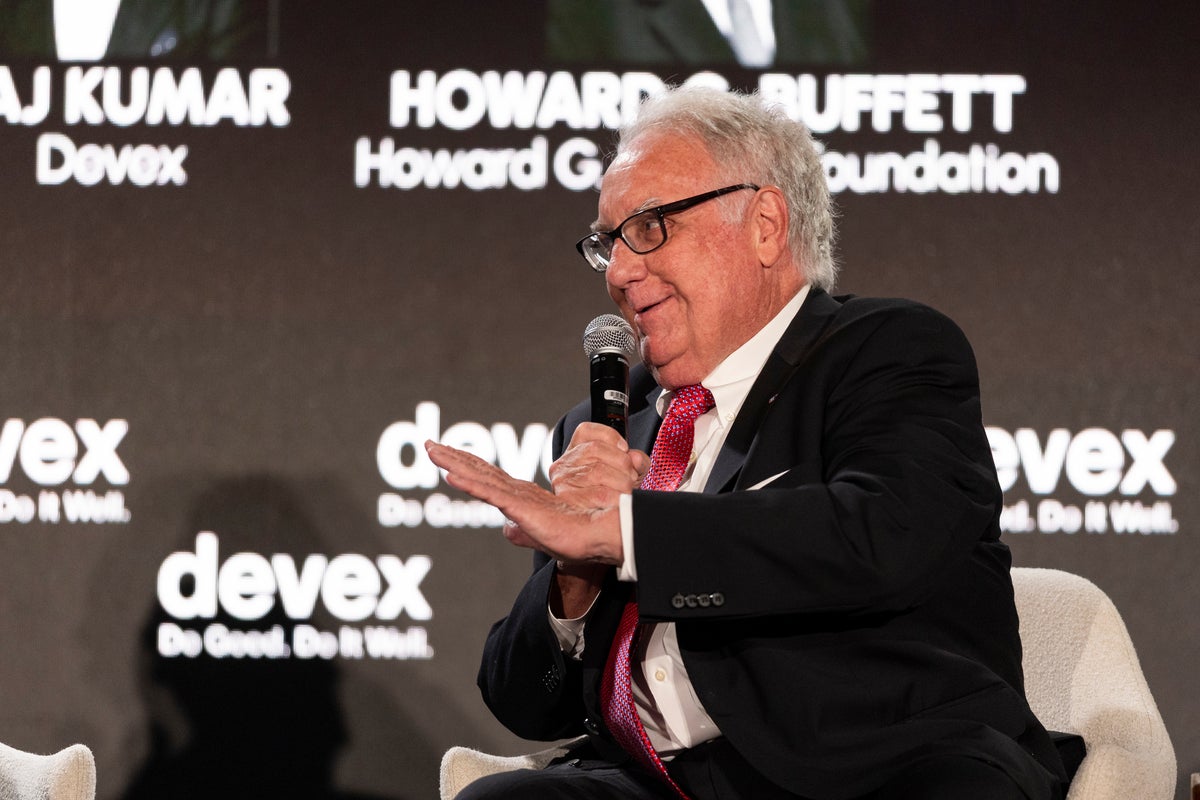
Even Howard G. Buffett, the eldest son of mega-billionaire investor Warren Buffett and one of three children tasked with giving away their father’s fortune after his death, ditched his private family farm for Midtown Manhattan this year.
He was motivated by what he saw as lagging support for Ukraine. Howard, who recently became Berkshire Hathaway’s new chairman, said Thursday at a forum hosted by the news organization Devex that “you cannot come to this week in New York without making Ukraine one of the highest priorities” of discussion.
His foundation, which doubled its spending when Russia invaded Ukraine in February 2022, has given the country $1.4 billion. The World Bank estimates the total cost of reconstruction and recovery in Ukraine at almost $588 billion — or nearly three times the country’s gross domestic product — over the next decade.
From grocery stores to mail delivery, Howard said, there are needs in Ukraine that American companies should invest in. His foundation pledged to finance the rebuilding of a Kharkiv-based publishing house destroyed by Russian missiles. An attack on the maker of children’s books and educational materials, he said, is “how you destroy a society.”
It’s “amazing” to Howard that he hasn’t been joined by more U.S. foundations focused on democracy. “Ukraine is the fight today that is telling the world whether we have the wherewithal to protect those values,” he said.
He also hinted at how his foundation might give away some of his father’s hundreds of billions of dollars. They’ll have to take more risks, he said, while also finding some recipients prepared to absorb $500 million donations at a time.
“I couldn’t imagine not continuing funding in Ukraine for a lot of years,” he added.
___
Associated Press coverage of philanthropy and nonprofits receives support through the AP’s collaboration with The Conversation US, with funding from Lilly Endowment Inc. The AP is solely responsible for this content. For all of AP’s philanthropy coverage, visit https://apnews.com/hub/philanthropy.