Your support helps us to tell the story
From reproductive rights to climate change to Big Tech, The Independent is on the ground when the story is developing. Whether it’s investigating the financials of Elon Musk’s pro-Trump PAC or producing our latest documentary, ‘The A Word’, which shines a light on the American women fighting for reproductive rights, we know how important it is to parse out the facts from the messaging.
At such a critical moment in US history, we need reporters on the ground. Your donation allows us to keep sending journalists to speak to both sides of the story.
The Independent is trusted by Americans across the entire political spectrum. And unlike many other quality news outlets, we choose not to lock Americans out of our reporting and analysis with paywalls. We believe quality journalism should be available to everyone, paid for by those who can afford it.
Your support makes all the difference.Read more
The humpback whale that kept Germany spellbound for months likely lived for roughly five days after the final controversial rescue attempt failed to guide it back to its natural habitat in the Atlantic Ocean, officials said Friday.
The whale, nicknamed “Timmy” and “Hope” by German media, was found dead on May 14, stranded just off the small island of Anholt in the Kattegat, the broad strait between Denmark and Sweden that connects the Baltic Sea to the North Sea.
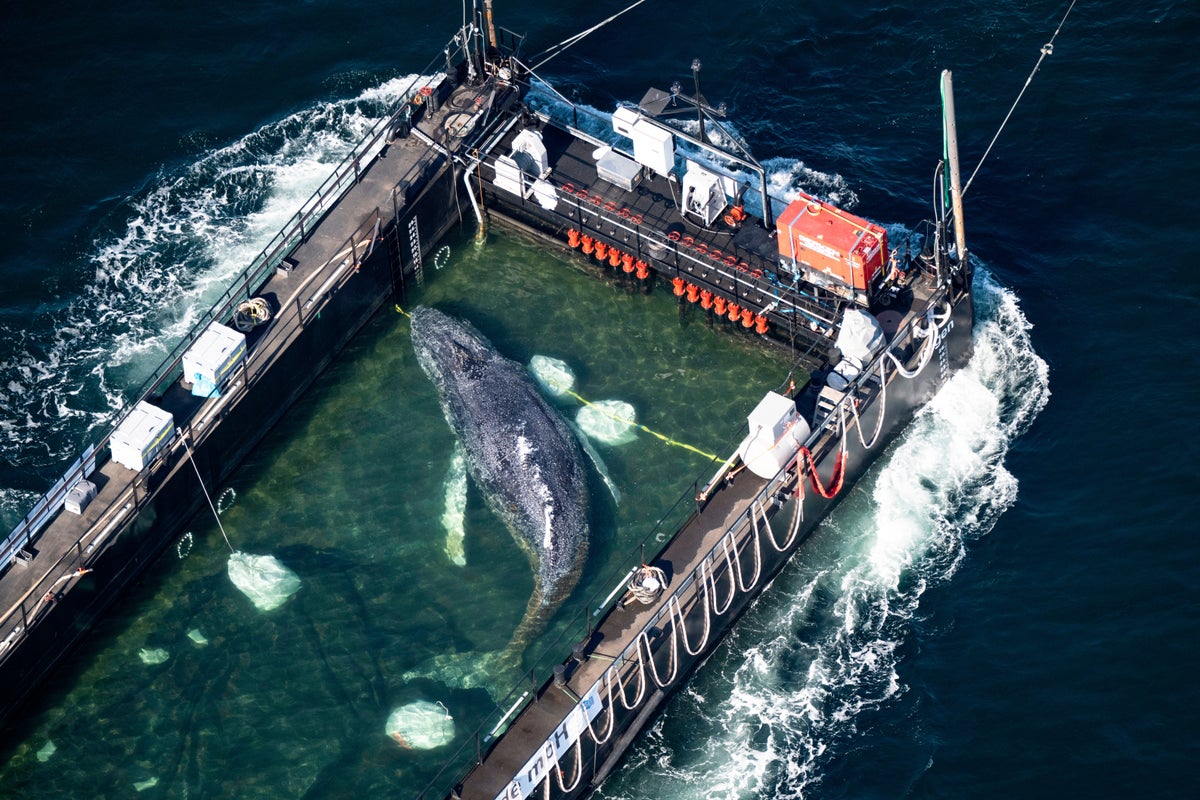
The discovery of the body ended months of a spectacular and contentious rescue effort that culminated May 2, when the mammal was transported toward the North Sea in a barge in the final rescue attempt. Scientists, government officials, the public and a private initiative sparred over whether it was more humane to let the weakened and sick animal die on its own or continue the rescue efforts.
Data from a tracking transmitter attached to its dorsal fin shows that the whale’s death likely occurred on May 6 or 7, according to Till Backhaus, the environment minister for the state of Mecklenburg-Western Pomerania.
It had swum roughly 215 kilometers (134 miles) over the five days and was heading back toward the Baltic Sea, which is the wrong direction for it to reach the Atlantic Ocean.
The data shows that the whale likely drifted aimlessly after that — or the transmitter’s signal was lost, Backhaus said Friday during a news conference.
The humpback whale lays in a washed-out tub off the island of Poel, Germany, April 22, 2026. (Philip Dulian/dpa via AP, File) (DPA)
Timmy was first spotted off the German coast on March 3, prompting a media frenzy that included push alerts and updated live blogs with the status of its health.
It’s not clear why it swam into the Baltic Sea, which it wasn’t suited to, although some experts said it may have lost its way while swimming after a shoal of herring or during migration.
An autopsy of the carcass has not yet determined the cause of death, Backhaus said, though officials were able to figure out that “Timmy” was a female whale, after months of assumptions that it was male.
The minister said no serious injuries were discovered during the autopsy, as well as no indication of violence or any items that would have caused its death.
“Did it have any nets or other foreign objects on its body, in its mouth or on its body?” Backhaus said. “Nothing was found.”
Some of the remains will be turned into biodiesel in Denmark, according to German news agency dpa. Some of the bones will go to a Danish museum.