Your support helps us to tell the story
From reproductive rights to climate change to Big Tech, The Independent is on the ground when the story is developing. Whether it’s investigating the financials of Elon Musk’s pro-Trump PAC or producing our latest documentary, ‘The A Word’, which shines a light on the American women fighting for reproductive rights, we know how important it is to parse out the facts from the messaging.
At such a critical moment in US history, we need reporters on the ground. Your donation allows us to keep sending journalists to speak to both sides of the story.
The Independent is trusted by Americans across the entire political spectrum. And unlike many other quality news outlets, we choose not to lock Americans out of our reporting and analysis with paywalls. We believe quality journalism should be available to everyone, paid for by those who can afford it.
Your support makes all the difference.Read more
Sweden’s next government remained uncertain on Monday as the national election inched toward a final result, with a thin lead for the left-wing opposition and an underwhelming performance by a hard-right anti-immigration party.
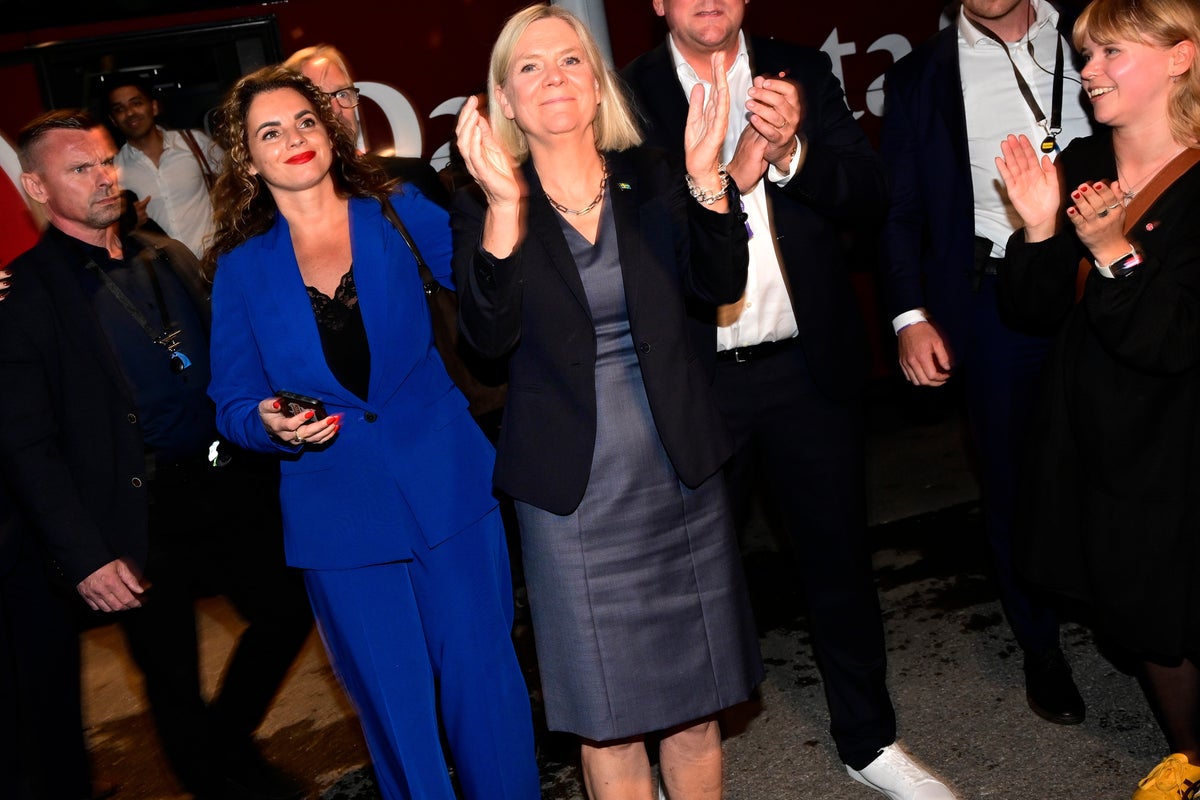
Preliminary results showed a narrow advantage for the opposition and former Prime Minister Magdalena Andersson’s bid to return to office at the head of a left-wing coalition, although her own center-left Social Democrats lost support.
But even if the left does win a majority of seats, Andersson faces a complicated task to translate that into a government, and conservative Prime Minister Ulf Kristersson said he would explore “possibilities” given the close result.
Sweden, which has about 10.6 million inhabitants, is a member of the European Union and the newest member of NATO.
With more than 94% of districts counted, the Swedish Election Authority reported that the four opposition parties were heading for 176 seats in the 349-seat parliament in Stockholm, the Riksdag, with 173 seats going to the four parties that make up or support the outgoing government.
The outcome may not be decided until Wednesday, when local election boards count early votes that did not make it to the polling stations by Election Day. That includes, among other things, overseas votes.
Andersson told supporters that “we must wait for the final election result” but added that “right now we are leading.”
Kristersson has led Sweden since 2022 with a three-party center-right coalition. It relied on outside support from the Sweden Democrats, an anti-immigration party that has far-right roots but has moved toward the political mainstream, for a parliamentary majority. The Sweden Democrats had been promised Cabinet posts this time if the governing coalition were returned to office.
“When we have the final result it’s a good idea to look at possible combinations,” he said early Monday, adding that “there is a very clear non-socialist majority, or non-left leaning economic majority in the Swedish parliament. And I will actually take note of that and at least figure out whether there are any possibilities.”
He said that the outcome “could lead to a complicated process of forming a government. It may take time, but we’re in no rush.”
Andersson’s Social Democrats emerged as the biggest single party with a bit over 28% of the vote but lost support compared with the last election in 2022. And there are tensions between two parties in the opposition bloc: the Center Party has said it doesn’t want to go into government with the Left Party. Any combinations across the traditional right-left division would also be complicated.
At the other end of the spectrum, the Sweden Democrats’ support slipped to just under 18%, down about 3 percentage points from its 2022 result, and they fell behind Kristersson’s Moderates to land in third place.
With broad political consensus in Sweden on several major issues such as support for Ukraine and the country’s decision to join NATO, much election discussion focused on the possibility of the anti-immigration hard right entering government. The Sweden Democrats’ role was in focus against a background of gains for the populist right in Europe.
The Sweden Democrats were founded in the 1980s by people who had been active in right-wing extremist groups, including neo-Nazis. They toned down their rhetoric and expelled openly racist members under Jimmie Åkesson, who has led them since 2005 and overseen their growth from what was once a marginal party.
___
David McHugh in Frankfurt, Germany contributed to this report.