Want to bookmark your favourite articles and stories to read or reference later? Start your Independent Membership today.
Join today
Already a member?
Log in
Your support helps us to tell the story
From reproductive rights to climate change to Big Tech, The Independent is on the ground when the story is developing. Whether it’s investigating the financials of Elon Musk’s pro-Trump PAC or producing our latest documentary, ‘The A Word’, which shines a light on the American women fighting for reproductive rights, we know how important it is to parse out the facts from the messaging.
At such a critical moment in US history, we need reporters on the ground. Your donation allows us to keep sending journalists to speak to both sides of the story.
The Independent is trusted by Americans across the entire political spectrum. And unlike many other quality news outlets, we choose not to lock Americans out of our reporting and analysis with paywalls. We believe quality journalism should be available to everyone, paid for by those who can afford it.
Your support makes all the difference.Read more
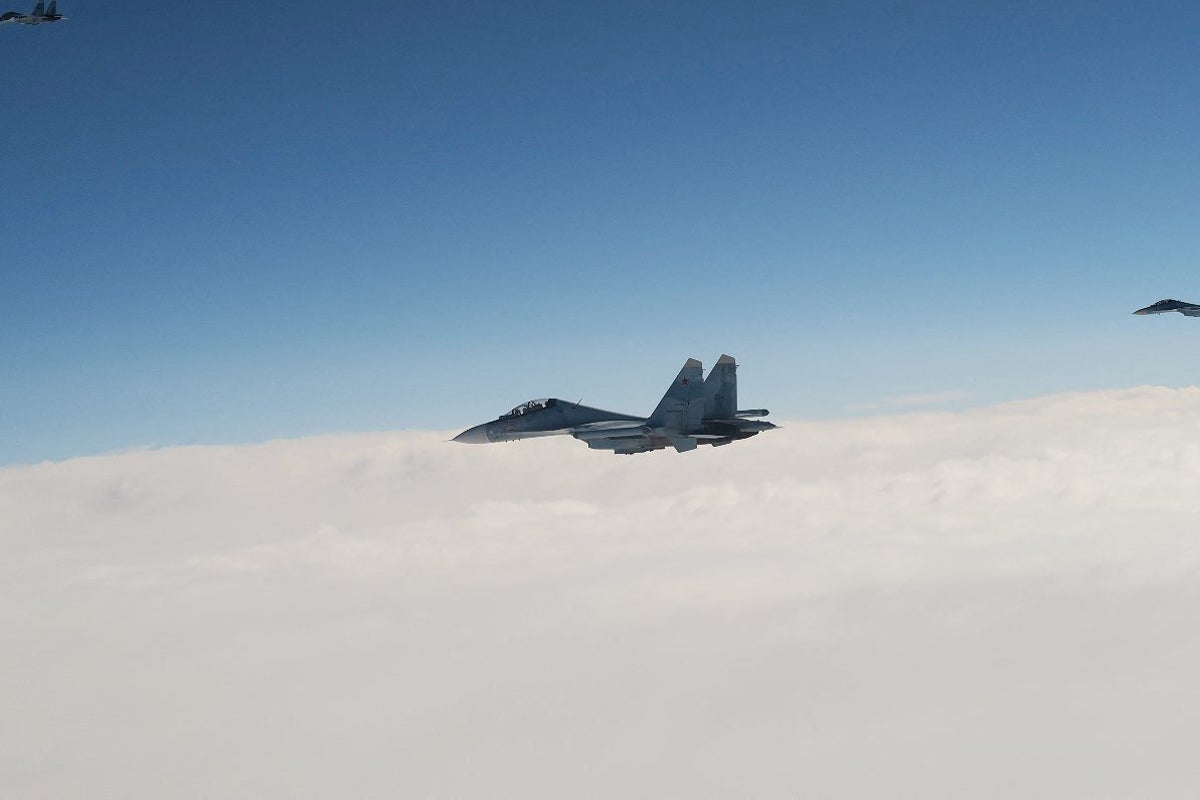
Sweden and Finland scrambled fighter jets together for the first time to intercept Russian military aircraft over the Gulf of Finland on Thursday as the Baltic countries cooperate against a growing threat from Moscow.
A group of Russian aircraft, including a Tu-134 transport plane and several MiG-31 and Su-30 fighter jets, was tracked down in international airspace by the Nato jets, in what Finland’s air force said was the first joint “identification mission” with Sweden.
Baltic countries have been on high alert after incidents of gas pipeline outages, drone sightings and airspace violations have grown rapidly since Russia launched its full-scale invasion of Ukraine.
“It is a concrete expression of the readiness and trust we have built together – and an expression of the strength in the Nordic, Nordic-Baltic, and broader Nato cooperation in our part of the world,” Swedish prime minister Ulf Kristersson said on X.
It was the first operation under Finland and Sweden’s new Quick Reaction Alert cooperation agreement, which allows fighter aircraft to operate from each other’s bases, Mr Kristersson said.
A Finnish F/A-18 Hornet flies over the Gulf of Finland (Reuters)
“The Baltic Sea has never been as vulnerable as it is now – but it has also never been better protected than it is right now,” he added.
The Russian embassies in Stockholm and Helsinki did not immediately respond to requests for comment when contacted by Reuters.
Finland and Sweden both joined Nato following Russia’s 2022 invasion of Ukraine, departing from a longstanding policy of non-alignment. Their Nordic neighbours Norway, Iceland and Denmark were already members of the Atlantic alliance, as were the Baltic republics of Estonia, Latvia and Lithuania.
The move came after Denmark’s defence intelligence service said Russia is likely to intensify its hybrid war against the West in the coming months, in a new threat assessment on Thursday.
Hybrid warfare and sabotage on European soil gained renewed attention after Germany recently blamed Russia for an attempted drone attack at the Leipzig/Halle Airport, prompting EU members to call for fresh sanctions against Russia.
Finnish and Swedish fighters were scrambled to intercept Russian Su-30 jets, above (Reuters)
Moscow has repeatedly denied any involvement in hybrid warfare, sabotage operations in Nato countries, or plotting any confrontation, and the Russian embassy in Denmark said Copenhagen’s assessment was unsupported by credible evidence.
“Our persistent warnings about the destructiveness of such an approach are being ignored,” it said in a statement.
The defence intelligence service said Russia would carry out more frequent attacks against the West and Nato “with greater consequences for the countries targeted than in the past”, adding that there is “a low but growing risk” that Russia would launch a limited military attack against one or several Nato countries that border it.
“A limited military attack would be a desperate move on Russia’s part and, like the intensified hybrid attacks, could potentially take place in the coming months,” it said.
This week, the CIA has also warned that Russia is preparing to carry out drone strikes in Europe targeting France, Spain and Italy from the sea, according to a report in Spanish newspaper El Mundo.
Several European governments have been passed information about the Kremlin’s supposed plans to escalate its interference on the continent, an unnamed source close to the Lithuanian ministry of defence told the outlet.
Russia has, meanwhile, ramped up its attacks on Ukraine’s data centres, with Ukrainian authorities stating that around 100,000 households in Kyiv were cut off from the internet this week.
Moscow is driving up attacks on Ukraine’s data centres, says Kyiv (X/@andrii_sybiha)
Ukrainian officials told the Financial Times the attacks on Wednesday and Thursday were a deliberate and targeted escalation.
“Russia has targeted major Ukrainian data centres, seeking to disrupt the flow of information,” foreign minister Andrii Sybiha said on X.
“Rapid alerts about missile and drone threats are essential, they save lives.”