The Swedish–American conductor Herbert Blomstedt, who has died aged 99, astonished the musical world by continuing to conduct until shortly before his death.
Indeed he had been touring as recently as the spring of this year, conducting Bruckner with the Berlin Philharmonic Orchestra in late April, and Mahler with the Detroit Symphony Orchestra early in May. But later that month, after his return to San Francisco, where he was conductor laureate of the symphony orchestra, he had to be helped mid-concert into an armchair, and though he resumed the performance he withdrew from further concerts.
During his time as music director of the San Francisco Symphony, from 1985 to 1995, he had transformed it into one of the most highly disciplined ensembles in the country. This was a matter not only of technical proficiency but of fostering a chamber music ethos in which orchestra members were encouraged to listen to and interact with each other. Thorough preparation and attention to detail were also central to his approach. Commentators noted that Blomstedt’s years in San Francisco also induced a greater emotional warmth and eloquence of phrasing in his own music-making.
Herbert Blomstedt at the time of his debut with the Royal Philharmonic Orchestra in 1954. Photograph: TT News Agency/Alamy
With this orchestra he made 28 recordings for Decca/London, more than by any other music director of theirs. He also made a crucial contribution to the acoustical renovation of the orchestra’s home, the Davies Symphony Hall.
He had made his professional debut with the Stockholm Philharmonic Orchestra in 1954, going on to hold numerous musical directorships including the Norrköping SO in Sweden (1954–61), Oslo PO (1962–67), Danish Radio Symphony Orchestra (1967–77), Dresden Staatskapelle (1975–85) and Swedish RSO (1977–83).
He was especially renowned for his interpretations of the German and Austrian classics, notably by Beethoven, Schubert, Brahms, Bruckner and Richard Strauss. But he was also a lifelong advocate of Nordic composers, both well-known – Sibelius, Nielsen, Grieg and Franz Berwald – and less so – Sven-Erik Bäck, Axel Borup-Jørgensen, Ingvar Lidholm, Per Norgärd, Ib Nørholm and Allan Pettersson. Bartók and Hindemith also featured regularly in his programmes.
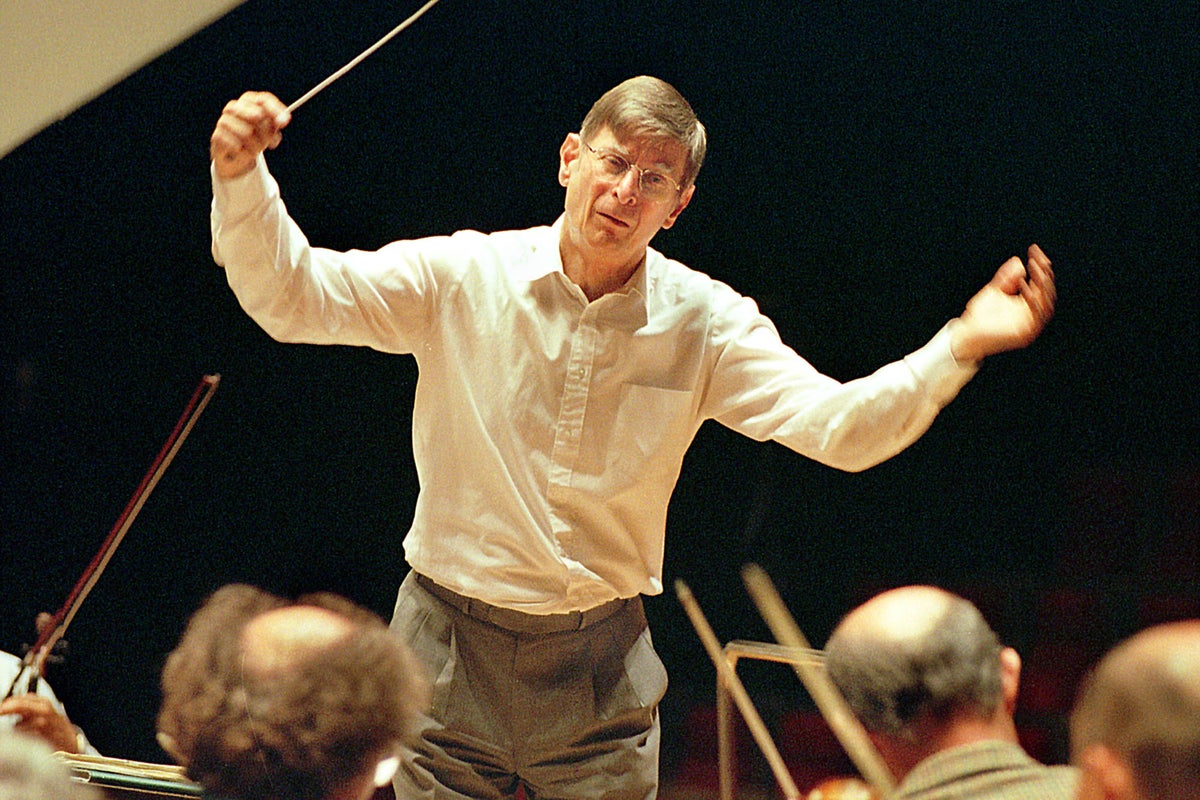
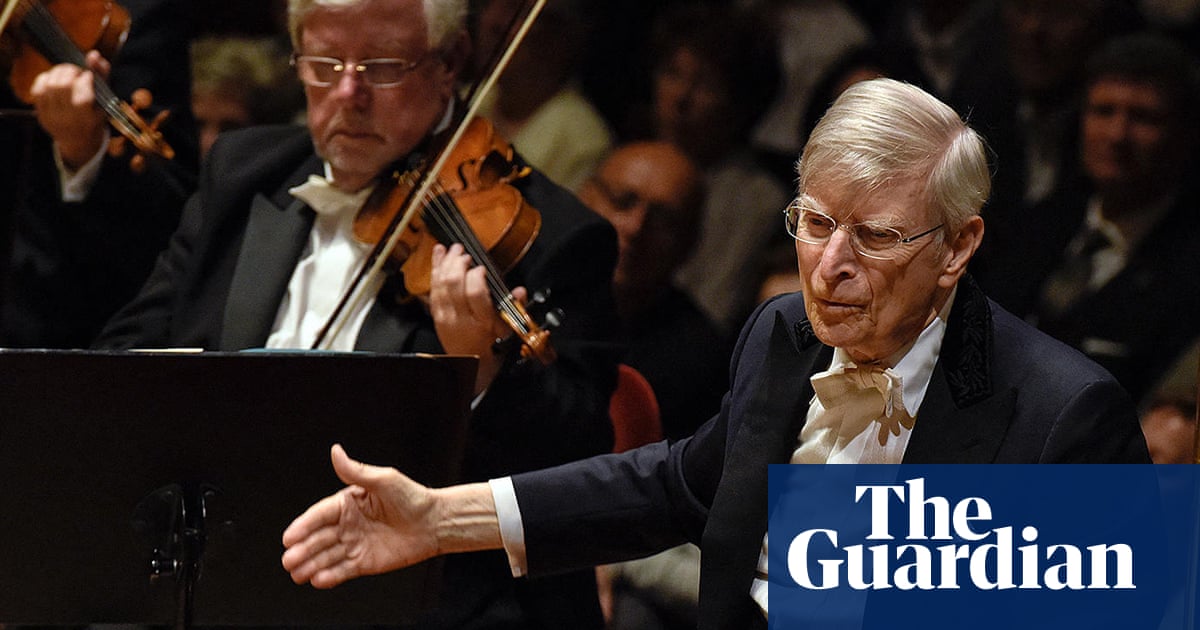
On leaving the full-time post in San Francisco, he held principal conductorships with the North German RSO (1996–98) and the Leipzig Gewandhaus Orchestra (1998–2005). When, as a spry nonagenarian, he subsequently brought the latter orchestra to London in 2017, the momentum he generated was less through brisk tempi than taut rhythms throughout the texture. His podium gestures ranged from four clenched fingers waving elegantly like a dorsal fin to wide-armed exhortations that elicited expansive playing from those high-calibre musicians.
Digging deep into the orchestral fabric, he sculpted big, muscular phrases into paragraphs characterised by finely calibrated dynamic levels.
In addition to the conductor laureateship in San Francisco, he later held honorary posts with several orchestras including the Bamberg SO, Danish National SO and others with which he had had earlier associations. In Britain he appeared as a guest conductor with the Philharmonia Orchestra, and in Japan with the NHK SO.
Interview with Herbert Blomstedt from 2020, starting with Bruckner’s Symphony No 4
Born in Springfield, Massachusetts, Herbert was the son of Swedish parents: Adolf Blomstedt, a Seventh-Day Adventist pastor and missionary, and his wife Alida Armintha Thorson, a piano teacher. When he was aged two, the family moved back to his parents’ native country, also living for a time in Finland.
After early lessons in conducting at the Swedish Royal College of Music (1945–50) under Tor Mann, and in musicology at the University of Uppsala (1948–52) under Carl-Allan Moberg, he studied contemporary music with John Cage at the Darmstadt Summer Course and Renaissance and Baroque performance practice at the Schola Cantorum in Basel. He subsequently studied conducting with Igor Markevitch at the Salzburg Mozarteum (1950–55), with Jean Morel at the Juilliard School of Music in New York (1953) and with Leonard Bernstein at Tanglewood, the summer festival in Massachusetts (1953), winning the Koussevitzky prize that year and the Salzburg conducting competition in 1955.
The training in historical performance practice doubtless stood him in good stead in his interpretations of the classics. His readings of Haydn and Beethoven remained in his senior years nimble and stylish, a Beethoven Pastoral Symphony in 2016 with the Leipzigers positively sprightly. At the Lucerne Festival in 2020 he and the 79-year-old Martha Argerich – his junior by nearly a decade and a half – delivered a vintage performance of Beethoven’s First Piano Concerto. Both alert to micro-inflections of weight, phrasing and colour, their sparkling articulation and rhythmic sweep exuded the joy of life.
Herbert Blomstedt conducting the Leipzig Gewandhaus Orchestra in Beethoven’s Pastoral Symphony in 2016
Among his many recordings are notable cycles of symphonies by Nielsen and Sibelius (with the San Francisco Symphony), Bruckner, Beethoven and Schubert (with the Staatskapelle Dresden) and Brahms (with the Leipzig Gewandhaus Orchestra). His Strauss tone poems were also acclaimed. His output was almost entirely restricted to the symphonic repertoire, but he did in 1977 produce the first recording of Beethoven’s Leonore, the prototype of Fidelio, in its original 1805 version, featuring Edda Moser as Leonore and Theo Adam as Don Pizarro.
Throughout his life he refrained from smoking, alcohol, meat and coffee, and as a strict Seventh-Day Adventist observing the sabbath he initially refused to rehearse or perform on Saturdays, even when this caused friction with orchestras.
The Berlin Philharmonic cancelled an engagement with him in the 1970s when he declined to rehearse on a Saturday. Later on, taking inspiration from his father, who he said delivered his ready-prepared sermons on the sabbath, he concluded that if he were to regard public performance as an act of worship, he could allow himself to deliver on the sabbath what had been studied in advance.
In 1953 he married Traute (Waltraud) Petersen, a linguist with a degree in musicology, who died in 2003. He is survived by four daughters and seven grandchildren.
Herbert Thorson Blomstedt, conductor, born 11 July 1927; died 4 November 2026