Your support helps us to tell the story
From reproductive rights to climate change to Big Tech, The Independent is on the ground when the story is developing. Whether it’s investigating the financials of Elon Musk’s pro-Trump PAC or producing our latest documentary, ‘The A Word’, which shines a light on the American women fighting for reproductive rights, we know how important it is to parse out the facts from the messaging.
At such a critical moment in US history, we need reporters on the ground. Your donation allows us to keep sending journalists to speak to both sides of the story.
The Independent is trusted by Americans across the entire political spectrum. And unlike many other quality news outlets, we choose not to lock Americans out of our reporting and analysis with paywalls. We believe quality journalism should be available to everyone, paid for by those who can afford it.
Your support makes all the difference.Read more
As the clock ticks down to the Netherlands’ opening World Cup match, soccer fans are gripped once more by orange fever.
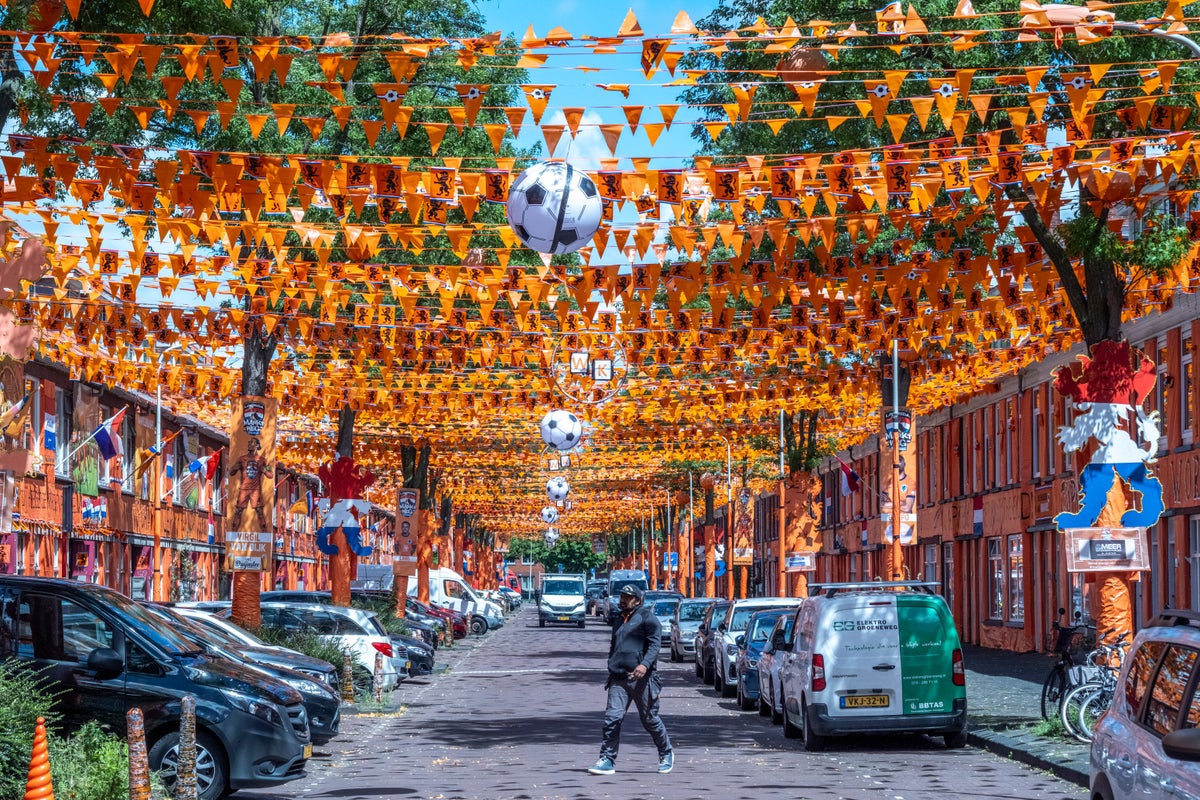
Nowhere is the mood of euphoric optimism that descends on parts of this country every time its national team plays at a World Cup more glaringly obvious than on the Marktweg in The Hague, where the local community comes together to crush as much orange as possible into virtually every square inch of their street.
From the thousands of tiny flags fluttering above the road to the facades of houses, trees and streetlights, everything is orange, apart from the few places that choose to display the red, white and blue of the Netherlands’ flag.
Depictions of lions — another national symbol — abound, many of them wearing the striking orange soccer shirt of the team known simply as “Oranje” — the Dutch word for orange.
Over the years, this epicenter of orange has become a popular destination for fans and an event that draws together neighbors who spend weeks transforming their street.
“So far, we haven’t encountered anyone who said ‘we don’t like it’ or complain about it,” organizer Danny van Dijk told The Associated Press on a visit Tuesday. “Up to now, we’ve only heard positive things.”
In a nod to an accommodation option often chosen by Dutch soccer fans, a single small red, white and blue caravan stands at an intersection surrounded by orange mesh and carrying a banner identifying it as the “Hague Orange Campsite.”
It will become a focal point for fans who aren’t traveling to the United States, where the Netherlands opens its Group F campaign against Japan on Sunday in Dallas, then plays Sweden in Houston on June 20 and completes its group stage against Tunisia six days later in Kansas City.
The country’s king, queen and crown princess will be in Houston for the Sweden match — and will watch Curaçao, which is part of the Kingdom of the Netherlands, play Ecuador. The national color is a consequence of the royals’ family name — Oranje-Nassau.
For a small nation of some 18 million, the Netherlands has often punched above its weight at the World Cup, reaching the final three times — 1974, 1978 and 2010 — but never winning the title.
If there were a world cup for street decorators, the residents of Marktweg would be serious contenders.
“The street is beautifully decorated. All that orange. That must have been a huge task,” said Rob van Rosmalen, an amateur photographer who visited the street Tuesday. “And it’s great that all the neighbors are working together like that seems to me that’s good for the neighborhood atmosphere.”
___
AP World Cup coverage: https://apnews.com/hub/fifa-world-cup