Report by Suleiman Siri for Radio Dabanga
Aviation expert and former director of Sudan’s Aviation Authority, Ibrahim Adlan, has confirmed that the arrival of a World Food Programme (WFP) aircraft, or any other humanitarian initiative at Khartoum airport carries many great connotations, which he described as direct, undeclared political and sensitive security at this time, stressing that it will not be used for any military purposes again.
Adlan told Radio Dabanga that the operation of flights for humanitarian purposes in an area that was considered the scene of military operations could not be achieved without prior arrangements of the warring parties in Sudan.
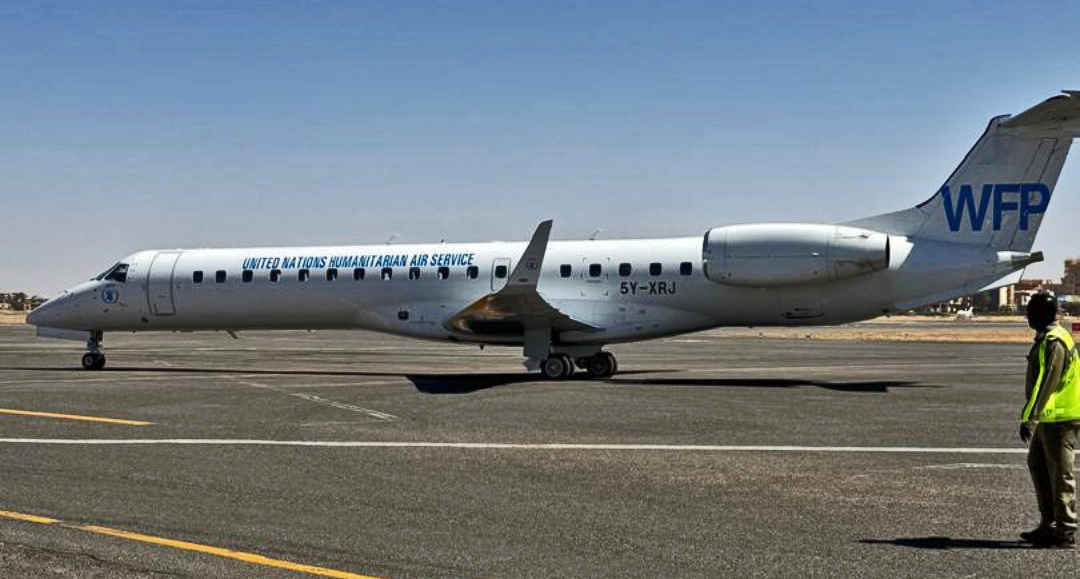
As previously reported by Radio Dabanga, a UN World Food Program flight landed at Khartoum airport on Thursday, the first flight of its kind since the outbreak of war in Sudan nearly three years ago, according to the U.N. humanitarian coordinator in the country, Dennis Brown.
The aviation expert said that these “security” arrangements were likely made between the Sudanese Armed Forces and the Rapid Support Forces, while all parties agreed to neutralise the airport as a starting point for humanitarian operations, conduct flights for this purpose, and distribute relief to the rest of the regions.
He stressed that according to these security understandings, this means, in practice, that Khartoum airport cannot be used again for military purposes or as a base for military operations at the same time during the implementation of the humanitarian mission, within the framework of commitments to ensure the safety of the crew, the plane and relief aid.
Security Guarantees
The former director of the Civil Aviation Authority, Ibrahim Adlan, predicted that the United Nations would have obtained written security guarantees from the party in control of the airport site, the Sudanese Armed Forces. He pointed out that there is a careful review and arrangements related to securing the airport’s perimeter extensively.
He added that these arrangements are linked to the measures taken by the government recently with the decision to end military appearances inside the capital, Khartoum, and to prevent the use of weapons within the scope of Khartoum airport during the period of humanitarian operation, explaining that the safety of the airspace is ensured, especially at low altitudes.
He explained that these security measures mean that there will be no person carrying a cannon or any type of weapon roaming in that area, or the areas around Khartoum airport, in order to maintain the security and safety of humanitarian work.
The “disengagement” mechanism
On the technical side, aviation expert Ibrahim Adlan said that there are procedures that are being reviewed related to the readiness of air navigation, control tower, and communication devices, and to ensure their work and effectiveness.
Adlan also explained that there is a mechanism known to the United Nations as the Deconfliction Mechanism or Disengagement Mechanism, which he said is a coordination measure used in conflict zones to locate humanitarian operations and neutralise them from military targeting.
This mechanism is based on the exchange of coordinates, risk assessments, and the issuance of comprehensive security assessments covering the airspace, the land ocean, and air traffic, before giving the green light to carry out the flight.
Observers believe that the activation of this mechanism at Khartoum airport reflects a certain level of coordination – direct or indirect – between the warring parties, even if it is minimal, allowing the passage of aid without endangering it.
Adlan had previously stated to “Radio Dabanga” that there are unannounced understandings between the two parties to the Sudanese conflict, the Sudanese Armed Forces and the Rapid Support Forces, and talks with international bodies, with the aim of neutralising Khartoum airport and reactivating it for humanitarian purposes within the United Nations plan and the initiative of the Quartet state to implement the “humanitarian truce”, as part of the efforts made by the US President’s Advisor for Arab and African Affairs, Massad Boulos.
The Quartet initiative includes the United States of America, Saudi Arabia, the Arab Republic of Egypt, and the United Arab Emirates.
Regular flights:
For his part, World Food Programme (WFP) spokesman Felipe Korf told Radio Dabanga that the flights of the United Nations Humanitarian Service (UNHAS) to Khartoum began last Thursday after a hiatus of nearly three years. He noted that the flight carried passengers from several UN agencies and NGOs as part of its work. He explained that the aircraft will make regular flights to Khartoum weekly in the future. He stressed that the United Nations Humanitarian Air Service (UNHAS) is managed by the World Food Programme (WFP) and provides safe, reliable, and cost-effective transportation services for passengers and light cargo, to serve the wider humanitarian community.