By: Staff Writer
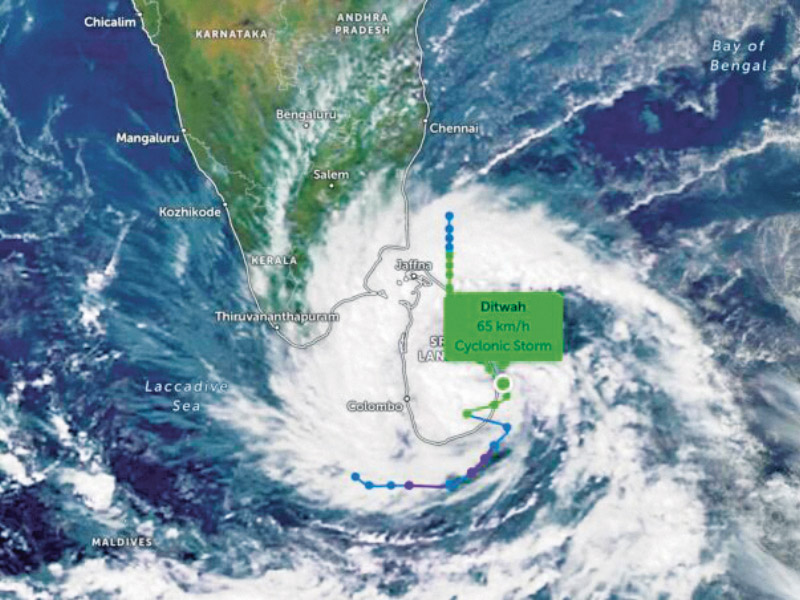
December 12, Colombo (LNW): Sri Lanka’s inability to forecast the recent cyclone with accuracy has sparked renewed scrutiny of the Meteorological Department’s long-running failures rooted not only in delayed technology but also in institutional neglect spanning nearly 20 years.
The centrepiece of this controversy is the Doppler radar: a tool used worldwide to track storm movements, wind speeds and rainfall intensity with extraordinary detail. It is standard equipment in modern weather services.
Yet Sri Lanka, an island acutely vulnerable to cyclones and monsoon floods, still does not have one functioning Doppler radar.
The government first attempted to acquire a unit in 2006 using a Rs 400 million allocation under a WMO-administered trust fund. That project ended in embarrassment. The radar, purchased from Enterprise
Electronics Corporation, was erected on a tower in Deniyaya, only for the supplier to later reveal it could not provide the necessary electronic connectivity.
The equipment fell into disuse, and to this day, its whereabouts remain unclear a failure the National Audit Office characterised as a serious lapse in procurement planning and technical evaluation.
A second opportunity emerged when JICA offered funding for two Doppler radars in 2017. Subsequent revisions reduced the proposal to a single installation at Puttalam. Despite this, the project stalled repeatedly. Officials cite pandemics, supply shortages and the economic crisis, but insiders point to deeper issues: chronic underinvestment, weak project oversight and an absence of urgency despite rising climate threats.
Contracts with Japanese firms were finally signed in mid-2024, setting a new completion target of 2027. For many meteorologists, this timeline is far too slow for a country already suffering the effects of climate volatility. Without Doppler data, forecasters rely on satellite imagery and outdated models that cannot predict sudden shifts—such as the rapid intensification that made recent storms so devastating.
The fallout from the misfired forecast has been intense. Residents in hardest-hit districts reported receiving late or conflicting warnings, leaving little time to evacuate. Public trust in the Met Department has plunged, and in a rare move, the Director General has been barred from engaging with media.
Climate experts warn that Sri Lanka cannot continue operating in “blind-spot mode.” As global weather systems become more erratic, Doppler radars are not luxury equipment but essential national security tools. Yet nearly two decades after the first attempt, Sri Lanka’s skies remain unmonitored.
The need for transparent investigation and urgent reform is now unmistakable. Unless the country ends its cycle of failed procurement and delayed implementation, future disasters will remain not just unavoidable but unpredictable.