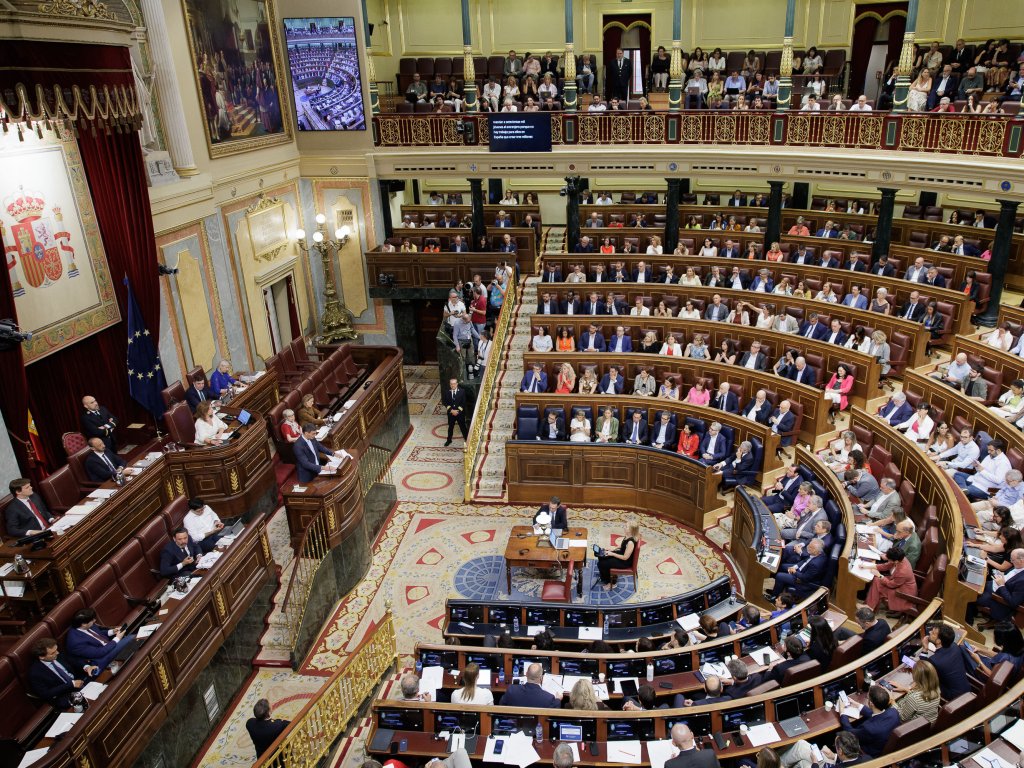
The Spanish Congress voted 176 to 166 against the proposal, with five abstentions, repeating exactly the outcome of an earlier vote a week previously. The result means the government has now failed twice to secure parliamentary backing for the fiscal path required before drafting its 2027 budget.
The proposal was opposed by the right-wing People’s Party (PP), the far-right Vox party, the Catalan pro-independence party Junts per Catalunya (JxCat) and the Unión del Pueblo Navarra, whose combined votes exceeded the absolute majority needed to defeat the measure.
The governing Socialist Party (PSOE) and its coalition partner Sumar were backed by the Basque Nationalist Party (EAJ-PNV), EH Bildu, Esquerra Republicana (ERC), the Galician Nationalist party (BNG) and the Canary Islands Coalition (CC), while the four Podemos MPs and the Compromís representative, now sitting in the ‘Mixed Group’, all abstained.
The defeat represents another obstacle for Prime Minister Pedro Sánchez’s minority coalition, which has struggled to secure enough support in Spain’s fragmented parliament. The country has been operating under the 2023 budget for three consecutive years after repeated failures to pass new spending plans, with the current accounts originally approved in 2022 by a previous parliament.
The latest vote also highlights the growing parliamentary isolation of the government. Several smaller parties that previously supported key legislation have become increasingly reluctant to do so, with some effectively writing off the remainder of the legislature amid corruption investigations involving the ruling PSOE. ALSO READ: Spain’s main opposition party claims the ruling socialists are in ‘irreversible decline’.
Despite the setback, the government insists it still intends to present a draft 2027 State Budget to parliament. Ministers are now expected to pursue an alternative approach by preparing the budget using tighter deficit limits that comply with the European Commission’s stricter fiscal rules.
That would remove the additional 0.1% of GDP deficit margin previously proposed for Spain’s Autonomous Communities, denying regional governments an estimated €5.84 billion in additional borrowing capacity over the next three years.
Although the government acknowledges such a budget would still face an uphill battle in parliament, it says it remains committed to attempting to restore a normal budget timetable before the legislature ends.
Sánchez has repeatedly pledged to remain in office until the end of the current parliamentary term despite mounting opposition calls for an early general election. If he follows through, Spain’s next national election must be held no later than August 2027. ALSO READ: Andalusia leaves Sánchez politically weakened as Spain edges further towards a PP-Vox era.
In a partial success for the government, MPs did approve separate measures designed to protect consumers and businesses from the economic effects of recent international conflicts, even as the broader fiscal framework was rejected.