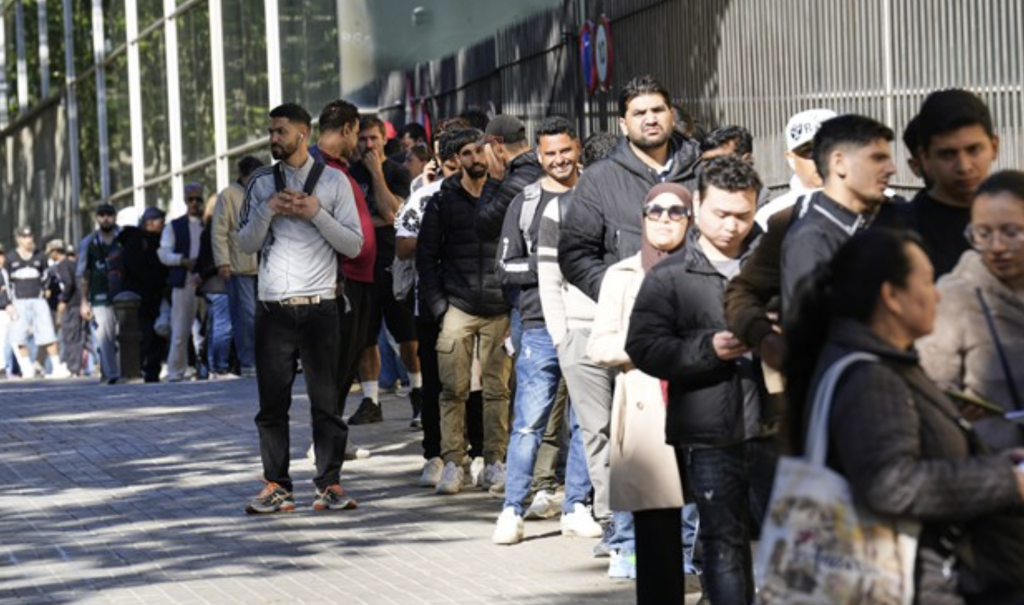
Spain’s landmark mass regularisation programme for undocumented migrants was set to close on Tuesday (30 June), bringing to an end a three-month process that has drawn more than one million applications and underscored the country’s increasingly distinctive approach to immigration within Europe.
Launched in April by the left-leaning government of Prime Minister Pedro Sánchez despite growing pressure across Europe for tougher migration controls, the scheme was originally expected to benefit around 500,000 people, most of them from Latin America. ALSO READ: Spain to commence mass regularisation of undocumented migrants.
Instead, demand has far exceeded expectations, with government figures and immigration officials indicating that between 1.2 and 1.3 million applications have now been submitted. ALSO READ: 900,000 migrants apply for Spanish residency drive with two weeks still to go.
By Friday, registrations had reached 1.27 million, according to César Pérez, the union leader representing Spain’s immigration officers. However, around 360,000 applications have already been declared admissible, according to Spanish media citing government sources, although many cases are still awaiting examination.
Applicants must demonstrate they had lived continuously in Spain for at least five months before 1 January, possess a clean criminal record and provide the required supporting documentation. The authorities will have up to three months after submission to assess each application and decide whether to grant a one-year residence and work permit valid only in Spain. ALSO READ: Spain granted citizenship to 300,000 foreigners in 2025 – highest annual figure since records began.
As the deadline arrived, non-governmental organisations intensified efforts to ensure as many undocumented migrants as possible were able to submit applications before the window closed, even if some paperwork remained outstanding.
Rights organisations CEAR and Cepaim encouraged applicants still waiting for documents from countries such as Mali, Iran and Venezuela to register before the Tuesday deadline, arguing that supporting documentation could be supplied later.
‘We’re carrying out a final check of all the people who have come to our offices and who may have been missing some documentation at the start of the process,’ Elena Muñoz, coordinator of CEAR’s legal team, told Spanish media.
‘If a case is not yet complete … we will submit it before 30 June so that they do not miss the opportunity to benefit from the regularisation process.’
Juan Segura, director-general of Cepaim, said migrants were being advised to lodge their applications because doing so would give them additional time to complete their files.
Experts say applicants from conflict-affected countries including Iran and Mali have struggled to obtain official documents through Spanish consulates, while similar bureaucratic difficulties have affected migrants from Algeria and Nigeria.
Many Venezuelan applicants have also experienced delays securing apostilled criminal record certificates. In addition, recent changes to Spain’s asylum policy required some Venezuelans to switch into the regularisation process only at the beginning of June, leaving them with considerably less time to prepare the necessary documentation.
‘This meant some Venezuelans had less time to gather the necessary documents,’ Segura said, adding that many now faced difficulties and extending the deadline would be advisable.
Spain’s Migration Ministry has said it has no plans to extend the scheme beyond Tuesday. ALSO READ: Spain to link newly regularised migrants with jobs amid labour shortages.
Rights groups have also expressed concern about what happens once the process concludes. CEAR has argued Spain needs a permanent pathway to legal residency so migrants are not forced to spend two years living irregularly before becoming eligible for legal status.
NGOs estimate that at least one in five applications could ultimately be rejected, citing incomplete documentation and limited administrative flexibility as major obstacles.
Spain, historically a country of emigration, has in recent decades become one of the European Union’s principal gateways for irregular migrants alongside Italy and Greece. Tens of thousands arrive each year, many after undertaking the dangerous Atlantic crossing from West Africa to the Canary Islands, although arrivals declined last year after reaching record levels in 2024.
Since the regularisation programme opened in April, long queues of men, women and children have formed outside immigration offices across Spain while many others have submitted applications online.
Sánchez has emerged as one of Europe’s strongest advocates of relatively open migration policies at a time when many neighbouring governments — including some led by fellow socialists — have tightened border and asylum rules under pressure from increasingly influential far-right parties.
His position has reportedly led to tense exchanges behind closed doors with several European leaders, including Italian Prime Minister Giorgia Meloni. ALSO READ: Spain stands alone as EU backs tougher deportation rules and overseas return centres.
‘Those who already live in our country and contribute to the economic development of our country deserve to have the same rights as any other citizen,’ Sánchez said after a recent European Union summit in Brussels.
The PSOE leader argues the policy will help address labour shortages in sectors such as construction while supporting one of the world’s fastest-growing advanced economies.
Spanish business organisations have broadly welcomed the initiative, but the right-wing and far-right opposition have fiercely criticised it, arguing that it will encourage further irregular immigration. Their anger was heightened by the minority government’s decision to introduce the measure by decree rather than seeking parliamentary approval.