
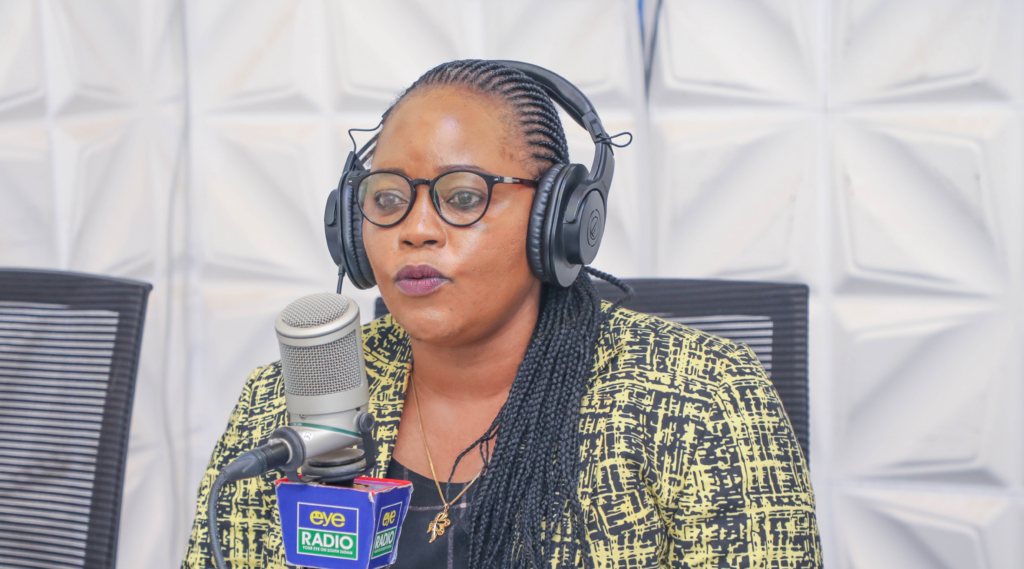
Dr. Harriet Akelo Pasquale, Director-General for International Health and Coordination, discusses the Ministry of Health’s strategy to protect essential services during a live interview at Eye Radio studios. February 4, 2026. Photo: Eye Radio/Moses Awan
JUBA, South Sudan (Eye Radio) – The National Ministry of Health has moved to reassure the public following the restructuring of the World Bank-supported Health Sector Transformation Project (HSTP), clarifying that 95% of essential health services across the country will remain fully operational despite the suspension of support to 102 facilities.
Speaking on the Dawn Show on February 4 regarding the strategic “right-sizing” of the project, Dr. Harriet Akelo Pasquale, Director-General for International Health and Coordination, emphasized that the decision was a proactive measure to prevent an abrupt collapse of the national health system.
“It is vital to explain to the public that this exercise was conducted to utilize available funding efficiently and ensure that essential health services are not interrupted,” Dr. Harriet stated. “Through this modeling exercise and impact analysis, we have ensured that 95% of the health services previously provided will be preserved.”
She pointed out that the ministry applied a strict set of criteria to identify which facilities would be transitioned out of the donor-funded program.
Dr. Harriet stated that in cases where two health facilities were located in proximity, one was discontinued to reduce duplication and maximize resources, while facilities with low patient turnout were prioritized for scale-down.
She said on accessibility challenges, the ministry accounted for South Sudan’s complex context, noting that some areas have become non-operational or inaccessible due to persistent insecurity or climate change impacts, such as severe flooding.
Dr. Harriet stated that the Ministry maintains that these measures are a “last resort” designed to protect the core of South Sudan’s healthcare referral pathways and ensure that the most critical, high-traffic centers remain funded through June 2027.
When South Sudan’s Ministry of Health and its international partners gathered in 2024 to chart a new course for the country’s fragile health system, hope was high. The outcome of those discussions was the Health Sector Transformation Project (HSTP)—a flagship initiative designed to strengthen health service delivery, protect mothers and children, and reach the country’s most vulnerable populations.
Dr. Harriet, who has been closely involved in steering the project through both ambition and adversity, explains: “This project was born out of partnership. The Ministry of Health, donors, and implementing partners agreed that South Sudan needed a coordinated, transformative approach to health service delivery.”
The HSTP is financed through a Multi-Donor Trust Fund managed by the World Bank, with support from a consortium including the United Kingdom, the European Union, and Canada. At its inception, the United States and the Government of Norway were also part of the funding partnership.
Originally designed as a three-year project running from 2024 to 2027, the HSTP aimed to support 1,158 health facilities nationwide, with a strong focus on maternal and child health. But global realities soon reshaped local plans.
As international funding priorities changed and aid budgets tightened worldwide, the project faced unexpected challenges. During implementation, South Sudan lost two major donors—the United States and Norway—significantly reducing the available funding envelope.
Despite these setbacks, Dr. Harriet says the project did not stop. “We still have the World Bank and other donors standing with us; the question became how to use the resources we have to keep services running.”
She notes that due to funding constraints, the number of supported health facilities was first reduced from 1,158 to 816. Over the past year, the Ministry of Health and its partners successfully implemented the project in these 816 facilities.
However, by December 2025, continued funding shortages made it clear that further action was unavoidable. Faced with the risk of interrupted health services, the Ministry undertook an extensive review to find efficiency gains. “We needed savings of about 18.7 million US dollars just to sustain services for the year,” Dr. Harriet explains.
The review examined every component—from facility coverage to incentive payments and implementing partner costs—involving detailed modelling to assess the impact of each decision. The outcome was a series of difficult but deliberate adjustments.
One major decision was to further reduce the number of supported facilities from 816 to 714—a cut of 102 health facilities. In addition, six hospitals experienced a reduction in support, shifting from hospital-level assistance to state-level or primary health care support.
Cost-saving measures were also introduced across other areas. Incentive payments, previously provided to all supported facilities, were reduced in rate, while implementing partner costs and supply chain expenses were scaled down. “These were not random cuts,” Dr. Harriet stresses.
“Every decision was guided by data and clear criteria.” To minimize disruption, priority was given to avoiding duplication; where two facilities were close to each other, one was removed to ensure resources were not spread too thin.
Facilities that were underutilized—often due to insecurity, poor access, or climate-related challenges like flooding—were also considered for reduction. Patient attendance data played a key role in determining which facilities served smaller populations and could be excluded without severely affecting access.
The result, according to Dr. Harriet, is that 95 percent of health services previously provided under the project will be preserved. “Our main objective was to keep services running,” she says. “Interrupting health service delivery would have had far more serious consequences.”
While the current adjustments are described as temporary, the long-term sustainability of South Sudan’s health system remains a pressing concern. Under the original agreement, the Government of South Sudan was expected to contribute 10 million US dollars—a commitment that has yet to be met.
Dr. Harriet notes, “We are still engaging the government on this; domestic health financing is critical if we are serious about sustainability.”
At the same time, the Ministry continues to engage donors, exploring new options to maintain service delivery despite shrinking global aid. Dr. Harriet adds, “For the future of our health system, we cannot rely on external funding alone. National ownership and increased domestic investment are the only way forward.”
As South Sudan navigates an uncertain funding landscape, she said the HSTP stands as a reminder that resilience is about adaptation, coordination, and the determination to keep essential services alive for those who need them most.
Previous Post
WFP suspends activities in Baliet county after convoy attacks


