
Your support helps us to tell the story
From reproductive rights to climate change to Big Tech, The Independent is on the ground when the story is developing. Whether it’s investigating the financials of Elon Musk’s pro-Trump PAC or producing our latest documentary, ‘The A Word’, which shines a light on the American women fighting for reproductive rights, we know how important it is to parse out the facts from the messaging.
At such a critical moment in US history, we need reporters on the ground. Your donation allows us to keep sending journalists to speak to both sides of the story.
The Independent is trusted by Americans across the entire political spectrum. And unlike many other quality news outlets, we choose not to lock Americans out of our reporting and analysis with paywalls. We believe quality journalism should be available to everyone, paid for by those who can afford it.
Your support makes all the difference.Read more
One of the most complete human ancestor fossils ever found could be an entirely new species, according to a new study.
The fossil, found in South Africa’s Sterkfontein Caves in 1998 and dubbed “the Little Foot”, was widely believed to be a member of the Australopithecus genus of ape-like upright-walking human ancestors that lived between 3 million and 1.95 million years ago.
When the fossil was first unveiled to the world in 2017, it was attributed to the species Australopithecus prometheus. However several experts maintained that it belonged to Australopithecus africanus.
Now, a new study suggests that Little Foot doesn’t share unique traits with either species, raising the possibility that it may represent an altogether new species.
“This fossil remains one of the most important discoveries in the hominin record, and its true identity is key to understanding our evolutionary past,” said anthropologist Jesse Martin from La Trobe University.
“We think it’s demonstrably not the case that it’s A prometheus or A africanus. This is more likely a previously unidentified, human relative,” said Dr Martin, an author of the new study published in the American Journal of Biological Anthropology.
“Our findings challenge the current classification of Little Foot and highlight the need for further careful, evidence-based taxonomy in human evolution.”
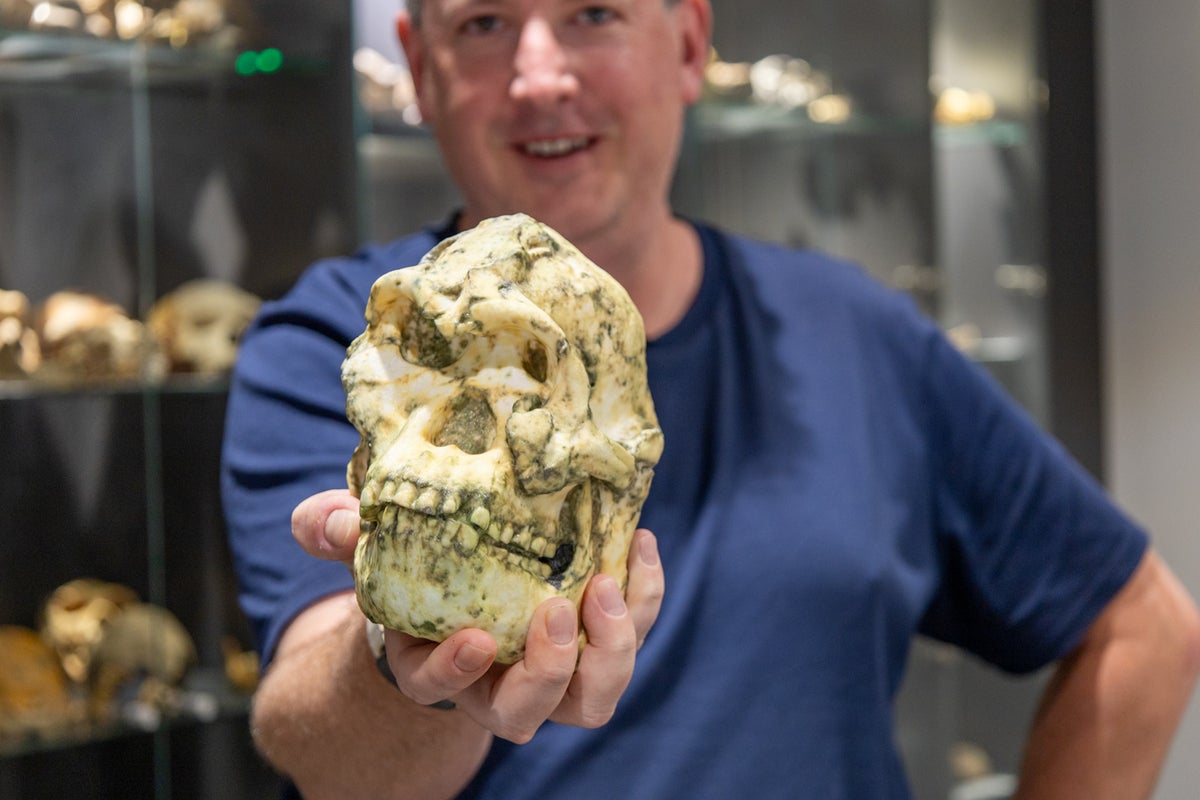
Jesse Martin holding a 3D print of the Little Foot skull (La Trobe University)
“We find that the morphology preserved by StW 573 doesn’t support assigning that specimen to A prometheus because it does not share a unique suite of primitive and derived traits in common with the A prometheus type specimen MLD 1,” researchers said in the latest study.
In future studies, scientists hope to test and clarify which species Little Foot represents and where that species sits in the human family tree.
“It is clearly different from the type specimen of Australopithecus prometheus, which was a name defined on the idea that these early humans made fire, which we now know they didn’t,” said anthropologist Andy Herries, another author of the study.
“Its importance and difference to other contemporary fossils clearly show the need for defining it as its own unique species.”


