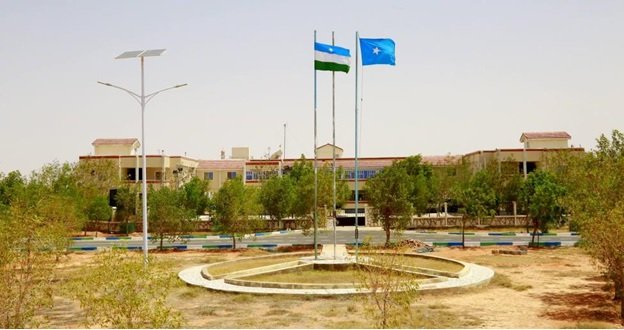
Garowe (WDN) – Puntland has formally ordered that military personnel and vehicles operating under the authority of Somalia’s Federal Government will no longer be permitted to enter, transit through, or remain within Puntland territory, marking a dramatic escalation in the long-running dispute between Garowe and Mogadishu.
In a statement issued following a meeting of the Puntland Council of Ministers, the regional government declared that Puntland does not currently consider itself part of Somalia’s federal military structure until a comprehensive political agreement is reached on the unresolved disputes between Puntland and the Federal Government.
The Council instructed all Puntland security agencies to enforce the directive, stating that no armed forces other than those officially under Puntland’s command will be allowed to operate within its jurisdiction. The decision comes amid growing controversy over the Federal Government’s recent appointment of General Jimcaale Jaamac Takar as commander of the Somali National Army’s 54th Division, a military formation whose headquarters is designated to be in Garowe, the capital of Puntland.
According to reports, the 54th Division is intended to oversee federal forces operating within Puntland’s regions. The move has fueled political tensions, particularly after newly recruited troops reportedly arrived in Galkayo following recruitment efforts in the town of Galdogob.
Puntland authorities and many local residents view the federal initiative with deep suspicion. Critics argue that the recruitment and deployment of federal-aligned forces inside Puntland is not a genuine national security effort but a politically motivated attempt to undermine Puntland’s stability and autonomy.
Among sections of the Puntland public, there is a growing belief that the force being assembled resembles a clan-based militia structure rather than a neutral national military formation. These critics accuse a number of Puntland-born politicians aligned with Mogadishu of facilitating the effort for political gain.
Several opposition figures, including Somalia’s Interior Minister Ali Hosh, Deputy Minister of Finance Mohamed Xaange along with other politicians associated with the former political network known as Aaran Jaan, that once held power in Puntland, have become the target of fierce criticism from Puntland supporters. Their opponents accuse them of serving as political operatives for former President Hassan Sheikh Mohamud and of supporting policies perceived as harmful to Puntland’s interests.
Such accusations reflect the increasingly bitter political atmosphere that has emerged between Puntland and federal authorities. Supporters of Puntland’s position argue that certain politicians have abandoned regional interests in pursuit of personal political rewards, while their critics maintain they are working within Somalia’s constitutional framework.
The dispute has now moved beyond politics and into the legal arena. According to activists and community groups, efforts are underway to compile complaints and petitions for submission to international organizations concerned with accountability, conflict prevention, and human rights.
Organizers behind these initiatives allege that individuals involved in efforts to destabilize Puntland should face international scrutiny. They claim documentation relating to financial assets, political activities, and other evidence is being collected for possible submission to relevant international bodies.
While no international organization has publicly announced any investigation, the growing campaign reflects the depth of anger among sections of the Puntland population, many of whom view recent federal actions as a direct threat to the peace and stability the region has maintained for decades.
The standoff represents one of the most serious confrontations between Puntland and Mogadishu in recent years. As both sides harden their positions, observers warn that the dispute risks further fragmenting relations between Somalia’s federal institutions and one of its most influential federal member states.
For many Puntland residents, the issue has become larger than a disagreement over military command structures. It is increasingly being framed as a struggle over political autonomy, constitutional authority, and the future balance of power within Somalia’s federal system.
Unless meaningful dialogue resumes, the latest measures taken by Puntland are likely to deepen mistrust and further widen the already significant divide separating Garowe and Mogadishu.
WardheerNews