By Osman A. Hassan
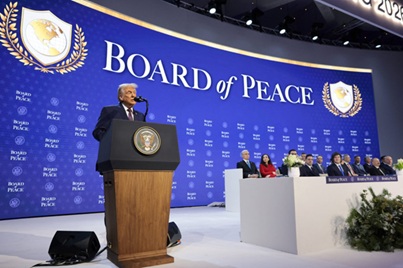
Board of Peace
The idea of a “Trump Peace Board” applied to Gaza and the broader Palestinian question represents a powerful metaphor for a radical shift in how peace, power, and diplomacy are imagined in the twenty-first century. In this conceptualization, Donald Trump appears as a CEO-President, directing strategy with the logic of executive decision-making rather than traditional diplomacy, while Benjamin Netanyahu functions as a principal implementing partner—sometimes portrayed as a secretary of policy execution within a coordinated U.S.-Israel framework aimed at reshaping the political future of Palestinian land, sovereignty, and governance. This metaphor does not merely describe personalities; it dramatizes a structural transformation in global politics where unilateral executive power, bilateral strategic alignment, and transactional diplomacy begin to overshadow multilateral institutions such as the United Nations, the European Union, and NATO. Within this narrative, these organizations are perceived by critics as being symbolically “switched off,” not literally dismantled but politically sidelined in the most consequential decisions regarding Gaza and the Israeli–Palestinian conflict.
The Trump-as-CEO framework rests on a worldview that treats geopolitics as a negotiation arena rather than a moral-legal process. In this worldview, conflicts are not primarily historical tragedies or ethical dilemmas but disputes to be resolved through leverage, incentives, and decisive agreements. The “Peace Board” thus becomes analogous to a corporate boardroom where stakeholders are not equal sovereign actors but parties with varying degrees of influence, bargaining power, and dependence. Israel, backed by U.S. financial, diplomatic, and veto power in global forums, becomes the dominant operational partner, while Palestinians appear as a party expected to accept terms framed as pragmatic solutions to an otherwise intractable conflict. The CEO model assumes that strong leadership and bold deals can overcome decades of stalemate, yet it also raises profound questions about legitimacy, representation, and justice.
One of the central claims embedded in this is that the United States, by virtue of its economic strength and consistent use of veto authority in international institutions, positions itself as both financier and guarantor of Israel’s strategic security doctrine. From this perspective, Washington’s role is not neutral mediation but strategic partnership, shaping negotiations in ways that critics argue privilege Israeli security concerns and territorial control over Palestinian sovereignty claims. This perceived imbalance fuels the argument that a Trump Peace Board is less a neutral negotiation platform and more a calculated policy architecture designed to finalize long-standing strategic goals under the banner of ending conflict. Supporters would counter that U.S. involvement is indispensable precisely because no other power can guarantee security assurances or mobilize resources on a scale capable of stabilizing the region. This further suggests that the “plan” is not spontaneous but historically ripened in an accumulation of policies, alliances, and geopolitical calculations waiting for a moment of political opportunity. Elections, domestic political shifts, and regional normalization agreements create windows in which previously controversial proposals become operationally feasible. In this interpretation, the CEO-President and the Israeli Prime Minister are not improvising but executing a long-calculated strategy aligned with security doctrines, regional alliances, and domestic political imperatives. The narrative portrays the deal as ripe, scheduled, and opportunistic, ready to be implemented once political conditions align domestically and internationally.
Similarly, the analogy that compares peace negotiators to a predator mediating between itself and its prey reflects a deeply critical moral argument: that negotiations perceived as dominated by one side’s strategic interests risk lacking credibility among the weaker party. Such a critique does not merely attack personalities; it questions whether asymmetrical power structures can ever produce genuinely balanced agreements. Sustainable peace, according to this line of thought, requires mediators who are seen as legitimate by both sides, not only powerful enough to enforce terms. If Palestinians perceive negotiators as structurally aligned with Israeli strategic goals, any proposed agreement risks being interpreted as imposed rather than mutually agreed, thereby undermining its long-term viability regardless of short-term enforcement. The role of key advisers and strategists in shaping such peace frameworks is also significant. Figures like Steve Witkoff and Jared Kushner became emblematic of a new style of diplomacy rooted in business negotiation tactics, regional economic integration proposals, and the idea that prosperity could soften political resistance. This approach emphasized investment, infrastructure, and regional normalization as pathways to stability, suggesting that economic incentives might gradually reduce hostility and create conditions for political compromise. Many critics, however, argued that economic development without political rights risks appearing as a substitute for genuine sovereignty, potentially deepening grievances rather than resolving them.
The President Trump’s peace board “switch off” of the UN, EU, and NATO is best understood as a symbolic critique of declining multilateral influence rather than a literal dismantling of global institutions. For decades, UN resolutions, EU diplomatic initiatives, and international legal frameworks have shaped discourse on the conflict, yet their inability to enforce final settlements has generated widespread frustration. The CEO-style model capitalizes on this frustration, presenting itself as a decisive alternative to slow, consensus-driven diplomacy. It implies that peace will not emerge from endless negotiations and resolutions but from a decisive power-backed agreement capable of imposing order and guaranteeing compliance. However, this vision also contains a paradox.
While unilateral leadership can accelerate decisions, peace in Gaza requires more than enforcement; it demands legitimacy, local acceptance, and long-term reconciliation. Agreements perceived as externally engineered may secure temporary calm but often fail to address deeper historical grievances rooted in displacement, identity, and contested sovereignty. Without addressing these foundational issues, even the most sophisticated peace architecture risks becoming a framework for managing conflict rather than resolving it.
Another dimension and concerns perception identified in negotiation processes. As many critics argue that negotiators’ backgrounds, ideological orientations, or political affiliations influence the direction of policy proposals, shaping which priorities are emphasized and which grievances are minimized. While such perceptions are politically powerful, a responsible analytical approach must distinguish between legitimate critique of policy alignment and the dangerous oversimplification of reducing complex diplomatic strategies to ethnic or religious identity. Policy decisions are shaped by strategic calculations, institutional interests, domestic politics, and geopolitical alliances; attributing them solely to identity risks obscuring these broader structural factors and can undermine the possibility of nuanced, constructive critique. The Trump Peace Board narrative also reflects a deeper transformation in how global leadership is imagined. Traditional diplomacy relied on multilateral conferences, gradual confidence-building measures, and legalistic frameworks rooted in international law. The CEO model instead emphasizes speed, branding, and decisive announcements, presenting peace as a deliverable product rather than a gradual process. This approach resonates with political constituencies fatigued by decades of stalemate, but it also risks oversimplifying the complexity of entrenched conflicts that require societal healing, historical acknowledgment, and grassroots reconciliation in addition to elite-level agreements.
Moreover, the close strategic alignment between Washington and Jerusalem under this framework highlights the enduring centrality of U.S.–Israel relations in shaping the conflict’s trajectory. Financial aid, military cooperation, intelligence sharing, and diplomatic coordination create a partnership that significantly influences regional dynamics. Supporters of this alignment argue that Israel’s security is non-negotiable and that strong U.S. backing deters wider regional escalation. Critics counter that such unwavering support reduces incentives for compromise and reinforces asymmetrical negotiation dynamics, making it more difficult to achieve a solution perceived as just by Palestinians. The “death” of international organizations, therefore, represents not their disappearance but a crisis of confidence in their ability to deliver decisive outcomes. The UN remains empty shell that continues to administer humanitarian programs, the EU remains a major donor and diplomatic actor, and NATO shapes broader regional security calculations. Their influence persists, yet the perception that decisive power now resides in bilateral executive alliances reflects a broader shift toward great-power pragmatism in global politics. In this emerging order, legitimacy is increasingly measured by effectiveness and enforcement capacity rather than universal endorsement.
Read more: President Trump’s Veto Power and Palestine Peace Board Plan Switch-off The UN, EU, NATO and Other International Organizations
Osman Ali Hassan
Email: abayounis1968@gmail.com