By Isha Qarsoon
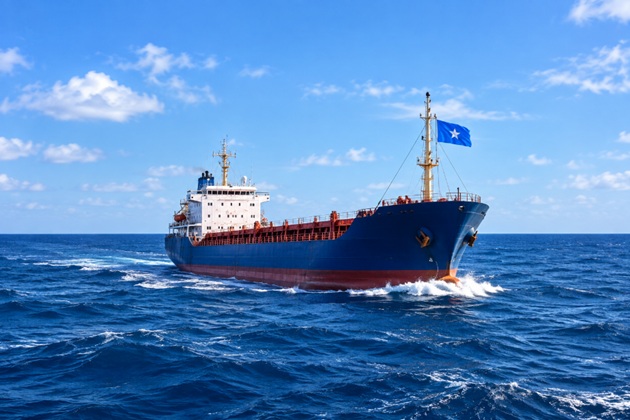
On the night of September 9, 2026, drones struck a tugboat named TEDY near Odesa, Ukraine. The vessel was hit again as it tried to reach Constanta. Two Azerbaijani crew members were killed and two suffered burns. Its ten-person crew included Azerbaijani, Turkish, German and Ukrainian nationals. Mert Marine Corporation, a Turkish company, owned the tug. TEDY sailed under the Somali flag. No Somali was aboard. [1]
Ukraine’s government blamed Russia and described the attack as part of a wider campaign against civilian shipping. Russia’s Defence Ministry said it had struck two cargo vessels and a tugboat near Odesa, alleging that the ships were carrying military supplies. It did not identify TEDY, and the connection between its statement and the attack has not been independently confirmed. Azerbaijan did not attribute responsibility. The competing accounts do not change the point. A Turkish-owned vessel with an entirely foreign crew carried Somali nationality into a European war.
The attack does not prove that the registry was inappropriate. A ship under any flag can be attacked in a war. Also, a ship crew does not have to include nationals of the flag it is sailing under. The attack exposes, however, the scale of the risk Somalia accepted: within months of reviving its ship registry, Somali nationality appeared on a foreign-owned ship with a foreign crew operating in a European conflict. Somalia acquired the flag state’s legal duties and reputational exposure without acquiring control of the voyage. The Turkish ownership was not incidental: Turkish interests already run Somalia’s main port and airport, train and help command its military, hold rights to its offshore oil and fish stocks, and now operate the very registry that flagged TEDY in the first place. TEDY is the trigger for examining what happens when that system is abused.
What a flag of convenience is
The term flag of convenience entered common use in the 1950s. American owners had used Panama between the two world wars to avoid domestic taxes, labour rules and crewing requirements. Liberia opened its international registry in 1948, and Honduras later joined the historical group known as PanLibHon. A flag of convenience generally describes a vessel registered in a country other than the country of its beneficial ownership or commercial control, often to reduce costs or avoid stricter regulation. A 1970 British government inquiry identified six common features of flag of convenience: foreign ownership or control, easy registration and withdrawal, low taxation, a registry maintained mainly for fee income rather than national shipping needs, unrestricted foreign crews, and limited capacity or willingness to enforce shipping rules.[3] These are descriptive indicators, not a binding legal test.
Somalia’s new registry displays several of those features. On March 30, 2026, Abdulkadir Mohamed Nur, then minister of ports and marine transport, signed a memorandum with Somali Ship Register Limited, represented by Turkish national Cagdas Oykun Saltas. On April 2, 2026, the government announced GUNEY as the first vessel admitted under the revived flag. It was foreign-owned or controlled, had just left the Honduran flag, and was registered while in Turkey.[2] The memorandum was signed on March 30, 2026, and Guney entered the register three days later, on April 2. That interval is too short for an owner unfamiliar with a newly created registry to locate it, complete a flag change out of Honduras, and clear administrative review. It indicates the vessel’s move to the Somali flag was arranged before the memorandum was signed, not decided afterward, which means the registry and its first customer were not two separate developments but one planned transaction presented as two. The September attack revealed that TEDY, another Turkish-owned vessel, was flying the Somali flag.[1] The public record establishes that Somalia opened its nationality to foreign shipping through a foreign private operator before publishing how that operator would be supervised.
Private administration is not automatically disreputable. Liberia and the Marshall Islands show that an overseas administrator can coexist with effective state regulation.
Somalia’s problem is the political setting. The registry entered a relationship in which Turkey and Turkish-linked bodies already occupy Somalia’s airport, port, military and maritime security, petroleum, fisheries licensing and prospective minerals.[8] In that setting, abuse cannot be treated as a remote possibility to be considered after the first scandal. It is the working risk that should govern the registry. The burden belongs on the government to prove that Somali officials can refuse, suspend and deregister a ship against Turkish commercial or political pressure.
The duties stay with Somalia
Article 91 of the United Nations Convention on the Law of the Sea requires a genuine link between a ship and the state whose flag it flies. Article 94 requires the flag state to exercise effective jurisdiction and control over administrative, technical and social matters. Those duties include maintaining a register, enforcing safety and crewing standards, and investigating serious casualties.[4] A private registrar may process applications, collect fees and arrange surveys. It cannot take Somalia’s international responsibility with it.
UNCLOS’s genuine-link rule offers less protection than its wording suggests. In M/V Saiga, the International Tribunal for the Law of the Sea held that the absence of an effective link does not, by itself, allow another state to refuse recognition of a vessel’s nationality. Coastal and port states retain enforcement powers under other rules, but they cannot erase the Somali flag simply because Somalia fails to control the ship. UNCLOS therefore leaves the main burden where Somalia placed it: on Somalia.
What abuse would cost Somalia
The first cost is damage to the flag’s reputation. A poorly maintained vessel may be detained because of its own deficiencies. The Paris Memorandum of Understanding on Port State Control coordinates inspections of foreign ships entering participating European and North Atlantic ports. It classifies flags according to their inspection and detention records over a rolling three-year period. A flag enters the white, grey or black list only after at least thirty inspections. Once that threshold is met, repeated deficiencies and detentions can push the flag into a worse category and subject other vessels flying it to greater scrutiny.[5] Reputable owners then face higher inspection, insurance and chartering costs merely for carrying the same flag. The fastest customers to leave are often the ones Somalia should want to keep.
The second cost is loss of control over who claims Somali nationality. The International Maritime Organization has documented fraudulent registrations and unauthorized use of flags, including several African flags targeted by vessels seeking a permissive or unverifiable identity.[6] A new international registry with opaque records is attractive to operators fleeing another flag, concealing ownership, manipulating vessel identities or avoiding scrutiny. If Somalia cannot publish and verify its register in real time, foreign authorities and commercial databases will struggle to distinguish a valid Somali ship from a fraudulent one. Both damage the same name.
The third cost is sanctions exposure. The US Treasury’s Office of Foreign Assets Control administers sanctions in support of United States foreign policy and national security. A Somali flag provides no immunity when a vessel, owner, manager, or service provider is subject to a US sanctions program. OFAC has warned that helping a blocked carrier reflag its vessels may constitute providing services to a blocked person and may itself support designation.[7] Misconduct by one vessel would not automatically subject Somalia or its registry to sanctions. It could nevertheless associate the Somali flag with weak screening, increase scrutiny of other vessels flying it, and discourage reputable owners from using the registry.
The remaining costs are practical and political. Unsafe ships injure crews. Uninsured ships leave pollution and wreck-removal claims behind. Deceptive ships switch off tracking, falsify cargo papers or move sanctioned oil and weapons. Ships trading near wars pull the flag state into disputes it did not create. Each event demands records, investigation, cooperation and enforcement from Mogadishu. If the Somali government cannot or will not act against a vessel admitted by a Turkish operator, Somalia carries the liability while foreign owners and managers keep the commercial benefit.
The control question
The registry memorandum has not been published. The public therefore cannot see who has final authority over admission, beneficial-ownership checks, sanctions screening, surveyors, casualty investigations, suspension, deregistration, data and audits. Even if there is no public evidence that Ankara formally directs Somali Ship Register Limited, formal instructions are not the only measure of control. When a government already depends on the same foreign partner across its principal gateways, security and resources, the registrar’s independence cannot simply be presumed.
Nur, who signed the registry memorandum and invited international owners to use the flag, later became Speaker of the House of the People. The issue is larger than one official. Somalia has built a structure in which the state must police ships brought to it through a relationship it may be politically unable to challenge. That conflict is exactly how a flag of convenience becomes dangerous: enforcement against a ship can also become a confrontation with the power behind the registry.
Conclusion
TEDY is a warning of potential misconduct. It shows how quickly Somalia’s legal identity can travel far beyond Somali commerce, territory or control. The next case may involve sanctions evasion, pollution, crew abuse, false registration or a voyage that serves a foreign war. By the time that case arrives, the cost will already carry Somalia’s name.
The government licensed use of its flag through a Turkish-run company inside a relationship already marked by extreme dependence. Before more ships are admitted, Somalia should publish the memorandum and the live register, keep final registration and deregistration authority in accountable Somali hands, require independent ownership and sanctions screening, audit the operator, and fund the investigations and enforcement required by UNCLOS. Without those safeguards, Somalia will collect registration fees while assuming legal, diplomatic and reputational risks it cannot control. That is the harm an abused flag of convenience can do.
Isha Qarsoon
Email: Ishaqarsoon1@gmail.com
——-
Isha Qarsoon- is a platform dedicated to addressing critical issues pertaining to good governance, corruption, and social challenges.
—–
Sources
1. TEDY attack: https://www.euronews.com/2026/09/11/two-azerbaijani-sailors-killed-in-black-sea-tugboat-drone-attack; The Insider: https://theins.ru/en/news/297038; OC Media: https://oc-media.org/two-azerbaijani-citizens-killed-in-drone-attack-on-cargo-ship-in-black-sea/.
2.Somali registry and GUNEY: https://sntv.so/2026/03/30/muxuu-yahay-heshiiska-cusub-ee-wasiirka-dekadaha-iyo-gadiidka-badda-xfs-uu-saxiixay/; https://www.aa.com.tr/en/africa/somalia-registers-ship-under-national-flag-after-over-3-decades/3888956.
3.Flag-of-convenience definition and Rochdale criteria: https://www.itfglobal.org/en/sector/seafarers/flags-convenience; https://www.cambridge.org/core/journals/american-journal-of-international-law/article/flags-of-convenience-vessels-recent-developments/DDC208B5B2F58FF1E9884D68355D954C; https://discovery.nationalarchives.gov.uk/details/r/C10967884.
4.UNCLOS and M/V Saiga: https://www.un.org/depts/los/convention_agreements/texts/unclos/unclos_e.pdf; https://www.itlos.org/fileadmin/itlos/documents/cases/case_no_2/published/C2-J-1_Jul_99.pdf.
5.Port-state-control rankings: https://parismou.org/2025-performance-lists/.
6.Fraudulent ship registration: https://www.imo.org/en/ourwork/legal/pages/fraudulent-registration-and-fraudulent-registries-of-ships.aspx. 7.Maritime sanctions: https://ofac.treasury.gov/recent-actions/20120719; https://ofac.treasury.gov/media/37751/download?inline. 8.Turkey’s wider position in Somalia: https://cabinet.gov.so/en/policies/framework-agreement-on-defence-and-economic-cooperation-between-turkiye-and-somalia; https://www.reuters.com/business/energy/turkey-signs-energy-cooperation-deal-with-somalia-2024-03-07/; https://www.aa.com.tr/en/africa/turkiye-somalia-to-cooperate-in-fisheries-sector/3773577; https://oag.gov.so/special-audit-report-on-favori-llc-decale-hotel/; https://www.albayrak.com.tr/en/sectors/port-management/; https://www.hurriyetdailynews.com/somalia-eyes-new-mining-deal-with-turkiye-210309; https://wardheernews.com/facts-figures-who-really-controls-somalias-oil-and-gas-part-i/; https://wardheernews.com/somalias-turkey-hydrocarbons-agreement-how-somalia-gave-away-its-oil-and-gas-fields-part-ii/; https://wardheernews.com/somalias-turkey-hydrocarbons-agreementwho-had-the-authority-to-sign-it-part-iii/