Foreign Policies
The protection of schools, hospitals and other publicly accessible places, the fight against drug-related crime and effective border protection were high on the agenda of a meeting held by the interior ministers of the Visegrad Group countries and Austria in Kosice on Thursday.
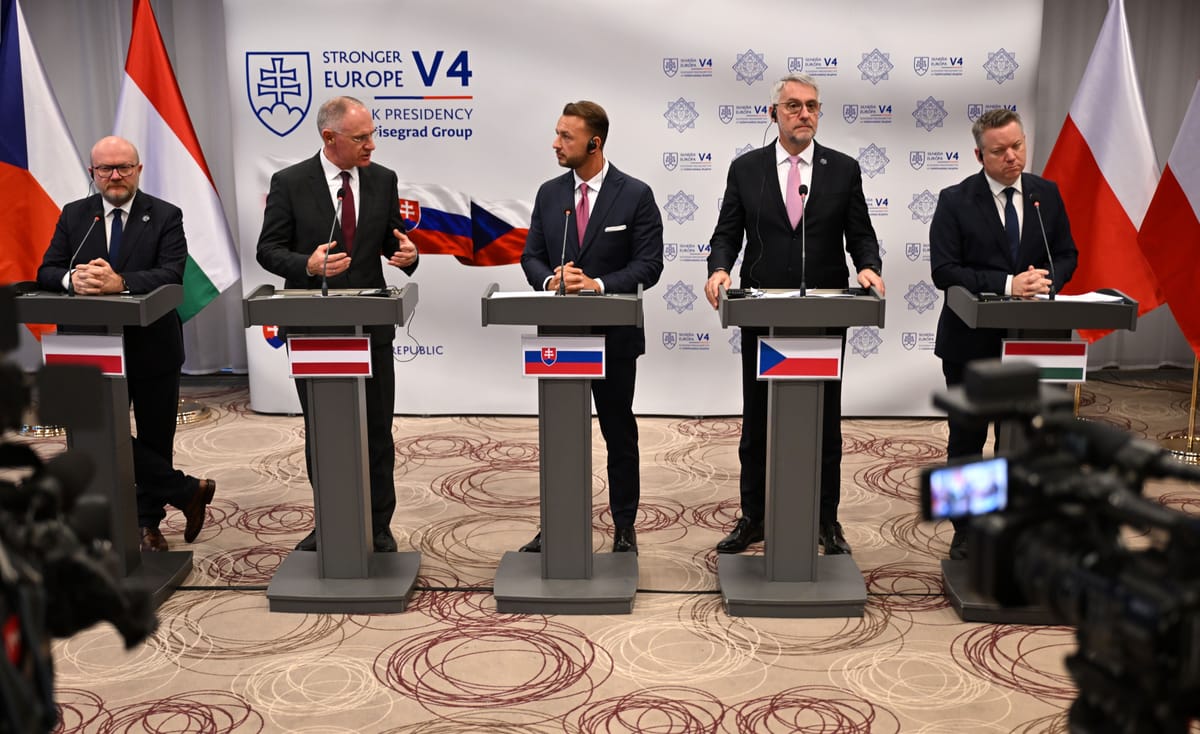
Pictured from left: Poland’s Undersecretary of the Interior Maciej Duszczyk, Austrian Interior Minister Gerhard Karner, Slovak Interior Minister Matus Sutaj Estok, Czech Interior Minister Lubomir Metnar and Hungarian Interior Minister Gabor Posfai (photo by TASR)
Kosice, 26 November (TASR) – The protection of schools, hospitals and other publicly accessible places, the fight against drug-related crime and effective border protection were high on the agenda of a meeting held by the interior ministers of the Visegrad Group (V4) countries (Slovakia, the Czech Republic, Hungary and Poland) and Austria in Kosice on Thursday.
The ministers agreed on the need to coordinate their approaches and exchange information. The meeting, held as part of Slovakia’s V4 presidency, resulted in the signing of a joint declaration on these issues.
In addition to Slovak Interior Minister Matus Sutaj Estok (Voice-SD), the meeting was attended by ministers from the Czech Republic, Hungary and Austria – Lubomir Metnar, Gabor Posfai and Gerhard Karner (respectively). Poland was represented by Maciej Duszczyk, Undersecretary of the Ministry of the Interior and Administration.
According to the Slovak Interior Ministry, the guests spent the morning observing security measures along Slovakia’s eastern border – which serves as a Schengen border with Ukraine – as part of a security and law-enforcement operation codenamed ‘Green-East’. In practice, they familiarised themselves with the coordination between the police, armed forces and financial administration, the deployment of joint patrols and the use of modern technologies in detecting illegal migration, people smuggling and the trafficking in hazardous materials.
“We managed to agree on joint approaches and reach a consensus on key security issues, including with our Austrian partner,” Sutaj Estok said after the talks. He stressed that the meeting once again confirmed the viability and relevance of the Visegrad Group.
According to the ministry, expert teams will continue working on the areas outlined in the declaration, with the partners aiming to jointly implement the agreed-upon proposals and regularly assess their results.
Regarding the protection of so-called ‘soft targets’, the ministers agreed to exchange experience, particularly in the early identification of risks, securing of premises and practical drills for crisis situations. The aim is to improve the security of schools, hospitals, transport hubs and other publicly accessible places, which regularly face threats such as bomb alerts.
Sutaj Estok also identified the prevention of radicalisation and extremism – along with professional communication during crises so that people know what’s happening and how to act – as an important aspect of protecting ‘soft targets’. In this context, the ministers cited tragic incidents that occurred in Krakow (Poland) and Graz (Austria).
Another area of cooperation will be the fight against drug-related crime, particularly synthetic drugs, highly potent opioids, the illegal online sale of pharmaceutical substances and the misuse of transport routes. The Slovak minister informed his counterparts about preparations for a separate law on new psychoactive substances, through which Slovakia aims to respond to rapidly evolving forms of drugs and the risks they pose to children and young people. He also drew attention to a worrying increase in the illegal sale of unregistered peptides and anabolic agents, which easily reach young people through postal and delivery services, as well as a rise in pharmaceutical crime.
The discussion will be followed by two expert meetings in Bratislava in the first half of 2027. They will focus on the river transport safety and the fight against the illegal market in peptides and anabolic steroids.