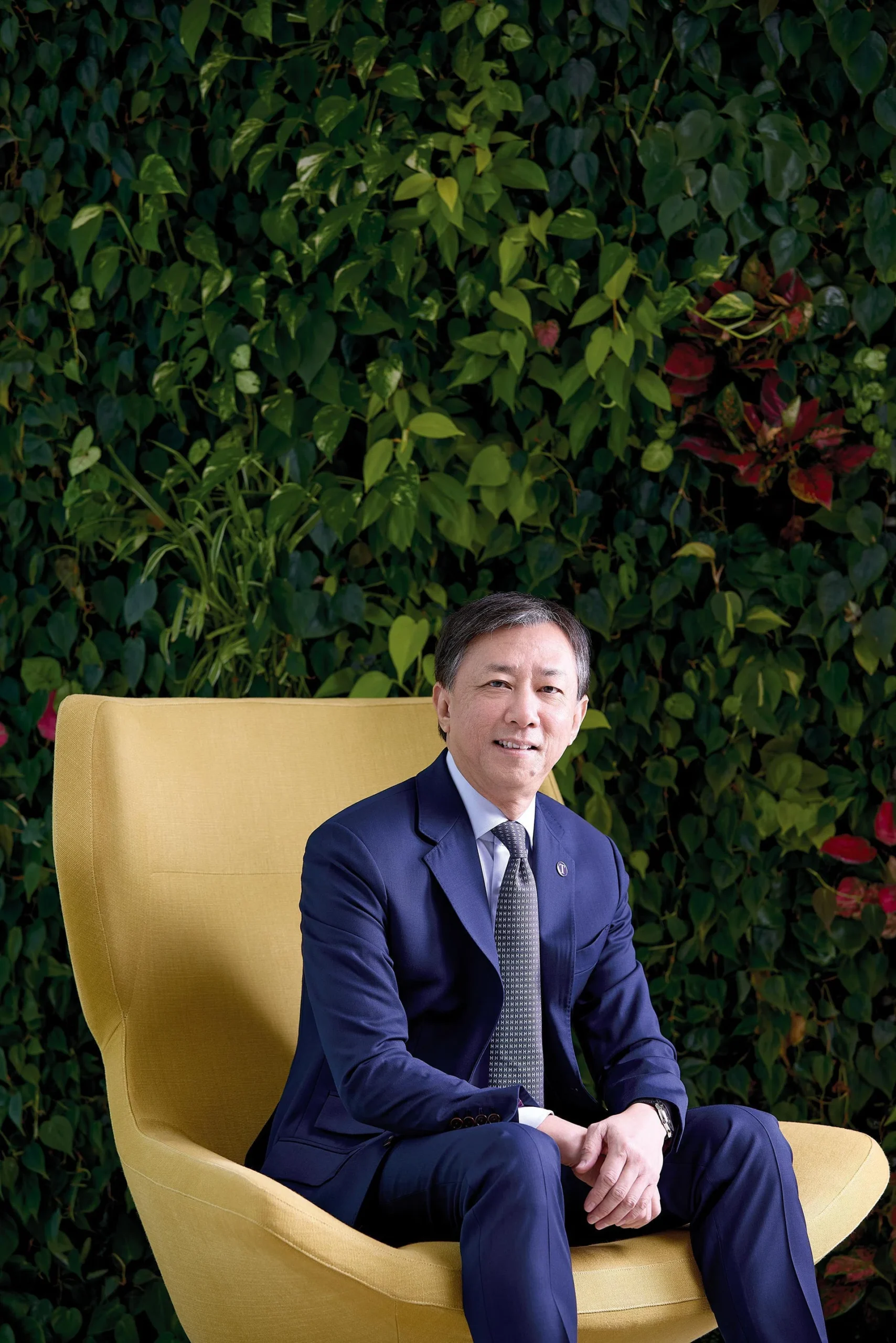
It plans to grow AI-linked investments from 6% to 15% of its portfolio, says Temasek Global Investments’ CEO
[SINGAPORE] As markets remain caught up in the latest hype over SpaceX and artificial intelligence, investment company Temasek has been quietly focused on tapping AI’s potential to see where it can be used to boost its portfolio.
This has involved actively supporting its portfolio companies to accelerate their use of AI. Temasek has also been making more AI-related investments, with plans to grow them further. Thirdly, it is using AI to help it achieve superior performance as an investor.
As Temasek announced that its portfolio hit a fresh record of S$518 billion for the year ended Mar 31, Chia Song Hwee, CEO of Temasek Global Investments, spoke to The Business Times about Temasek’s AI journey.
Back in 2016, before the AI boom, the investment company was already ahead of the game by identifying digitisation as one of four key structural trends that would guide its investments.
In 2019, it set up an AI-focused pod. This comprised a multidisciplinary team with hands-on engineers who could apply analytics, machine learning and the early stages of generative AI (GenAI).
A couple of years later, Temasek founded Aicadium to co-innovate and scale AI products in partnership with its portfolio companies. It has a team of more than 60 technologists, engineers and researchers across Singapore and the US. They aim to develop and scale AI applications to help portfolio companies solve their real-world challenges.
Chia said: “From years back, we rolled out initiatives in digitisation and, through our AI pod, built early AI capabilities within the organisation – including through startups like Aicadium. That prior work gave us a better understanding of the success factors for implementing AI capabilities.”
Continued focus on portfolio companies to tap AI
As at end-March, stakes in the Temasek Portfolio Companies (TPCs), including the likes of DBS, Singapore Airlines and ST Engineering, accounted for about 43 per cent of Temasek’s overall portfolio.
Apart from ongoing efforts, forums have been organised for the leaders of TPCs to keep them abreast of the latest developments in AI.
SEE ALSO
In the past year, there have been trips to Silicon Valley, Shanghai and Hangzhou to see how AI is affecting businesses and how TPCs can benefit from these trends.
Chia highlighted the key questions companies must address in implementing AI. These include clarifying and framing the problem statement on the technology front; they would also need access to the right set of use cases, data sets and an adequate data management system.
In the case of TPCs, those in financial services would already have such capabilities; it can be more challenging for those with physical assets. These businesses need a “real-world model” – essentially one with AI that operates in the physical world of machinery and movement, rather than through a large language model.
Chia cited international port operator PSA for managing to tap AI and digitisation to address the manpower issue at its ports.
He said: “I would like everyone to run faster; and they acknowledge the opportunities. We will continue to encourage them and create resources to assist them.”
Evaluating AI-related investments
Even as TPCs press on with AI adoption, Temasek plans to grow the proportion of its AI-related investments from the current 6 per cent to as much as 15 per cent of its overall portfolio by Mar 31, 2031.
Nevertheless, it is mindful of the challenges that arise when investing in AI, one of them being able to “discern what is noise and what will fundamentally affect the investment”, he added.
Take the global sell-off in software stocks earlier in 2026, on the back of investors’ fears that these businesses would be disrupted by the rise of agentic AI – the more advanced version of AI that can reason, plan and act on its own to achieve a goal with minimum human oversight – compared with GenAI that generates text.
It is important to distinguish between the leaders in the field who still have a competitive edge and those who will face disruption. Chia acknowledges that after the sell-off, the valuations of these software stocks have now become more realistic, given their forward-looking growth and the value of their products.
He added that software stocks, either directly held or through funds, form only a low single-digit proportion of Temasek’s overall portfolio.
The latest Temasek Review showed that the investment firm has stakes in high-profile AI stars Anthropic and OpenAI.
Chia said Temasek’s investment approach has been to invest at the later stage of a company’s growth, which – all things being equal – lowers risk.
He also pointed out that Temasek has indirect and earlier-stage exposure to both companies through its fund investments – reflecting its multilayered approach to investing in higher-risk opportunities, through which direct, fund and co-investment routes are taken to manage risk and exposure.
The ability of a company to deliver a return on investment is another important consideration.
Chia said: “We have to see what the go-to-market (ability to bring products to the market) is. The technology may be compelling, but we may not know about the monetisation prospects or even if there will be customers.”
Investing in AI and technology requires an understanding of the technology as well as commercial considerations. Chia said Temasek’s various partnerships play a useful role in providing it with valuable information.
For example, Temasek joined the AI Infrastructure Partnership – a consortium formed by BlackRock, Global Infrastructure Partners and MGX – which gives it access to critical AI infrastructure.
Being part of such an ecosystem enables Temasek “to get access to investing opportunities – important especially for companies that sit in this part of the world”, said Chia.
Given geopolitical tensions, Temasek has to give due consideration to how its various investments – especially private investments in the tech and AI space – are perceived by various parties. “We do not want our actions to be misinterpreted, which then creates more problems for us,” he added.
Enabling better portfolio performance with AI
While Temasek is galvanising its portfolio companies on the AI front, it is also expending efforts on training its 1,000-strong workforce, to make them AI-fluent and eventually be more productive.
On the investing front, AI has the potential to improve Temasek’s investment returns.
“AI can help in making better decisions, in evaluating areas in which we could have done better, and codifying it into a system to ensure that there is a lower probability of missing out on good investments, underestimating risks and identifying blind spots,” he said.
But Chia cautioned against expecting an AI lift to move the needle substantially for Temasek’s portfolio in the short term. As a bottom-up investor, and given the gestation period of new investments, it will take time for the benefits to show at the portfolio level.
The make-up of the portfolio
As Temasek’s portfolio grows, even a large absolute gain would be less significant in percentage terms.
Another factor is the make-up of Temasek’s portfolio, nearly 40 per cent of which is classified as Global Direct Investments (GDIs). These include stakes in publicly listed stocks and privately held investments. Singapore-based TPCs comprise the bulk of the remaining portfolio.
While the GDI segment is targeted to have a higher risk-return profile – higher risks are usually linked to higher returns – it delivered 10-year returns of around 8 per cent, similar to the TPC portfolio.
One reason is that a sizeable proportion, around 40 per cent, of the GDI segment is invested in unlisted companies.
Chia, explaining how the returns in private investments work, said: “When we make a private investment, there’s usually a thesis behind it. It’s about supporting the company to grow its top line (and) bottom line. That’s where we get the value uplift from its profit or cash-flow generation.
“It typically takes five to seven years before you see the results.”
Meanwhile, there are investments which are maturing and may be sold off. These are displaying healthy returns, but are being diluted by new investments, which are still in their gestation period.
“As a result, the GDI’s returns and the TPCs’ returns have coincidentally landed at similar levels – not because they are structurally alike, but because the weight from newer GDI investments has narrowed what would otherwise be a wider gap.”
Still, Chia concluded that in the long term, “we know that if we do our job right, we’re going to get better returns. If AI can help us do the right thing more consistently, eventually this will translate to better results for the portfolio, and a higher return.”