AYV News, July 1, 2026
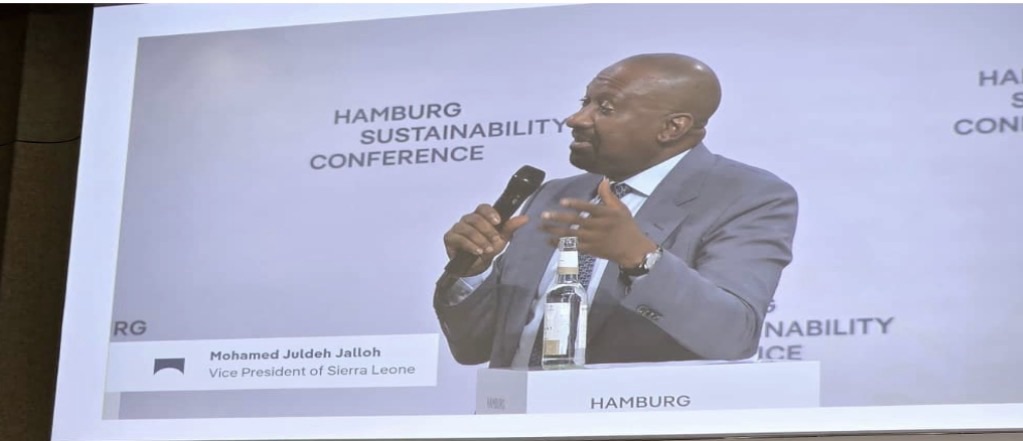
Sierra Leone’s Vice President, Dr. Mohamed Juldeh Jalloh, has called for stronger global cooperation and greater support for developing nations to withstand the impact of geopolitical crises, as he joined world leaders and international development partners at the Hamburg Sustainability Conference (HSC) 2026 in Germany.
The conference brought together heads of state, senior government officials, presidents of multilateral development banks, United Nations leaders, and global policymakers to discuss strategies for strengthening international resilience, sustainable development, climate action, and economic stability amid growing global uncertainty.
Vice President Juldeh Jalloh participated alongside an array of prominent international leaders, including German President Frank-Walter Steinmeier, World Trade Organization Director-General Dr. Ngozi Okonjo-Iweala, Asian Development Bank President Masato Kanda, United Nations Deputy Secretary-General Amina J. Mohammed, Germany’s Federal Minister for Economic Cooperation and Development Reem Alabali-Radovan, United Kingdom Minister of State for International Development and Africa Baroness Jennifer Chapman, United Nations Development Programme (UNDP) Administrator Alexander De Croo, and President of the African Development Bank Group Dr. Sidi Ould Tah.
From the official leaders’ reception at Hamburg’s historic City Hall to a series of high-level policy discussions, the Sierra Leonean Vice President engaged with international counterparts on issues relating to sustainable development, economic resilience, peace, and global partnerships.
A major highlight of his participation was his contribution to the high-level panel discussion titled “Navigating the Hormuz Crisis: Forging a Collective Response,” which followed a keynote address by United Nations Deputy Secretary-General Amina J. Mohammed.
Drawing on his experience as a former United Nations governance and security expert for West Africa and the Sahel, as well as his current role as Vice President of an import-dependent economy, Dr. Juldeh Jalloh underscored the disproportionate impact that global geopolitical conflicts have on developing countries.
He warned that disruptions to key international shipping routes, particularly the Strait of Hormuz, have consequences that extend well beyond energy markets, affecting food security, public finances, and overall human development.
“For the Global South, an oil shock is never just an oil shock. It becomes a food shock, a fiscal shock, and ultimately a human development shock,” the Vice President stated.
He stressed that countries in the Global South remain highly vulnerable to external economic shocks despite contributing the least to many of the crises affecting the international community. He therefore called for stronger international cooperation, more resilient global supply chains, and increased investment in sustainable development to help vulnerable economies withstand future disruptions.
The Hamburg Sustainability Conference serves as a major international platform for dialogue among governments, international financial institutions, the private sector, and civil society on advancing the United Nations Sustainable Development Goals (SDGs) and strengthening global resilience.
Sierra Leone’s participation at this year’s conference reflects the country’s continued engagement in international policy discussions aimed at promoting sustainable economic growth, climate resilience, and inclusive development while strengthening partnerships with global development institutions.