
Sierra Leone is no longer a quiet participant in international justice. Its judges are seated in courtrooms where global disputes are resolved, international crimes are prosecuted, and regional human rights standards are enforced. From The Hague to West Africa and beyond, Sierra Leonean jurists are shaping legal outcomes that extend far beyond national borders.
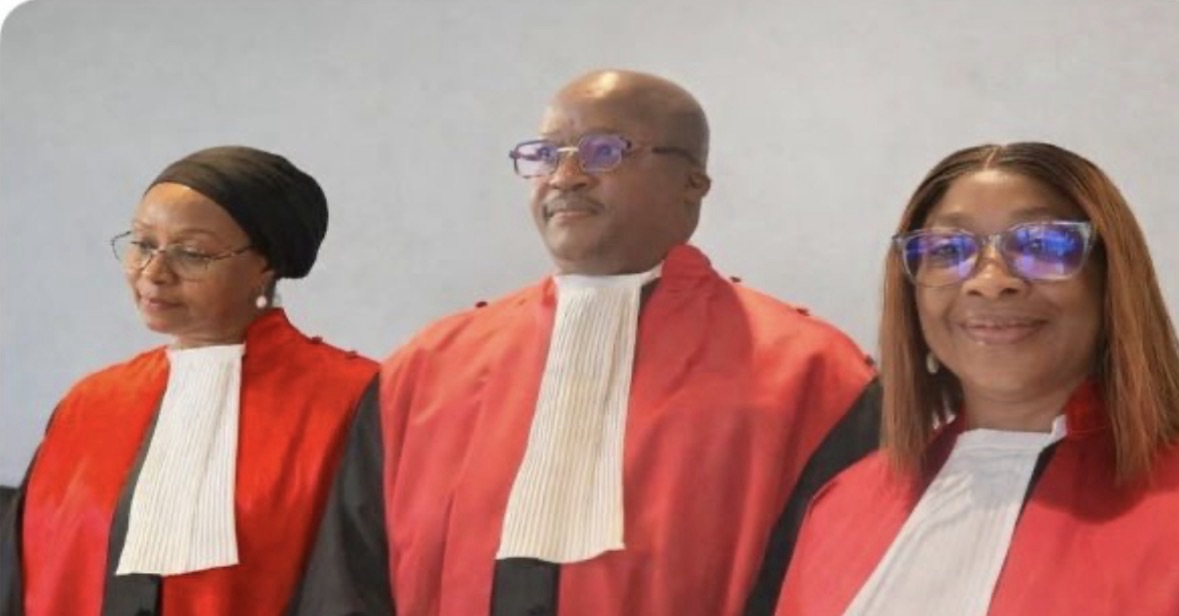
On 26 February 2026, Chief Justice Komba Kamandawas appointed as a Judge of the Residual Special Court for Sierra Leone in The Hague. His appointment strengthens Sierra Leone’s historic link to a court born out of the country’s own pursuit of accountability. He joins Supreme Court Judge, Honourable Justice Fatmatta Bintu Alhadi, who now serves as a Judge of the same Court. Honourable Justice Tonia Barnett has also been appointed as Staff Appeal Judge by the Judges of the Residual Special Court.
Their appointments add to the distinguished service of other Sierra Leonean jurists at the Court, including the Honourable Emanuel Eku Roberts and the Honourable Alusine Sesay. Together, they represent continuity, experience, and sustained confidence in the professional standards of Sierra Leone’s bench.
Sierra Leone’s international judicial footprint extends well beyond the Residual Special Court. Honourable Justice Abdul G. Koroma served two terms as a Judge of the International Court of Justice, the principal judicial organ of the United Nations. His tenure placed Sierra Leone at the centre of landmark decisions involving state responsibility, treaty interpretation, and territorial disputes.
Honourable Justice Osman Keh Kamara now serves as a Judge of the International Tribunal for the Law of the Sea, contributing to the adjudication of complex maritime and ocean governance issues. Justice M. Samba sits as a Judge at the International Criminal Court, where proceedings address genocide, crimes against humanity, and war crimes. Sengu Koromaserves as a Judge of the ECOWAS Court of Justice, reinforcing regional accountability and the protection of fundamental rights within West Africa.
Sierra Leone’s influence is not confined to the bench. Professor Charles Chernor Jalloh, an internationally respected scholar and practitioner of international criminal law, stands as a key contender for election as a Judge of the International Court of Justice. His candidacy signals intellectual depth and generational continuity in Sierra Leone’s contribution to global legal thought.
These gains reflect more than individual merit. They also mirror coordinated national support. The administration of President Julius Maada Bio, in partnership with the Ministry of Foreign Affairs and International Cooperation, has intensified diplomatic engagement to promote qualified Sierra Leonean judges and legal scholars for positions within international courts and tribunals. Strategic lobbying, multilateral outreach, and sustained advocacy have become central to expanding Sierra Leone’s representation in global legal institutions.
International judicial elections are competitive. They demand reputation, credibility, and diplomatic backing. By aligning judicial excellence with foreign policy strategy, Sierra Leone has positioned itself as a country willing to compete and capable of succeeding at the highest level of international adjudication.
Since assuming office in December 2024, Chief Justice Kamanda has prioritised judicial diplomacy and institutional reform. Structured partnerships with foreign judiciaries, participation in global judicial forums, and targeted capacity-building initiatives have increased exposure to international standards in adjudication, ethics, and court administration. Training programmes, exchange schemes, and reforms in case management continue to strengthen the domestic justice system.
“Our judiciary must not only administer justice within our borders but also stand confidently among the community of nations,” Chief Justice Kamanda stated. “By investing in capacity building and creating opportunities for international exposure, we are strengthening the integrity of our institution and demonstrating that Sierra Leonean judges can contribute meaningfully to global jurisprudence.”
Within legal circles, these developments are viewed as markers of institutional maturity. They signal a judiciary that has moved from post-conflict reconstruction to active participation in shaping international legal norms.
From the International Court of Justice to the International Criminal Court, from the International Tribunal for the Law of the Sea to the ECOWAS Court of Justice, and through continued service at the Residual Special Court for Sierra Leone, Sierra Leonean jurists are not observing the evolution of international law from a distance. They are contributing to it directly.
Sierra Leone has moved beyond the margins. Its judges are helping write the legal narrative of our time.


