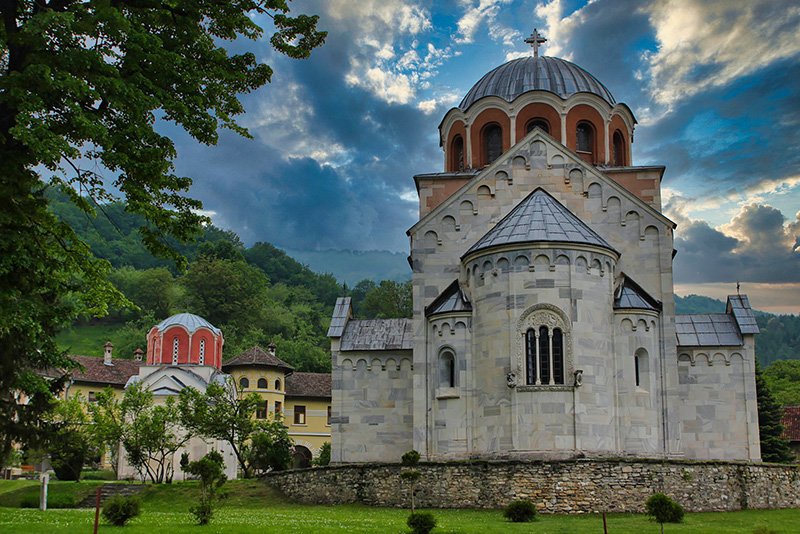
Kosovo’s requirement, which dictates that from 1 August Orthodox pilgrims visiting monasteries and churches in Kosovo and Metohija must be accompanied by a tour guide licenced in Pristina, is yet another attempt by Albin Kurti to restrict the arrival of large numbers of Serbs to KiM, analysts tell Blic.
As they point out, whilst Kurti cannot legally restrict freedom of movement and religious freedom in KiM, this move demonstrates precisely what troubles him.
Kurti has until 7 August to find a coalition partner to secure the necessary majority in the Pristina parliament to form a government and elect a president. Should he fail, Kurti will be forced to call yet another election – his fourth in under two years. However, he appears less concerned with this political challenge and more focused on targeted measures against the Serbs.
Following the unlawful demolition of Serbian holiday homes at Lake Gazivode and the ban preventing Serbian prosecutors from returning to work, Kurti has now decided to effectively equate pilgrim visits to KiM with standard tourism from 1 August.
The Eparchy of Raška and Prizren reacted swiftly, warning that religious journeys cannot be equated with commercial travel arrangements.
Gogić: Pristina cannot ban freedom of movement
Political scientist Ognjen Gogić says that Pristina cannot ban the freedom of movement for pilgrims in Kosovo and Metohija.
“If groups of pilgrims arrive in Kosovo and Metohija without a guide licenced in KiM, Pristina can only penalise the tour guide financially; it cannot ban freedom of movement,” Gogić states.
He emphasizes that pilgrimages cannot be treated as ordinary tourist activities.
“If this happens in Kosovo and Metohija, it would be equivalent to equating a Muslim pilgrimage to Mecca with tourism. It would be deeply offensive. You cannot infringe upon religious freedoms. Therefore, this measure by Pristina must not serve as a ban preventing believers from entering KiM,” Gogić argues.
“It is obvious that the arrival of large numbers of worshippers bothers them”
He adds that, unfortunately, Pristina can act arbitrarily in practice.
“For instance, the so-called Kosovo Police could question groups of pilgrims at administrative crossings, asking ‘who are you with, who is leading you?’ to cause disruption. It is obvious that the arrival of large numbers of worshippers bothers them, and they want to complicate and somehow restrict it on an ‘if we get away with it, we get away with it’ basis,” Gogić assesses.
In his view, a resolution remains possible.
“I believe the solution could be a member of the clergy heading the pilgrim group. Furthermore, Visoki Dečani and Gračanica have their own curators. I do not know how they are recognised or whether they are licenced. In any case, I reiterate: Pristina has no right to jeopardize freedom of movement and religious freedoms,” Gogić concludes.
Vučić: Pristina’s terror continues, but no terror lasts forever
Commenting on Pristina’s latest measure, President Aleksandar Vučić stated that “the terror continues, but no terror lasts forever.”
“The other day, during the ceremony marking the commissioning of our young second lieutenants into the Serbian Armed Forces, I stated that the Constitution, Resolution 1244, and the United Nations Charter must be respected. To that, they (Pristina) claimed: ‘Vučić is threatening annexation,’” Vučić noted.
He added that Pristina – much like certain others – has reached a phase where anyone advocating for respect for UN Resolutions and the UN Charter is labelled “unreasonable and an aggressor.”
“Meanwhile, separatists and those violating international public law are treated as normal, as if this should become a new rule, a new standard. As you can see, they are trying to enforce this in Montenegro and everywhere else. Naturally, they want to force this through in Kosovo and Metohija by demolishing the holiday homes of everyone – especially those who have always been loyal to the state of Serbia – using every means possible,” Vučić said.
Organisers of pilgrimages received no timely official notice
Ivana Ćorić, an organiser of pilgrimage trips to KiM, notes that the surrounding uncertainty could deter worshippers from visiting. Speaking to RTS, she highlighted that pilgrimage organisers received no timely official notice regarding the new regulations; instead, they learned of them “via social media and leaflets handed out to certain groups as they were leaving the province.”
“We were caught off guard, surprised, and frankly alarmed. We do not know what this decision implies for pilgrimage agencies and humanitarian organisations that visit KiM with increasing frequency,” Ćorić stresses.
Jovanović: An attempt to detach the Serbian people from the pillar of their existence in KiM
Luka Jovanović, a teaching assistant at the Department of History at the Faculty of Philosophy in Kosovska Mitrovica, told RTS that Pristina’s decision “is not merely technical, but a measure that could weaken the position of the Serbian Orthodox Church (SOC) and its connection to the monasteries.”
“I believe this is an attempt to detach the Serbian people from what constitutes the very pillar of their existence in KiM – their monasteries. They have become places of pilgrimage and symbols of the SOC’s survival,” says Jovanović.
He added that increasingly large groups of pilgrims have become more visible across the province, recalling previous incidents during monastery visits, including arrests outside Visoki Dečani.
“All of this has served to deter people from making future visits, yet I believe this measure will ultimately prove counterproductive. It may well strengthen the devotion of the faithful to their holy sites,” Jovanović concludes.
(Blic, 31.07.2026)
https://www.blic.rs/vesti/politika/kurti-udara-na-crkve-i-vernike-na-kosovu-evo-sta-se-sprema-od-1-avgusta/02g0xkf