By Dragan Nalović, a member of the Executive Board of the Senior Organisation of the Green-Left Front
We fell in love with students, whom we affectionately call “our children”, for good reason. But politics is not a family album. In it, every unasked question eventually comes due. And with interest.
What could be the most extreme form of public performance in Serbia today? Quite possibly playing live-streamed Russian roulette. Or leaping off Branko’s Bridge without a bungee cord in front of a shocked audience. This might sound overly dramatic, but publicly criticising the moves of student leadership is hardly any less risky.
If you fancy a swift and free overhaul of your reputation – the kind former oligarchs spent a good chunk of their newly acquired wealth on – the recipe is simple. All you need to do is comment publicly on the student leadership’s next step. Even better if that remark carries a hint of criticism: a swift social execution is virtually guaranteed.
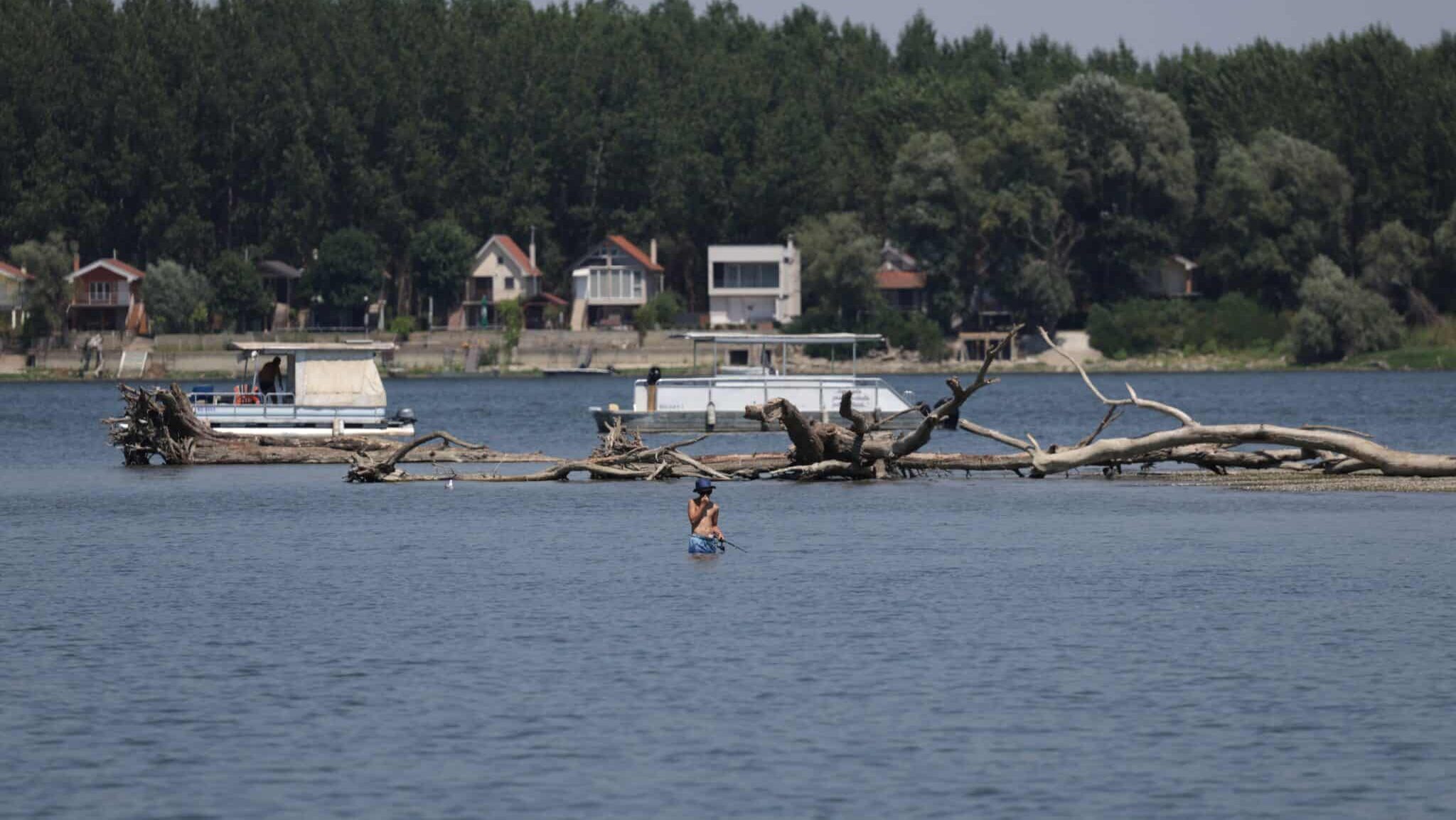
Photo credits: BETAPHOTO/SASA DJORDJEVIC
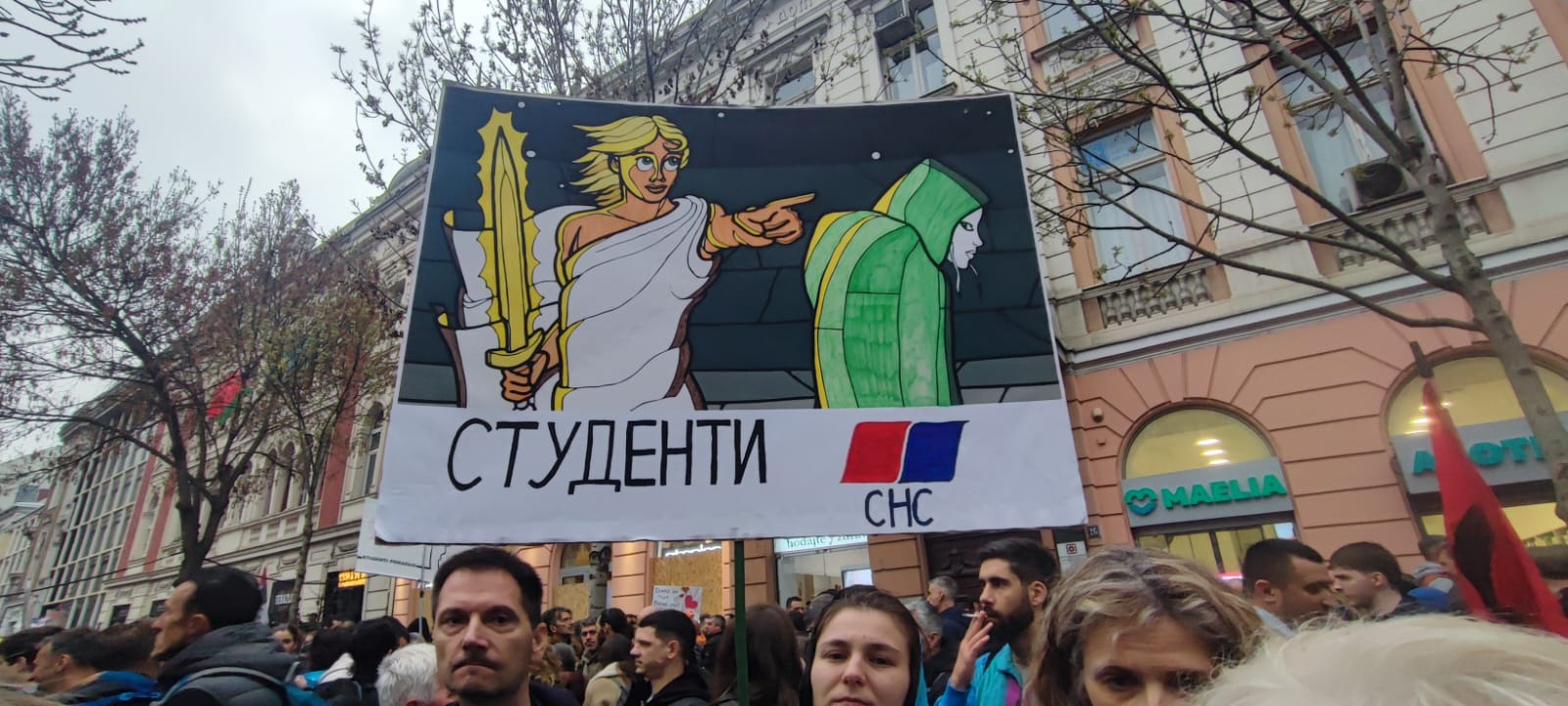
A section of the public, spearheaded by an army of online witnesses, stubbornly attempts to turn students into a protected species. They keep an entire arsenal of guided missiles loaded with emotional shrapnel on standby. The tactic never changes: eliminate the embedded dissenter and brand them an assassin of student vigour and a destroyer of popular energy.
The leadership of the student movement (whatever that term might mean today) may not have actually intended to erect an impenetrable wall of their own ego around themselves. Still, it is hard not to notice that they do not seem to mind at all that their most loyal internet followers add to that wall daily. On duty at the front line of defence, they greet every “but” with keyboards drawn.
When the collective student mind – hovering high above the lecture halls – makes a decision that strikes even its unreserved supporters as unexpected and problematic, common sense does not object. On the contrary! It willingly lays itself down as a voluntary sacrifice on the altar of choral euphoria.
In this region, collective enthusiasm rarely stops at a mere feeling. Sooner or later, it turns into a choir performance. In that massive choir, whether you have an ear for music or a decent voice is beside the point – what matters is that you stick to the prescribed tune. It is enough that everyone sings the same song.
And then, when the score draws to an end, instead of looking back to finally dissect the off-key notes we sang, we follow our fine old tradition: we tear up the old sheet music, disband the old choir, and set up a new one. Wiped slates, an empty music stand, and the illusion that the music of the past never even existed…
To the new choir, that “clean slate” feels thrilling and thoroughly logical. The fact that every previous premiere turned out to be a rehashed old composition bothers no one. Never mind – we will just set up the choir again and again.
After all, our political reality almost never aligns with what we expect and long for from that music. Perhaps we have an unusual phenomenon to thank for that, one that routinely pops up just as the new voices are tuning up, whilst the audience waits impatiently in the dark auditorium for the curtain to rise.
Zoologists have never discovered this fauna, nor shown any particular interest in it, but a tale circulates among the people that this strange, giant bird is merely biding its time. It usually happens when enough disgruntled people gather in one place, ready to sing in a new choir. Then, out of nowhere, it swoops down among them, violently beats its large wings, and begins throwing dust into everyone’s eyes. Soon, the dust becomes part of the choreography, stinging the eyes of both those on stage and everyone else in attendance.
It matters little that it can obscure the conductor’s view as well. If he can no longer see clearly where he is taking the piece, it is comforting that the choir cannot see much better either.
The fear of “rocking the boat” here often works on the same principle: someone else will take care of everything, so why stand out unnecessarily and spoil the mood?
Perhaps that is precisely why Asch’s conformity experiment lost its meaning here long ago. The majority no longer needs to misjudge the length of a drawn line. It is enough for an authority figure to claim it is straight. After a while, you no longer correct the line, but your own perception of it.
Where doubt becomes unwelcome, even the fear that past mistakes might return is treated as an impermissible solo performance. Such consensus, demanding blind and unquestioning acceptance of every decision, is almost always a byproduct of choral euphoria – which is not merely an expression of support, but often a refuge for conformism. Questions become redundant, dilemmas a sign of disloyalty, and more often than not, instead of resolving a problem, we sweep it under the carpet.
It is human nature to fiercely defend an illusion into which one has invested their last grain of hope. When that illusion collides with reality, what psychologists call cognitive dissonance occurs – an uncomfortable state where facts no longer fit our beliefs. Yet instead of altering our beliefs, we far more frequently try to alter the facts.
We fell in love with students, whom we affectionately call “our children”, for good reason. In them, many recognised what we lost long ago: courage that has not yet learned to calculate the cost, idealism that has not yet entered the market, and dignity that has not been mortgaged. That is no small thing. Quite the opposite!
Yet politics is not a family album. In it, every unasked question eventually comes due. And with interest.
The greatest injustice we can do to young people is not to criticise them. The greatest injustice is to declare them infallible. Because when you deny someone the right to make mistakes, it may feel flattering at that moment, but life is more than just that single moment.
If we have declared students to be the carriers of change, have we simultaneously absolved them of all accountability? It is therefore no great surprise that, despite the undeniable energy, courage, and perseverance of the student movement, increasingly vocal warnings have been heard in recent weeks. Their weight comes not from the fact that they exist, but from who is voicing them – people who can hardly be accused of malice or hidden political motives.
Professor Filipović takes it a step further. His criticism is aimed not at the students, but at their loudest patrons – those who cut short every dilemma with the familiar refrain: “Let them make mistakes!”
Filipović warns that a comfortable stance lies behind this seemingly well-meaning attitude. Those who encourage students in this manner simultaneously leave themselves room to shift the blame onto those very students if some of those decisions prove wrong.
“Then they will dump it onto the shoulders of specific students, someone’s children,” Filipović warns.
And that is precisely where the circle closes. In our political choir, the loudest and most frequent voices often come from those taking the least risk. They are not overly concerned with whether they are right. It is enough that, if it turns out they are not, someone else foots the bill.
In an effort to make the choir as large as possible, its leadership decides to broaden the audition. It no longer matters which sheet music someone carries or which music school they attended. All that matters is that the voice carries as far as possible and that there are as many singers as possible.
At first glance, such an idea seems appealing. A larger choir makes a stronger impression. But a choir is not just a sum of voices. It takes only a few of the loudest singers shifting key for the entire piece to start sounding like a completely different song.
That is how it works in the music world, whereas in politics, sheer numbers are often viewed as proof of strength.
In an effort to secure enough votes to form a government independently, the leadership of the student movement has evidently calculated that it can hardly achieve this goal without compromising with a section of the right wing. Thus, space is opened for Eurosceptic and nationalist figures, on the assumption that a shared opponent can temporarily override deep ideological differences.
Such calculations are not unfamiliar. Coalitions of diverse actors often form out of the need to achieve a common goal. The problem arises when this temporary alliance begins to present itself as something more – as proof that differences have disappeared or no longer matter.
Yet politics is not merely arithmetic. Votes can be tallied, but values cannot always be added together using the same formula.
Some differences are not technical; they are fundamental.
It is no coincidence, then, that terms reminding many of past eras are returning to the political rhetoric accompanying the student protests: svesabornost (sovereign unity), the Kosovo memorandum, reciprocity, Serbian integralism… With them return emotions and mindsets that were believed to have been left in the past. At the same time, the narrative contrasting European integration and democratic standards with national interests is gaining traction once more, as if we have forgotten how heavily such a division has already cost our society.
The problem is not that people with varying political convictions can be found within a broad civic movement. That is practically inevitable. No serious social movement is formed in laboratory-clean conditions.
The problem arises when compromises begin to be made on the very issues that define the movement’s political identity.
The Serbian right wing differs from civic, pro-European politics not just in its degree of supposed patriotism. The differences touch upon the very understanding of the state, society, and the future of Serbia: attitudes towards the European Union, regional policy, confronting the legacy of war, civil rights, and the nature of state institutions.
These are not minor differences within the same political family; they are diametrically opposed ideologies and political agendas.
For this reason, collaboration can be tactical and short-term, directed towards a single goal. But trying to forge a unified programme out of distinct political traditions almost invariably ends with one side having to abandon a portion of its own principles.
The experience of our political life shows something else as well: in such compromises, it is rarely the more moderate part of the coalition that wins, but rather the louder, more extreme one.
The choir may then be larger, but it is no longer the same choir. The melody that made people trust it in the first place slowly fades, leaving only a shared rhythm against someone. That may be enough for a protest. It is usually not enough for serious politics.
One rarely emerges from such internal conflict without scars. It is hard to admit that things did not turn out as imagined in the end. It is even harder to accept that, in defending a particular idea or the people representing it, we were sometimes defending our own expectations more than reality itself.
In theory, history should be a teacher. In practice, we persistently return to her for remedial lessons. How many times have we believed that democratic change in itself guarantees democracy? How many times have we thought that changing the people in charge would automatically alter the political culture?
We have already paid dearly for that mistake.
Following the high expectations of the early 2000s, we believed that a change of government would, on its own, bring about a different political reality. Instead, behind grand speeches on reform and European values, old patterns resurfaced all too often: the party-controlled state, concentration of power, privileged individuals, and networks of interest that managed to survive political transitions.
It was not just the people in office who changed. Flags, slogans, and party emblems changed too, whilst the logic of political power frequently remained surprisingly identical.
That is precisely why we owe today’s generations neither blind trust nor a pre-determined verdict. We owe them what must belong to every democratic transition – the right to support, but also the right to question and criticise.
Because if we erred once by believing that the people we supported were beyond questioning, there is little reason to repeat the same mistake simply because the actors have changed, even if we perceive them as “our children”. When we shield someone from every question and criticism, we are not necessarily protecting them from mistakes, nor are we doing them a favour.
Democracy does not begin the moment new faces appear for us to trust unreservedly. It begins when we realise that even the best intentions are no substitute for accountability, and even the greatest trust is no reason to silence a critical voice.
The dust raised by that giant bird still hovers over our political landscape. The conductor feels it. The choir members feel it too. Everyone who wants change feels it. Nobody is saying it will be easy. But perhaps, before we sing a new song, it might be worth making sure we can finally see the sheet music clearly.
(Danas, 03.08.2026)
https://www.danas.rs/dijalog/licni-stavovi/ne-treba-od-studenata-praviti-zasticenu-vrstu/